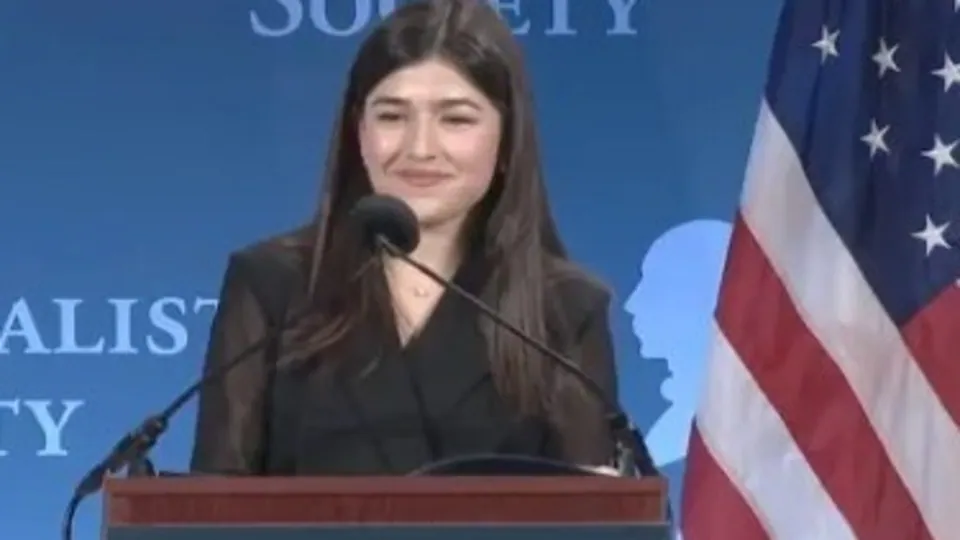
US Secretary of State Marco Rubio had a personal reason to smile before delivering a major address in Washington on Friday. His daughter, Daniella Rubio, took the stage to introduce him at the Federalist Society’s National Lawyers Convention, earning an affectionate and amused reaction from her father.
Daniella, a third-year law student at the University of Virginia School of Law, introduced Rubio as the 72nd Secretary of State of the United States and described the values he had passed on to her. Her confident delivery prompted an immediate response from the secretary of state, who turned to the audience and asked, “Was that cool or what?”
Daniella highlights her father’s values and legacy
Daniella’s introduction went beyond a formal presentation of her father’s political position. She spoke about his personal journey, his family background and the principles that shaped his public life.
She described Rubio as the son of Cuban immigrants who came to the United States in pursuit of the American dream. She also referred to the influence of faith, family, community and hard work on his life, connecting those values to his approach to public service.
In one of the most personal parts of her introduction, Daniella said his greatest legacy would always be the values he had instilled in her, particularly the importance of putting the Lord first. She also praised his love for the United States and his commitment to defending basic rights.
She ended by telling the audience that she was proud, grateful and fortunate to call him her father before formally welcoming him to the stage.
Rubio appeared visibly pleased by the introduction. His immediate question, “Was that cool or what?”, drew laughter from the audience and briefly shifted attention away from the political themes of the event.
Rubio admits his daughter is more comfortable with public speaking
After taking the stage, Rubio joked that the family tradition had changed. He said he used to bring his children on stage and show them off, but they were now the ones introducing him.
He admitted that Daniella’s confidence was something he could not explain. Pointing to her lack of stage fright, he said she was not afraid to speak in front of an audience, unlike him.
“I don’t really like public speaking that much,” Rubio told the gathering, before praising his daughter’s performance as fantastic.
He also mentioned that Daniella was a third-year student at the University of Virginia School of Law, adding a light-hearted comment about the expense of attending law school. The exchange offered a glimpse of the secretary of state’s family life during an otherwise politically focused appearance.
Daniella’s introduction was also a reminder of the personal role that family and faith play in Rubio’s public identity. Her remarks connected his professional achievements with the values he has spoken about throughout his political career.
‘My home was not a democracy’: Rubio jokes about family rules
The family moment continued during the question-and-answer session, when a law student asked Rubio how parents could pass on a love of freedom and American values to younger generations.
The questioner pointed to Rubio’s relationship with Daniella as an example of how those principles could be passed from one generation to another. Rubio initially responded with a joke about the rules in his household.
“Well, my home was not a democracy,” he said, prompting laughter. He quickly added that he was not the dictator either, describing his family role as “the minister of defense”.
Behind the humour, Rubio offered a more serious explanation of how he believes young Americans should understand their country and its history.
He said he had no problem with young people exploring different ideas as they grew older. However, he argued that an understanding of America’s history and founding principles should remain central to how the next generation views the country.
Rubio described the American story as exceptional, while acknowledging that the country’s history was not perfect. He argued that major movements for justice, including the abolition of slavery, the end of segregation and women’s right to vote, should be understood as efforts to fulfil the principles expressed in the country’s founding documents.
His response linked the personal question about parenting to a wider discussion about education, national identity and the values that shape public life.
Rubio urges Republicans not to be discouraged by midterm losses
After the lighter exchange, Rubio turned to the political challenges facing Republicans following the Democrats’ strong performance in the 2026 midterm elections.
The address marked one of his first major public appearances after the Republican setbacks. Rather than treating the results as the final word on the conservative movement’s future, he urged supporters to take a longer view of political change.
To make his argument, Rubio looked back at the early years of former President Ronald Reagan’s administration. He recalled that Reagan had entered office after a major electoral victory and promised a sweeping conservative transformation, but faced serious difficulties less than two years into his presidency.
Rubio described how the political atmosphere had changed by 1982. Reagan’s approval ratings had fallen sharply, the United States was experiencing a severe recession, unemployment was approaching double digits and the administration was facing growing criticism over its domestic and foreign policies.
The Republican Party also suffered significant losses in the 1982 midterm elections, leaving the conservative movement on the defensive.
Rubio used the comparison to argue that a difficult election does not necessarily determine the long-term direction of a political movement. He suggested that conservatives should look at how institutions and ideas can continue to develop even when their preferred candidates lose elections.
Why Rubio pointed to the Federalist Society’s history
A central part of Rubio’s argument was that political influence cannot be measured only by control of the White House, Congress or the courts.
He pointed to the history of the Federalist Society, which began with a small gathering of law students in 1982. According to Rubio, four law students organised a symposium on federalism in New Haven, Connecticut, attracting around 200 participants. Among those who attended was legal scholar Antonin Scalia, who later became a Supreme Court justice.
Rubio argued that the organisation’s growth demonstrated how a movement could build influence over several decades by developing ideas, recruiting supporters and establishing connections across important institutions.
He said political power also existed in universities, the media, nonprofit organisations, think tanks, businesses and other parts of civil society. Winning an election could determine who held public office for a limited period, he argued, but it could not automatically change the beliefs and institutions that shape a country’s direction.
In his view, lasting political influence required more than winning campaigns. It depended on developing networks, promoting ideas and preparing people to take influential positions over time.
His message was particularly relevant to the conservative audience following the Republican midterm setbacks. Rather than focusing exclusively on the immediate electoral consequences, Rubio encouraged supporters to study how the Federalist Society had built influence through sustained institutional work.
‘Great things that last are built in decades, not election cycles’
Rubio’s broader message was that political movements should not allow individual election results to define their ambitions. He argued that significant changes in society and institutions require patience, organisation and commitment over generations.
“We have much more to do over the next two, the next six, the next 20 years,” he told the audience. “Great things that last are built in decades, not election cycles.”
He acknowledged that political movements would experience both victories and defeats. Setbacks, he suggested, were an unavoidable part of pursuing goals that extend beyond a single election or administration.
“There will be more victories, and there will be more defeats. There will be more triumphs, and there will be more disappointments,” Rubio said, describing these ups and downs as part of undertakings of such scale and importance.
He reinforced the point by drawing another comparison with American history, this time referring to the Revolutionary War. Rubio recalled that the struggle for independence was far from a guaranteed victory in its early stages.
He described the difficult position of George Washington’s army in December 1776, when fewer than 3,000 men were fit for duty and the revolutionary cause appeared close to collapse. Some supporters had accepted British pardons and returned their allegiance to the Crown.
Rubio recalled Washington’s doubts during that period but also highlighted his belief that the situation could eventually improve. The eventual American victory, achieved with French support, became an example in Rubio’s argument that major historical achievements can emerge from periods of uncertainty and defeat.
Rubio ends with a message of confidence in the conservative cause
Rubio concluded his address by expressing confidence that the conservative movement could overcome its current difficulties. He argued that historical leaders and important causes had faced serious setbacks before achieving their objectives.
“There are no great men or great causes in the pages of history that did not suffer the same,” he said.
He added that Republicans remained convinced of the justice of their cause and would ultimately triumph. His closing remarks focused on the responsibility of the current generation to leave a strong country for their children and grandchildren.
The speech therefore combined a defence of long-term conservative institution-building with an appeal for patience after the midterm results. Rubio did not present the election setbacks as insignificant, but argued that they should be viewed within a much longer political and historical timeline.
For the audience, the address offered both a reflection on the conservative movement’s past and an argument for how it should approach the years ahead. The message also gave the speech a personal dimension: Rubio’s remarks about passing values to the next generation echoed the introduction delivered by Daniella shortly before he began speaking.
While the political themes dominated the address, it was the brief exchange between father and daughter that provided one of its most memorable moments. Daniella’s confident introduction, followed by Rubio’s delighted reaction, gave the Washington event a family moment that stood apart from the wider debate over the Republican Party’s future.
For breaking news and live news updates, like us on Facebook or follow us on Twitter and Instagram. Read more on Latest World on thefoxdaily.com.






COMMENTS 0