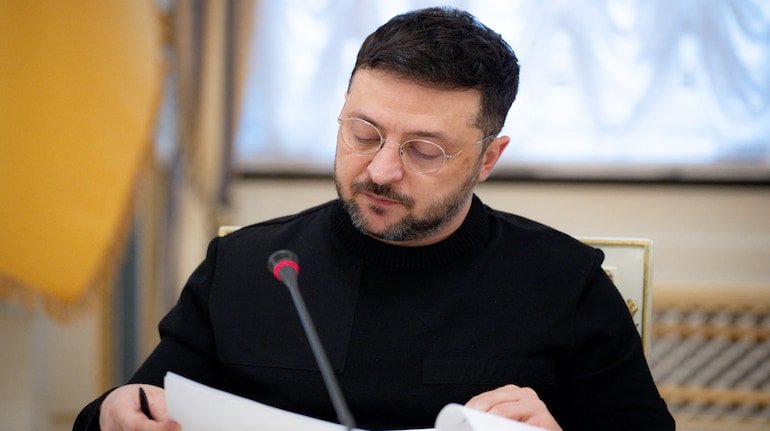
Ukrainian President Volodymyr Zelenskyy has said US negotiators asked whether Ukraine would withdraw from the eastern Donbas region in exchange for membership in NATO. He described the question as the first time Washington had raised that possibility during discussions about ending Russia’s war against Ukraine.
Zelenskyy reiterated that Ukraine would not voluntarily surrender its territory or recognise Russian claims over occupied areas. However, he indicated that he could put such a proposal before the Ukrainian public if the United States and other NATO partners first offered a comprehensive package of security guarantees.
The remarks were made during a conversation with reporters on Friday and released by Zelenskyy’s office on Saturday. They came amid renewed diplomatic efforts led by Washington to narrow differences between Moscow and Kyiv over territory, security arrangements and Ukraine’s future relationship with NATO.
Zelenskyy says any proposal must include concrete security guarantees
Zelenskyy said Ukraine was already discussing detailed security arrangements with Western partners, including NATO members and the European Union. He stressed that a territorial compromise could not be considered separately from the guarantees needed to protect the country against another Russian attack.
He outlined several conditions that would have to be addressed before he could present any proposal to Ukrainian citizens:
- Reliable security guarantees: Western partners would need to provide credible commitments to protect Ukraine against future aggression.
- A strong Ukrainian military: Ukraine must retain sufficient troops, weapons and defence capabilities to protect its territory.
- Long-term financial support: The country would need funding to maintain and equip its armed forces over an agreed period.
- A reconstruction programme: Any settlement would need a clearly funded plan to rebuild areas damaged by the war.
Zelenskyy said that if Washington confirmed these arrangements alongside other NATO partners, he would ask Ukrainian society whether it accepted the proposal.
“I have no right to make that decision on my own,” he said, emphasising that a decision involving the country’s territory and future security could not be taken solely by the president.
He also made an important distinction between withdrawing troops from territory and legally recognising that territory as Russian. Zelenskyy said any arrangement would not mean Ukraine formally accepting Russian sovereignty over the occupied areas.
Why Donbas is central to the negotiations
The Donbas is an industrial and strategically important region in eastern Ukraine, comprising the Donetsk and Luhansk regions. It has been at the centre of the conflict between Russia and Ukraine since 2014, when Moscow-backed separatists took control of parts of the territory.
Russia expanded the war with its full-scale invasion in February 2022. Moscow subsequently declared Donetsk and Luhansk, along with Kherson and Zaporizhzhia, part of Russia following annexation claims that Ukraine and most of the international community do not recognise.
Russia currently controls roughly one-fifth of Ukraine’s internationally recognised territory, including most of the Donbas. However, Ukrainian forces continue to hold areas in Donetsk that Moscow wants Kyiv to surrender as part of a peace settlement.
For Ukraine, withdrawing from the remaining areas under its control would carry significant military, political and symbolic consequences. It would mean abandoning territory that Kyiv continues to regard as sovereign Ukrainian land, while potentially giving Russian forces a stronger position in the region.
The issue is also connected to the security of other Ukrainian cities and regions. Kyiv has argued that surrendering territory without enforceable guarantees could leave the country exposed to renewed Russian military pressure in the future.
Russia continues to oppose Ukraine’s NATO ambitions
Ukraine has pursued NATO membership as a long-term security objective, arguing that joining the alliance would provide protection against another Russian invasion. Moscow, however, has consistently opposed Ukraine’s membership and has demanded that Kyiv abandon its ambitions to join the military bloc.
Russia’s broader demands have included Ukrainian neutrality, restrictions on the size and capabilities of its armed forces, and the surrender of territory in the east. Kyiv has rejected these conditions, arguing that limits on its military would undermine its ability to defend itself.
The latest question reported by Zelenskyy introduces a possible link between two issues that have remained difficult to reconcile: Ukraine’s demand for a dependable security framework and Russia’s insistence that Kyiv should not become part of NATO.
For Zelenskyy, NATO membership would represent one possible security arrangement. But he acknowledged that reaching an agreement would be difficult because of Putin’s continued opposition.
“That is why I believe NATO is back on the agenda,” he said, while describing the discussion as extremely difficult.
The remarks do not establish that Washington has formally offered Ukraine NATO membership in exchange for a withdrawal from Donbas. They reflect Zelenskyy’s account of a question raised by US negotiators during the diplomatic discussions.
Zelenskyy says EU and NATO are essential to Europe’s security
In separate remarks, Zelenskyy argued that the European Union and NATO were central to Europe’s security architecture. He warned that attempts to reshape the continent’s security arrangements without addressing the concerns of countries directly affected could create conditions for further confrontation.
“Real security in Europe means the EU and NATO. That’s it. There is no other security in Europe,” he said.
His comments reflected Kyiv’s concern that negotiations between Washington and Moscow could produce a wider European security arrangement without adequately protecting Ukraine’s interests.
Ukraine has repeatedly called for European countries to participate directly in discussions about the continent’s future. Zelenskyy has argued that European governments should have a meaningful role because the consequences of any agreement would extend beyond the battlefield in Ukraine.
That issue also featured in the latest diplomatic meetings. Following discussions in Moscow and Dublin, US envoy Jared Kushner said future negotiations would be expanded to include European partners. Zelenskyy welcomed the prospect of Europe having a place at the negotiating table.
US-led peace negotiations continue after Moscow and Dublin meetings
The latest comments came during an intensive round of diplomatic activity involving the United States, Russia and Ukraine.
US envoys Steve Witkoff and Jared Kushner travelled to Moscow for talks with Russian President Vladimir Putin before meeting Zelenskyy in Dublin. The meetings were part of Washington’s effort to narrow the differences between the two sides and explore possible terms for ending the war.
Earlier in November, Russian, Ukrainian and US representatives also held US-mediated discussions in Abu Dhabi. The talks focused on territorial questions, security arrangements and other issues that would need to be resolved before a comprehensive peace agreement could be reached.
US Secretary of State Marco Rubio described the Abu Dhabi discussions as very productive, while Zelenskyy called them constructive and substantive. However, the positive descriptions did not indicate that the central disagreements had been resolved.
One area of progress involved preparations for further prisoner exchanges. Zelenskyy also said that European representatives should be more actively involved in the diplomatic process, rather than being left outside discussions that could determine the continent’s security arrangements.
Despite the renewed negotiations, the positions of Moscow and Kyiv remain far apart. Russia continues to demand territorial concessions and restrictions on Ukraine’s future military alignment. Ukraine insists that any agreement must preserve its sovereignty and provide guarantees strong enough to prevent another invasion.
What the Donbas proposal could mean for a possible peace deal
Linking a Ukrainian withdrawal from Donbas to NATO membership would raise difficult questions about how such an arrangement could be implemented and guaranteed.
First, NATO membership is not a decision that the United States can grant to Ukraine on its own. Admission requires agreement among existing alliance members. Any proposal would therefore depend on whether NATO countries were prepared to support Ukraine’s membership under the conditions being discussed.
Second, the security guarantees would need to be specific and credible. Kyiv would want clarity on what its partners would do if Russia launched another attack, how quickly military assistance would be provided and whether financial support would continue over the long term.
Third, the territorial question would remain politically sensitive inside Ukraine. Even if a withdrawal were considered as part of a broader security arrangement, the distinction between leaving an area under a ceasefire agreement and recognising Russian sovereignty over it would be fundamental.
There would also be questions about enforcement, the position of civilians living in the affected areas and the future status of territory currently controlled by Ukrainian forces.
For Washington, the challenge is to find terms that could bring the fighting to an end while addressing the security concerns of both sides. For Kyiv, the central test is whether any proposed settlement would prevent Russia from using a pause in fighting to prepare for another offensive.
Ukraine maintains that territorial concessions cannot be imposed
Zelenskyy has repeatedly rejected the idea that Ukraine should simply abandon its internationally recognised territory to secure an end to the war. His latest comments maintained that position while leaving open the possibility of presenting a specific proposal to the public if it came with substantial security commitments.
“I have said repeatedly: Ukraine is not retreating and is not giving up its land to terrorists,” he said.
The statement underlined the gap between the conditions Kyiv says it needs and the territorial demands Moscow continues to make. It also showed why the reported US question has become significant: it places Ukraine’s NATO ambitions and control over Donbas within the same diplomatic discussion.
For now, Zelenskyy has not announced acceptance of any territorial withdrawal proposal. He has instead made clear that the United States and other Western partners would first need to put concrete guarantees on the table, after which Ukrainians would have a say in whether such an arrangement was acceptable.
With further negotiations expected to involve European partners, the future of Donbas, Ukraine’s military strength and the form of any security guarantees are likely to remain central issues. Whether the latest diplomatic efforts can bridge those differences remains uncertain.
For breaking news and live news updates, like us on Facebook or follow us on Twitter and Instagram. Read more on Latest World on thefoxdaily.com.






COMMENTS 0