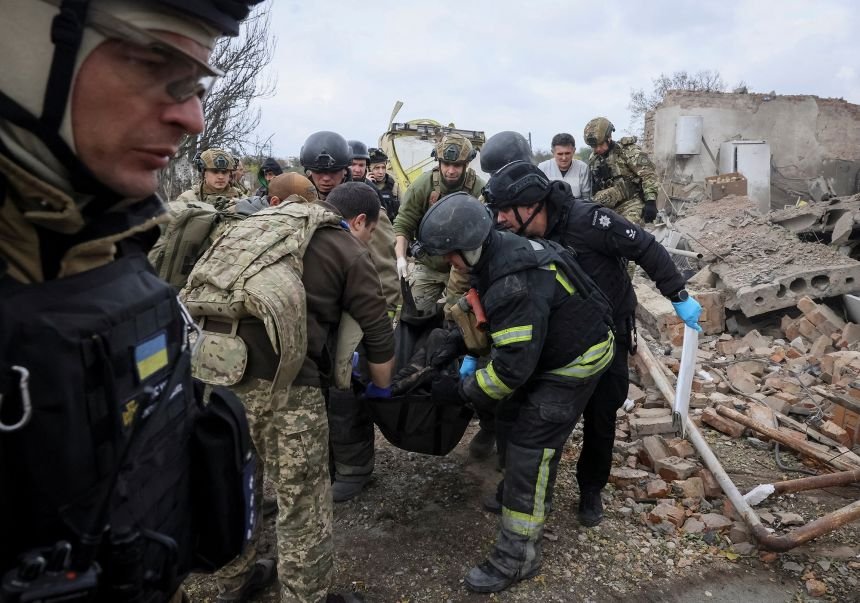
At least 33 people have been killed after Russia dropped nine bombs on a school building in southeastern Ukraine where civilians had gathered for shelter and humanitarian assistance. Ukrainian President Volodymyr Zelensky described the attack as one of the deadliest strikes of the war, as rescue efforts continued amid reports that dozens of people remained unaccounted for.
The attack took place on Monday in Komyshuvakha, a village in the Zaporizhzhia region. Local governor Mykhailo Semikin said the building was being used as a shelter and a centre for distributing humanitarian aid. At least 33 deaths had been confirmed by Tuesday, while another 50 people were still unaccounted for.
The building had a reinforced basement designed to protect people from attacks. However, the force of the bombs caused the concrete structure to collapse, triggering a fire and trapping people inside.
The United Nations Human Rights Monitoring Mission in Ukraine expressed concern over the strike, noting that civilians had gathered at the location to receive humanitarian assistance. Its head, Danielle Bell, said the timing and location of the distribution had been widely publicised and questioned whether Russian forces had taken adequate steps to establish what was happening in the village before attacking it.
The strike has intensified concerns about the safety of civilians and emergency responders in areas affected by the war. It also came amid another large Russian aerial assault targeting Ukraine’s energy infrastructure, despite repeated calls from US President Donald Trump for an energy ceasefire.
What Happened in the Russian Attack on Komyshuvakha?
Russian forces struck a building in Komyshuvakha, in Ukraine’s southeastern Zaporizhzhia region, on Monday. According to Ukrainian officials, the building was being used as a civilian shelter and humanitarian aid distribution centre rather than as an operational school.
Local governor Mykhailo Semikin said at least nine bombs were dropped on the building. The attack caused extensive structural damage, with the reinforced basement collapsing under the force of the explosions. A fire also broke out, further complicating the situation for people trapped inside.
The shelter had been constructed last year as part of an effort to allow educational activities to continue during wartime. It included a newly built, reinforced basement funded by the European Union and designed to withstand most strikes.
However, as fighting moved closer to the village, many civilians left the area. The building was no longer being used as a school. Local authorities had instead turned it into an administrative centre and humanitarian hub, providing a location where residents could seek assistance and receive essential supplies.
The presence of a reinforced basement was intended to offer protection against attacks. But the scale of the bombardment overwhelmed the structure, causing the concrete shelter to collapse.
At least 33 people had been confirmed dead by Tuesday, while another 50 remained unaccounted for. The reported number of missing people underlined the scale of the disaster and the uncertainty surrounding the fate of those who had been inside the building.
The attack also raised questions about the safety of humanitarian distribution points in areas close to active fighting. Civilians had gathered at the location to receive aid, making the building an important point of assistance for the local community.
UN Raises Concerns Over Attack on Humanitarian Aid Centre
The United Nations Human Rights Monitoring Mission in Ukraine highlighted the timing of the attack, saying it took place as civilians from the surrounding area had gathered to receive humanitarian assistance.
Danielle Bell, head of the mission, said the timing and location of the humanitarian distribution had been well publicised. She questioned whether Russian forces knew about the gathering or had failed to take basic steps to determine what was happening in the village before launching the attack.
“Either the Russian armed forces knew that there was a humanitarian distribution taking place, or they failed to take the most basic steps to find out what was happening in this village they were planning to attack. In either case, this attack seems to have violated the most fundamental principles of international humanitarian law.”
Bell’s statement focused on the presence of civilians at a location being used for humanitarian assistance. The fact that residents had gathered to collect aid made the circumstances of the strike particularly concerning for the UN monitoring mission.
International humanitarian law establishes protections for civilians during armed conflicts. Parties to a conflict are required to distinguish between civilians and military targets and take precautions to reduce the risk of civilian harm.
The concerns raised by the UN mission centre on whether those obligations were respected in Komyshuvakha. Bell’s remarks highlighted two possibilities: Russian forces may have known that humanitarian assistance was being distributed at the building, or they may not have taken sufficient steps to establish the circumstances before carrying out the attack.
Her statement described the attack as appearing to violate fundamental principles of international humanitarian law. However, the legal responsibility for the strike would depend on the relevant evidence and any subsequent investigation.
The incident has renewed attention on the vulnerability of humanitarian centres in communities located near active conflict zones. Such locations are often used by civilians who need food, essential supplies and protection, making their security especially important during military operations.
Emergency Responders and Police Officers Among Those Killed
The casualties in Komyshuvakha included emergency responders who rushed to the scene after the initial strike. At least two first responders, identified locally as Denys Konovalenko and Oleksiy Sushchevsky, both aged 44, were killed while responding to the attack.
Their deaths were reported after they arrived to assist people affected by the first wave of bombing. The incident has drawn attention to the dangers faced by emergency personnel who enter damaged buildings and affected areas to rescue survivors.
At least four Ukrainian police officers were also killed, according to the Ukrainian Police. They were identified as Mykhailo Buzhenko, Mykola Balanda, Mykhailo Romanov and Dmytro Besedin.
Buzhenko and Balanda had each served in the police for more than two decades. Romanov and Besedin had worked as community police officers for more than a decade.
The police said the officers had been helping local residents take shelter in an underground school when the follow-up strike occurred.
“(They) were helping local residents take shelter in an underground school. A treacherous follow-up strike trapped everyone who was trying to escape,” the police said in a statement.
The deaths of emergency responders and police officers highlight the risks faced by those attempting to protect civilians during attacks. Rescue personnel often have to enter damaged structures while fires, debris and the possibility of further strikes create dangerous conditions.
The reported follow-up attack also raises concerns about the safety of people responding to the initial bombing. When emergency workers arrive at a strike location, they may face additional danger if another attack takes place while rescue operations are underway.
What Weapons Did Russia Use in the Attack?
Local governor Mykhailo Semikin said Russia used KAB-500 and FAB-3000 bombs in the attack on Komyshuvakha.
He specifically highlighted the destructive power of the FAB-3000, describing it as a three-ton aerial bomb containing nearly 1.5 tons of explosive material. According to Semikin, weapons of this type are primarily designed to destroy heavy concrete fortifications and bunkers.
“To put this into perspective, this is a three-ton aerial bomb containing nearly 1.5 tons of explosive material; such weapons are primarily designed to destroy heavy concrete fortifications and bunkers,” he said.
The reported use of these weapons helps explain the scale of the structural damage described by local authorities. The building had a reinforced basement designed to provide protection during wartime, but the force of the bombs caused the concrete structure to collapse.
The incident also demonstrates the limitations of civilian shelters when exposed to powerful aerial weapons. Reinforced underground spaces can offer protection against many threats, but they cannot guarantee survival in every type of attack.
For residents in communities close to the fighting, the destruction of a shelter can remove one of the few available places of protection. The collapse in Komyshuvakha left people trapped and complicated efforts to reach those inside.
Russia Launches Another Major Attack on Ukraine’s Energy Infrastructure
The bombing of Komyshuvakha came shortly before Russia launched another large-scale aerial assault against Ukraine. Zelensky said Russian forces carried out a barrage involving hundreds of drones and dozens of powerful cruise and ballistic missiles targeting the country’s energy infrastructure.
The latest strikes came despite repeated calls from US President Donald Trump for an energy ceasefire. Attacks on energy infrastructure can place additional pressure on civilian communities by threatening the facilities and systems needed to maintain essential services.
Zelensky linked the attacks to Russia’s broader military strategy and called for greater support to strengthen Ukraine’s air defences. He argued that protecting the country’s skies was essential to preventing further missile strikes.
He also pointed to the timing of the attacks, saying they had taken place on the day of the US congressional elections. In his remarks on Tuesday morning, the Ukrainian president said Russia appeared to believe that the United States would not pay attention to the signal being sent through the attacks.
“It is very telling that all of this is happening on the day of the US congressional elections. The Russians believe that America will not notice this signal from them. But such terror must be noticed and stopped,” Zelensky said.
He further urged international partners, particularly the United States, to help Ukraine defend its airspace and support efforts to establish a lasting peace.
“Ukraine must be helped to defend its skies, otherwise Russia will never stop its missile strikes. It is essential to help build peace honestly and reliably, and America can do that,” Zelensky added.
The comments reflect Kyiv’s continued appeal for military assistance and diplomatic pressure as Russian attacks continue. Ukraine has repeatedly stressed the importance of strengthening its air-defence capabilities to protect cities, infrastructure and civilian populations.
US Push for Negotiations Continues Amid Intensifying Attacks
The latest Russian strikes have taken place as the Trump administration pursues renewed diplomatic efforts to bring the war towards negotiations.
US envoy Steve Witkoff recently met Zelensky in Norway before travelling to St. Petersburg for a meeting with Russian President Vladimir Putin. The diplomatic engagements form part of Washington’s efforts to maintain communication with both sides and explore possibilities for negotiations.
However, the continued attacks have highlighted the difficulties facing diplomatic efforts. While discussions are taking place, Ukrainian communities remain exposed to aerial bombardments and strikes against civilian and critical infrastructure.
The gap between diplomatic engagement and developments on the battlefield remains a major challenge for efforts to reduce the violence. Calls for a ceasefire have not prevented the latest attacks described by Ukrainian officials.
The United States has also been involved in separate humanitarian developments concerning occupied Ukrainian territory. First lady Melania Trump helped secure a ceasefire in the occupied city of Oleshky, enabling the evacuation of hundreds of civilians over the weekend.
Trump’s office announced on Tuesday that the first lady would bring together representatives from Russia and Ukraine at the White House on Thursday. The announcement described the planned meeting as an extraordinary moment in American history.
The planned gathering comes against the backdrop of continuing military operations and diplomatic contacts. While the evacuation in Oleshky represented a humanitarian development, the bombing of Komyshuvakha demonstrated the continuing dangers faced by civilians in other parts of Ukraine.
Why the Komyshuvakha Strike Is Among the Deadliest Recent Attacks
The attack on Komyshuvakha is among the deadliest strikes reported since Russia launched its full-scale war against Ukraine. The scale of the casualties, the destruction of a civilian shelter and the deaths of emergency personnel have made the incident particularly significant.
Ukrainian civilians have faced increasingly intense aerial attacks in recent months. Russian forces expanded their strikes on towns and cities across the country over the summer, targeting locations at different times of the day.
Several previous attacks have also resulted in significant Civilian Casualties.
- Kramatorsk: At least 33 people were killed last month when Russia struck two civilian buses in the Donetsk region.
- Near Kyiv: In August, 38 people were killed after a Russian drone strike on an ammunition depot triggered a large fire and multiple explosions that continued for hours in a residential area.
- Kyiv: A mass Russian missile attack in July killed 33 people across the capital during a coordinated barrage.
- Komyshuvakha: At least 33 people were confirmed dead after the Monday attack, while another 50 remained unaccounted for as of Tuesday.
These incidents illustrate the continuing risks faced by civilians across Ukraine. Attacks involving drones, missiles and aerial bombs have affected urban areas, transport facilities and locations where people gather for shelter or assistance.
The Komyshuvakha attack is particularly concerning because the building was being used as a humanitarian centre at the time. Residents had gathered there to receive aid, and the reinforced basement was intended to provide protection from military strikes.
What Is a Double-Tap Strike?
The attack on Komyshuvakha followed a pattern described as a double-tap strike. This refers to a situation in which an initial attack is followed by another strike after emergency services and rescue personnel have arrived at the scene.
According to the account provided by Ukrainian authorities, the first wave of strikes hit the building, prompting emergency responders and police officers to assist people affected by the bombing. A subsequent strike then trapped people who were attempting to escape or help others.
The Ukrainian Police said officers had been helping residents take shelter in the underground school when the follow-up strike occurred. At least four police officers were killed, along with two first responders identified locally as Konovalenko and Sushchevsky.
Such attacks create additional dangers for rescue operations. Emergency personnel entering a damaged building may already be dealing with collapsing structures, fires and unexploded debris. A second strike can expose both survivors and rescuers to further danger.
The allegations surrounding the Komyshuvakha attack have therefore raised serious questions about the safety of emergency personnel and the protection of civilians during rescue operations.
International Humanitarian Law and the Protection of Civilians
The attack has renewed attention on the rules governing military operations during armed conflicts. International humanitarian law requires parties to distinguish between civilians and combatants and to take precautions to minimise harm to civilian populations.
Humanitarian distribution centres and civilian shelters are particularly important in areas affected by fighting. People may depend on these locations for food, essential supplies and protection when ordinary services are disrupted or when homes become unsafe.
The UN Human Rights Monitoring Mission’s statement focused on the fact that the humanitarian distribution in Komyshuvakha was widely publicised. Its head questioned whether Russian forces knew that civilians had gathered at the location or failed to take basic steps to establish what was happening before launching the attack.
These concerns do not by themselves constitute a final legal determination. Establishing responsibility requires examining the available evidence, the circumstances of the attack and the information available to those who planned and carried it out.
Nevertheless, the reported deaths of civilians, emergency responders and police officers have made the incident an important subject of international scrutiny. The destruction of a reinforced shelter being used for humanitarian assistance also highlights the vulnerability of civilian infrastructure in areas close to active fighting.
What Happens Next?
The immediate priority following the attack is determining the fate of those still unaccounted for and establishing the full scale of the casualties. With at least 33 people confirmed dead and another 50 missing as of Tuesday, the human cost of the bombing remains significant.
The circumstances surrounding the destruction of the building, the reported use of KAB-500 and FAB-3000 bombs and the deaths of emergency personnel are also likely to remain central to scrutiny of the attack.
Diplomatic efforts involving the United States, Ukraine and Russia are continuing, but the latest bombardment demonstrates the difficulty of securing a sustained reduction in violence. The attack on Komyshuvakha has also strengthened Ukraine’s calls for international assistance to defend its airspace and protect civilians.
For residents of communities near the front lines, the destruction of shelters and humanitarian facilities creates additional uncertainty. Locations intended to provide safety can become dangerous when military operations reach civilian areas.
The bombing of Komyshuvakha has therefore become more than another report of destruction in the war. It has raised urgent questions about civilian protection, humanitarian access, the safety of rescue workers and the effectiveness of diplomatic efforts to prevent further attacks.
For breaking news and live news updates, like us on Facebook or follow us on Twitter and Instagram. Read more on Latest World on thefoxdaily.com.





COMMENTS 0