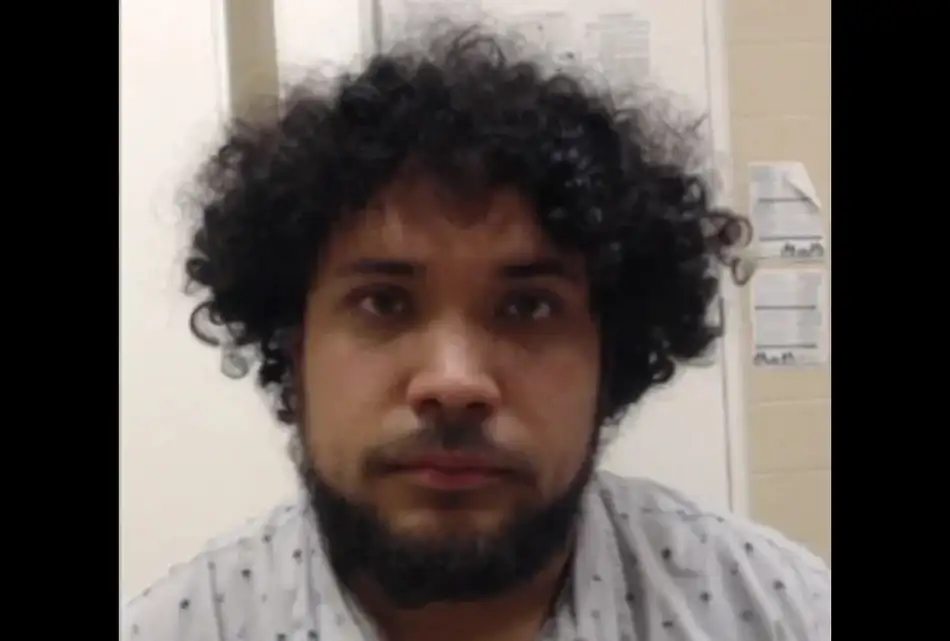
A Venezuelan man has been taken into US Immigration custody after federal investigators linked him to stickers allegedly encouraging violence against President Donald Trump. The case has drawn attention because the material reportedly called for Trump’s assassination and was distributed during a meeting of a local group opposing Immigration and Customs Enforcement (ICE) activities in Utah.
The man, identified by the Department of Homeland Security (DHS) as Hector Alejandro Mujica-Hernandez, was arrested in Provo, Utah, on October 16, 2026. The department publicly announced the arrest on November 23, saying the investigation began after the Federal Bureau of Investigation (FBI) shared information about alleged threats against the president identified through Mujica-Hernandez’s online activity.
According to federal authorities, the investigation centred on stickers displaying the words “Shoot Trump, be a hero, become unforgetable.” The message also featured a stylised letter “A” resembling an upside-down anarchist symbol. Investigators allege that Mujica-Hernandez distributed the stickers during a meeting of a group called People of Provo Against ICE (POPAI).
The immigration element has added another dimension to the case. DHS said Mujica-Hernandez entered the United States legally in July 2016 but remained in the country after his visa expired. The agency has described him as an immigration violator and said it would not tolerate threats against the president.
However, important questions remain unanswered. The DHS announcement did not specify whether federal prosecutors had filed criminal charges over the alleged threats, and local reporting indicated that federal court records did not show a criminal case against him at the time of publication. His arrest and immigration detention should therefore be distinguished from a criminal conviction.
Who Is Hector Alejandro Mujica-Hernandez?
Hector Alejandro Mujica-Hernandez is a Venezuelan national who had been living in Provo, a city in Utah County, Utah. He came to the United States in July 2016 through a lawful admission process, according to the Department of Homeland Security.
Federal authorities say he subsequently overstayed his visa and remained in the country without valid immigration status. The department has not publicly specified the type of visa he originally held, the exact circumstances of his arrival or the details of his immigration history beyond the reported July 2016 admission.
His name became the focus of a federal investigation after information about alleged online threats against President Trump was shared by the FBI with Homeland Security Investigations (HSI), the investigative arm of ICE. Authorities say the investigation connected him to images of stickers carrying language that encouraged an attack on the president.
Investigators allege that Mujica-Hernandez distributed the stickers during a gathering organised by People of Provo Against ICE. The group is associated with opposition to immigration enforcement activities in the Provo area. Its stated position, as reflected in its public social media description, is to challenge ICE activity through legal means.
Beyond these details, publicly available information about Mujica-Hernandez remains limited. Authorities have not provided a detailed account of his education, occupation, family background or length of residence in Provo. His alleged role in producing or distributing the stickers is based on the federal investigation and has not been established through a reported criminal conviction.
What Did the Stickers Targeting Donald Trump Say?
The central piece of evidence described by DHS is a set of stickers carrying the message:
“Shoot Trump, be a hero, become unforgetable.”
The word “unforgetable” appeared with that spelling in the reported message. The stickers also featured the letter “A” designed as an upside-down anarchist symbol, a visual element commonly associated with anarchist movements.
Federal investigators described the material as images intended to encourage the assassination of President Trump. According to the department, the FBI identified alleged threats through Mujica-Hernandez’s online activity and passed the information to Homeland Security Investigations.
The investigation then focused on the creation and distribution of the stickers. Authorities said investigators determined that Mujica-Hernandez had handed them out during a meeting of People of Provo Against ICE.
The distinction between political expression and threats of violence is important in understanding the case. Opposition to a president, criticism of government policies and protests against immigration enforcement are forms of political activity. A message explicitly encouraging someone to shoot a political leader, however, raises a separate and serious legal question.
Whether the material meets the legal requirements for a criminal threat or another offence is a matter for the relevant authorities and courts. The DHS announcement characterised the stickers as assassination-related threats but did not publicly explain whether prosecutors had decided to pursue a criminal case.
How the FBI and ICE Investigation Led to His Arrest
The investigation involved information sharing between the FBI and Homeland Security Investigations. According to DHS, the FBI provided information concerning alleged threats against President Trump that had been identified through Mujica-Hernandez’s online activity.
That information prompted a federal investigation into the images of the stickers. Investigators examined the message, its visual design and its alleged distribution during a meeting of People of Provo Against ICE.
The sequence described by federal authorities involved three main stages:
- Online activity identified: The FBI reportedly identified alleged threats against Trump through online activity associated with Mujica-Hernandez.
- Information shared with investigators: The FBI passed the information to Homeland Security Investigations, which examined the stickers and their alleged distribution.
- Arrest in Provo: ICE’s investigative unit arrested Mujica-Hernandez on October 16, 2026, during a targeted enforcement operation.
The arrest was not publicly announced immediately. DHS released details on November 23, more than five weeks after the reported October 16 detention.
Local reporting also placed the arrest in downtown Provo, with accounts from supporters saying federal agents detained Mujica-Hernandez near a coffee shop. The federal announcement, however, focused on the targeted enforcement operation and the investigation into the alleged threats.
The involvement of both the FBI and Homeland Security Investigations reflects the different responsibilities of federal agencies. The FBI investigates potential federal crimes and national security-related threats, while HSI investigates a range of cross-border and immigration-related offences. Their cooperation can allow information identified through one investigation to be examined by another agency with relevant enforcement responsibilities.
What Is People of Provo Against ICE?
People of Provo Against ICE, commonly referred to as POPAI, is a local group that opposes immigration enforcement activities in Provo, Utah. The group has presented its stated objective as challenging ICE operations through legal means.
The organisation became relevant to the investigation because federal authorities allege that Mujica-Hernandez distributed the stickers during one of its meetings. The gathering reportedly provided the setting in which the material was handed out, making the group’s activities part of the circumstances being examined by investigators.
However, the allegations against one individual should not automatically be attributed to every person associated with the group. The federal announcement identified Mujica-Hernandez as the alleged distributor but did not announce that POPAI itself was being prosecuted or that all its members were suspected of involvement in threats against Trump.
The distinction matters because political groups can organise demonstrations, criticise government agencies and campaign against immigration policies without necessarily engaging in unlawful conduct. Whether any other individual was involved in producing, approving or distributing the stickers would require separate evidence.
Local reporting also described a fundraising effort intended to help Mujica-Hernandez with legal expenses. The fundraiser’s organiser disputed the circumstances of his detention, describing it as an unjust action and alleging that federal authorities had taken him from a local coffee shop. Those statements represent the supporters’ account and have not been independently established as facts.
Why Was Mujica-Hernandez Arrested by ICE Instead of Being Publicly Charged With a Crime?
One of the most important unanswered questions concerns the legal basis for Mujica-Hernandez’s detention. DHS connected the arrest to an investigation into alleged threats against the president, but its public announcement also placed considerable emphasis on his immigration status.
According to the department, Mujica-Hernandez was legally admitted to the United States in July 2016 and subsequently overstayed his visa. A person who remains in the country after their authorised period of stay expires can become subject to immigration enforcement and removal proceedings, depending on the circumstances of their case.
Immigration detention and criminal prosecution are separate legal processes. ICE can take a person into custody for immigration enforcement purposes even when prosecutors have not publicly announced a criminal charge related to the conduct that initially attracted federal attention.
In this case, local reporting indicated that federal online court records did not show criminal charges against Mujica-Hernandez at the time of publication. Authorities had not publicly identified a specific criminal charge arising from the alleged sticker distribution in the DHS announcement.
That does not establish that prosecutors will never pursue charges. It means only that the public information available at the time did not confirm a criminal prosecution connected to the alleged threats. Any later decision to file charges would need to be assessed separately from the immigration case.
The distinction is also important when describing his legal status. Being arrested by ICE does not establish that someone has been convicted of threatening the president. Immigration proceedings determine questions concerning a person’s right to remain in the United States, while a criminal case would require prosecutors to establish the elements of the alleged offence under applicable law.
Where Is the Venezuelan Man Being Held?
Following his arrest in Provo, Mujica-Hernandez was reported to be in ICE custody at the Central Louisiana ICE Processing Center in Jena, Louisiana. The detention information was reported through online immigration records and local media coverage.
The reported transfer from Utah to Louisiana means that his immigration detention is being handled outside the state where the arrest occurred. ICE operates detention facilities in different parts of the country, and individuals in immigration custody may be held at facilities away from the location of their initial arrest.
His detention does not, by itself, reveal what the final immigration decision will be. Possible developments could include further immigration proceedings, a decision about continued detention or removal, or other legal steps depending on the details of his case.
As of the latest publicly reported information, authorities had not announced a final outcome in his immigration proceedings or confirmed a criminal conviction connected to the stickers.
What Did Homeland Security Secretary Markwayne Mullin Say?
Homeland Security Secretary Markwayne Mullin strongly condemned the alleged conduct in the department’s announcement. He connected the immigration violation cited by DHS with the alleged threats against the president and said the department would not tolerate death threats.
Mullin said:
“This illegal alien not only broke our laws by illegally overstaying his visa, but threatened the life of the President of the United States.”
He also said the Department of Homeland Security would not tolerate death threats of any kind and praised ICE officers for their enforcement work.
The statement reflects the administration’s position that threats against elected officials are a matter of public safety and federal law enforcement. However, the department’s characterisation of the allegations should be distinguished from a judicial finding. The legal responsibility of Mujica-Hernandez, if any, must be determined through the applicable proceedings.
Why Threats Against a US President Are Treated Seriously
Threats directed at a sitting US president are treated as a serious law enforcement matter because the president is both a national political leader and a protected public official. Federal agencies responsible for security and criminal investigations assess information that could indicate a risk of violence.
Such investigations can involve online posts, messages, images, reported statements and other material that may help establish whether a threat is credible or whether someone is encouraging violence. The FBI’s reported involvement in this case began with information about alleged threats identified through online activity.
At the same time, not every offensive or extreme political statement automatically constitutes a criminal threat. The legal assessment can depend on the precise wording, context, intent and other circumstances. Authorities must establish that the relevant legal requirements have been met before a criminal conviction can follow.
The stickers described by DHS go beyond ordinary criticism of a political leader because their reported wording explicitly refers to shooting the president. That is why federal investigators treated the material as a potential assassination-related threat rather than simply a disagreement over government policy.
The case also highlights how online activity can become part of a physical-world investigation. Digital material may provide an initial lead, while evidence about where and how it was distributed can help investigators establish the context surrounding the alleged conduct.
What Happens Next in the Hector Mujica-Hernandez Case?
The next developments will depend on decisions by immigration authorities and whether prosecutors pursue a separate criminal investigation. Several issues remain unresolved in the public record.
First, authorities have not publicly provided a detailed account of the alleged online activity that prompted the FBI’s referral. The DHS announcement described the investigation’s focus but did not explain the full timeline of the digital evidence or identify all the platforms involved.
Second, the department has not disclosed how many stickers were produced or distributed, whether anyone else helped create them or whether investigators identified additional people connected to the alleged activity.
Third, the criminal status of the case remains unclear. The public announcement did not specify charges relating to the alleged threats, and local reporting indicated that no corresponding federal criminal case was visible in online court records at the time.
Finally, the immigration proceedings will determine whether Mujica-Hernandez can remain in the United States. His reported visa overstay is a separate issue from whether the allegations concerning the stickers amount to a criminal offence.
The case has also placed attention on the relationship between immigration enforcement and investigations into threats against public officials. While the government has emphasised both issues, the legal processes involved must be evaluated independently.
What the Case Reveals About Online Threat Investigations and Immigration Enforcement
The arrest of Hector Alejandro Mujica-Hernandez brings together two areas of federal enforcement: the investigation of alleged threats against a national political leader and the detention of a foreign national accused of overstaying his visa.
The reported sequence began with online activity identified by the FBI, continued through an investigation into stickers allegedly distributed at a local meeting and ended with an ICE arrest in Provo. The subsequent DHS announcement made the allegations public more than a month after the detention.
For investigators, the central issue is whether the available evidence establishes that Mujica-Hernandez was responsible for distributing material that encouraged violence against Trump and whether that conduct supports any criminal charge. His immigration status creates a separate legal question about his right to remain in the country.
The involvement of People of Provo Against ICE has also brought the case into the wider debate over immigration protests and political expression. However, allegations involving an individual cannot be treated as proof of wrongdoing by an entire organisation or everyone associated with it.
For now, the most firmly established details are that Mujica-Hernandez was arrested by ICE in Provo on October 16, that DHS announced the arrest on November 23, and that the department alleges he distributed stickers carrying a message encouraging violence against President Trump. Authorities also say he entered the United States legally in July 2016 and overstayed his visa.
The final legal outcome remains uncertain. Until further evidence, formal charges or court decisions become public, the allegations surrounding the stickers must remain allegations rather than established findings of criminal guilt.
For breaking news and live news updates, like us on Facebook or follow us on Twitter and Instagram. Read more on Latest World on thefoxdaily.com.



COMMENTS 0