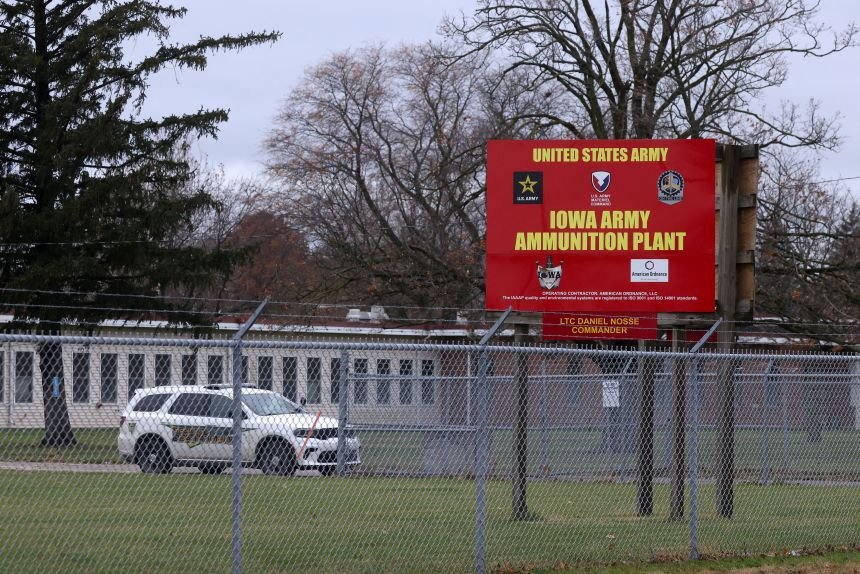
The United States Army is preparing to destroy approximately 9,700 pounds of unstable lead azide at the Iowa Army Ammunition Plant near Middletown on Wednesday morning, November 25, 2026. The operation can proceed after the US Court of Appeals for the Eighth Circuit lifted an administrative pause that had temporarily blocked the environmental permit authorising the controlled detonations.
The dispute has brought together concerns over public safety, hazardous waste management and environmental protection. The Army argues that the degraded explosive material has become increasingly dangerous during long-term storage and could trigger an uncontrolled explosion, particularly as temperatures fall. Environmental organisations, however, have questioned whether the proposed operation adequately protects nearby communities from exposure to toxic lead particles.
The latest development came after President Donald Trump publicly directed the military to wait until the court and Iowa’s incoming governor agreed to the operation. The appeals court subsequently removed its temporary restriction, while incoming Governor Rob Sand indicated that the decision should be guided by federal experts.
Acting Army Secretary Adam Telle said the military would proceed with the controlled removal in coordination with state, local and federal authorities. The announcement means the Army can move ahead with a plan that has already faced several postponements, legal objections and criticism from residents concerned about the potential environmental consequences.
Why the Army wants to detonate nearly five tons of lead azide
The material at the centre of the dispute is lead azide, a highly sensitive explosive compound used as a primary explosive in detonators and ammunition systems. Its purpose is to initiate a larger explosive charge, making it an important component in military munitions.
However, the same sensitivity that makes lead azide useful in ammunition also makes degraded or improperly stored material extremely dangerous. The Army has said that the stockpile at the Iowa Army Ammunition Plant has deteriorated after years of storage, leaving it in a condition that makes ordinary handling and transportation unsafe.
The material was discovered in storage bunkers at the facility in March 2026. According to the Army, the stockpile consists of 68 drums containing approximately 9,700 pounds of lead azide. The military has warned that the explosive has become increasingly unstable and that moving it could trigger an accidental detonation.
This is the central argument behind the Army’s decision to use controlled destruction rather than conventional disposal methods. Officials have maintained that transporting the material to another location or attempting to process it through alternative methods could expose workers and nearby communities to a greater immediate danger.
The military has also pointed to falling temperatures as an important factor in the timing. It has warned that colder conditions could further destabilise the material, increasing the risk of an unplanned explosion. From the Army’s perspective, a carefully managed detonation is intended to eliminate the hazard before the stockpile becomes even more dangerous.
However, the operation creates a separate environmental concern. Because lead azide contains lead, its destruction can generate hazardous particles. The central question is whether the Army’s proposed safeguards can sufficiently limit the release and movement of those particles into surrounding communities.
What the federal appeals court decided
The legal dispute centres on an emergency hazardous-waste permit issued by the US Environmental Protection Agency (EPA) on November 13, 2026. The permit authorised the Army to carry out the controlled detonation of 68 drums of lead azide at the Iowa facility.
The Iowa Environmental Council and the Iowa chapter of the Sierra Club challenged the EPA’s decision. Represented by environmental law organisation Earthjustice, the groups asked the Eighth Circuit Court of Appeals to review the permit and temporarily stop the operation while the legal challenge was considered.
Their concerns included the possibility that the detonation could release a plume of lead dust, potentially affecting homes and communities far beyond the ammunition plant. They also questioned whether the government had adequately evaluated alternative disposal methods and completed the necessary environmental monitoring, soil sampling and public notification.
On November 20, the appeals court issued an administrative stay, temporarily preventing the Army from relying on the contested permit while the judges considered the emergency request. The pause disrupted the military’s original schedule and added another delay to an operation that had already been postponed.
On November 23, however, the court lifted the administrative stay and rejected the environmental groups’ request for an emergency halt. The judges acknowledged the risks associated with the planned detonation but concluded that the petitioners had not demonstrated that the EPA and Army had failed to adequately consider the available options and measures to reduce potential exposure.
The court’s reasoning focused on the immediate danger presented by the unstable stockpile. It described the choice as one between the risks of a controlled detonation and those of an accidental explosion, rather than a comparison between the proposed operation and a completely risk-free alternative.
The ruling allows the Army to proceed, but it does not mean every environmental concern has been resolved or that the underlying legal challenge has necessarily ended. The decision addressed the emergency request to stop the operation while the broader case continues.
Why environmental groups are opposing the operation
Environmental organisations are concerned that detonating a large quantity of lead-based explosive material in the open could release toxic particles into the atmosphere. Lead is a hazardous heavy metal, and exposure can affect the nervous system and other organs. Children and pregnant women are particularly vulnerable to its harmful effects.
Unlike some pollutants that can disperse and become less concentrated over time, lead does not break down into harmless substances. Particles released during an explosion can settle on soil, buildings, vehicles, outdoor surfaces and vegetation. Depending on weather conditions, some airborne material may also travel away from the original site.
The Iowa Environmental Council and Sierra Club have argued that the potential consequences extend beyond the boundaries of the military installation. Their legal challenge raised concerns about the possibility of lead dust travelling significant distances and reaching residential areas.
The groups have also questioned whether residents have received sufficient information about the possible impact area and the precautions they should take. Their position is that the Army and EPA should demonstrate that the operation’s environmental risks have been properly assessed and that alternative approaches have been adequately examined.
These objections do not establish that a harmful plume will necessarily reach nearby communities. The actual movement of airborne particles depends on several factors, including wind direction, wind speed, atmospheric conditions, the characteristics of the detonation and the effectiveness of containment and monitoring measures.
Nevertheless, the concerns explain why the planned operation has become a major public issue in southeastern Iowa. Residents want clear information about the timing, expected impact area, safety arrangements and steps to take if dust or debris reaches their properties.
How the Army plans to limit environmental risks
The Army and EPA have maintained that the controlled detonation is the available option that presents the lowest immediate risk under the circumstances. The federal agencies have pointed to measures intended to reduce the likelihood of lead particles spreading and to protect people in the surrounding area.
The environmental permit and the government’s court submissions refer to safeguards that include barriers, weather restrictions, public notification, air modelling and environmental monitoring. These measures are intended to help authorities assess the likely movement of particles, manage the operation under suitable conditions and identify potential environmental impacts.
Weather conditions are particularly important because wind can influence the direction and distance travelled by airborne dust. The Army’s repeated schedule changes have reflected the need to coordinate the operation with the forecast and the changing condition of the stored material.
The military has also said that it has been communicating with stakeholders and residents since discovering the degrading material in March. Its stated objective is to remove the immediate explosive hazard while coordinating with relevant government agencies.
However, the effectiveness of the safeguards will depend on how they are implemented during and after the detonations. Air monitoring, clear public instructions and transparent communication will be important in determining whether residents receive timely information about any potential exposure.
Why the detonation has been postponed several times
The planned operation has been delayed repeatedly as the Army balanced the condition of the explosive material, weather forecasts, public concerns and legal proceedings.
The initial schedule called for two controlled detonations on November 20. The Army subsequently announced a postponement, citing the need to adjust the timing in response to forecast conditions and the risk that colder temperatures could further destabilise the lead azide.
The operation was then moved towards November 23. However, the environmental groups’ legal challenge and the appeals court’s temporary administrative stay created another obstacle. The Army and federal authorities also argued in court that the material presented an immediate danger and that waiting too long could increase the risk of an uncontrolled explosion.
The court’s November 23 decision removed the temporary legal barrier. The Army then identified Wednesday, November 25, as the date for the operation, citing the need for more suitable weather conditions.
The repeated changes have added to uncertainty for residents and officials in the region. They have also highlighted the difficult balance between acting quickly to eliminate an unstable explosive stockpile and ensuring that the surrounding population understands and can prepare for the environmental risks.
Trump’s intervention and the role of Iowa’s incoming governor
President Donald Trump became directly involved in the dispute by ordering the military to wait until the court and Iowa’s incoming governor agreed to the operation. His intervention came amid growing public concern and the legal challenge over the EPA permit.
The political dimension became particularly relevant because the detonation could have consequences beyond the Army installation and potentially affect communities in neighbouring areas. The operation therefore required coordination among federal authorities, Iowa officials and local emergency management agencies.
Iowa’s incoming governor, Rob Sand, indicated that the decision belonged to the experts responsible for assessing the safety risks. Acting Army Secretary Adam Telle subsequently defended the military’s approach, saying that expert agencies supported the operation and that both the current and incoming governors recognised the importance of expert guidance.
Telle’s statement also emphasised coordination with state, local and federal authorities. The Army’s position is that public safety must remain the priority and that the controlled removal should proceed under the arrangements established by the relevant agencies.
The disagreement has exposed the challenge of managing a hazardous military operation when technical safety assessments, environmental objections, public anxiety and political oversight intersect. The appeals court’s decision has cleared the immediate legal obstacle, but it has not removed the need for government agencies to explain the operation and address residents’ concerns.
What residents near the Iowa ammunition plant should know
The Iowa Army Ammunition Plant is located near Middletown in Des Moines County, southeastern Iowa. Because the operation involves a large quantity of lead-based explosive material, residents in the surrounding region have been seeking practical information about possible exposure and emergency precautions.
Authorities have advised people in potentially affected areas to follow official emergency instructions during the operation. Precautionary guidance reported by officials includes remaining indoors during the detonation and washing outdoor surfaces afterwards to reduce the possibility of contact with settled dust.
Residents should pay particular attention to instructions from local emergency management agencies and public health authorities. They should not approach the installation or attempt to inspect the detonation site themselves. Any specific guidance about closing windows, limiting outdoor activity or cleaning property should be followed according to the instructions issued for the relevant area.
Neighbouring states are also monitoring the situation because airborne particles can cross administrative boundaries depending on atmospheric conditions. Illinois agencies, for example, have been tracking the Army’s plans and sharing updates with residents as the schedule and weather projections change.
For communities near the facility, the key concerns are whether the detonation will remain within the expected safety parameters, whether environmental monitoring will identify any unexpected contamination and how quickly authorities will communicate the results.
What happens after Wednesday’s planned explosion?
The immediate objective of Wednesday’s operation is to eliminate the unstable lead azide stockpile at the Iowa Army Ammunition Plant. If the controlled detonations proceed as planned, the Army will have removed the explosive material that officials say has become increasingly dangerous during storage.
However, the end of the detonation would not automatically end the environmental questions surrounding the incident. Authorities will still need to assess the operation’s impact, review monitoring information and address any concerns about lead particles settling outside the facility.
The environmental groups’ broader legal challenge also remains an important part of the dispute. Their objections concern the EPA’s emergency authorisation and the government’s handling of the hazardous material. The appeals court’s decision to reject an emergency halt allows the operation to move forward, but it should not be confused with a finding that every environmental concern raised by the groups has been disproved.
The case also raises wider questions about how the military manages ageing explosive materials. Long-term storage can create serious safety challenges when hazardous compounds deteriorate, particularly when moving or treating them may itself create a risk of accidental detonation. The Iowa situation demonstrates why storage inspections, early identification of unstable materials and clear emergency disposal procedures matter.
For now, the Army’s priority is to complete the controlled removal before colder weather increases the danger associated with the stockpile. Environmental organisations and residents, meanwhile, will be watching whether the promised safeguards are effective and whether the government provides transparent information about the operation’s consequences.
The Eighth Circuit’s decision has removed the immediate court-imposed pause, clearing the way for the planned November 25 detonation. But the operation will be judged not only by whether the explosive material is destroyed, but also by how effectively authorities protect nearby communities and account for any environmental impact.
For breaking news and live news updates, like us on Facebook or follow us on Twitter and Instagram. Read more on Latest World on thefoxdaily.com.


COMMENTS 0