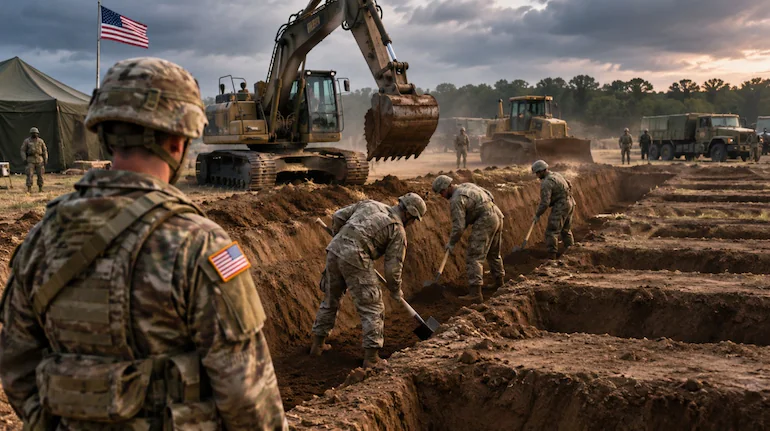
For the first time since the Korean War, the US Army is training soldiers to prepare temporary mass burial sites for fallen troops. The exercises, conducted at Fort Bragg in North Carolina, are designed to prepare military personnel for a high-intensity conflict in which battlefield casualties could overwhelm the capacity to recover, identify and individually bury every service member.
Called Operation Dragon Covenant Phase II, the drills began in September amid concerns about a wider military confrontation with Iran. The training involves preparing temporary burial grounds, preserving remains and establishing procedures to identify fallen personnel before their eventual repatriation to the United States.
The development has drawn attention because the US military has not needed to prepare temporary mass burial sites on this scale since the 1950–1953 Korean War. However, the exercise does not establish that the Army expects mass casualties in the current conflict. It is intended to test its preparedness for a possible large-scale war.
Why Is the US Army Practising Mass Battlefield Burials?
According to a Newsweek report published on October 29, Operation Dragon Covenant Phase II involved personnel from the 3rd Corps Sustainment Command and the 20th Engineer Brigade, alongside military chaplains and religious support teams.
The Army used bulldozers, excavators and other heavy equipment to assess how quickly temporary burial sites could be prepared during a major conflict. The drills also examined how remains could be preserved until they were identified and transported back to the United States.
The training is intended to address a difficult possibility: a conflict in which the number of battlefield deaths could make immediate individual burials and religious ceremonies difficult to arrange.
According to the US Army, temporary mass burial preparations on this scale have not been required since the Korean War.
How Many Soldiers Can the Temporary Burial Sites Accommodate?
The exercise included the preparation of five burial trenches with a combined capacity of up to 100 casualties. Soldiers in North Carolina took an average of one hour and 15 minutes to prepare each plot using heavy machinery.
The Army also assessed how quickly a larger operation could be carried out using multiple machines. It said eight bulldozers and four military excavators could potentially help prepare temporary burial arrangements for as many as 2,400 fallen soldiers within 24 hours.
These figures reflect the capacity assessed during the exercise. They do not indicate that the military has confirmed plans to bury that number of personnel in an actual conflict.
What Is the Purpose of Operation Dragon Covenant Phase II?
The central objective is to establish a systematic process for recovering and respectfully managing fallen service members during a high-intensity conflict.
Sergeant First Class Delbert Ruede of the 3rd Corps Sustainment Command told Newsweek that the exercise helped the military examine how it could honour and manage fallen personnel if casualties occurred on a large scale.
“This exercise allowed us to take a critical look at how we respect, honour, and systematically manage our fallen in a high-intensity conflict.”
Ruede said the Army needed tested procedures rather than having to improvise arrangements during a war.
“If we went to war tomorrow, we would be making this up as we went along. What we are doing here is taking a scientific, field-tested approach so that we can maintain positive control and respectfully care for our fallen.”
The drills also marked the first time in more than two decades that US Army chaplains and other religious affairs personnel had trained specifically for religious support during temporary battlefield burials.
Their involvement is intended to ensure that the military can provide appropriate religious support and maintain dignity in difficult circumstances, even when the scale of casualties makes normal procedures harder to carry out immediately.
How Many US Soldiers Are Still Missing From the Korean War?
The Korean War, fought between 1950 and 1953, resulted in heavy American military losses. Reports cited in the supplied material put the number of US personnel killed or untraceable at around 36,515, while another 7,245 were captured.
Thousands of American service members remain unaccounted for decades after the conflict. A 2018 BBC report cited estimates from a US defence agency indicating that approximately 5,300 American troops were still missing in areas that now fall within North Korea.
The number of missing personnel also varied across US states. The BBC report noted that 431 service members from Texas and 593 from California remained unaccounted for, while Alaska had one person on the missing list.
The Army has also said it knows the precise locations where many remains were buried. The continuing efforts to account for missing personnel highlight the challenges of identifying and recovering service members after a major war.
How Is the Iran Conflict Connected to the US Army’s Burial Drills?
The renewed training comes amid the ongoing US-Iran Conflict and concerns about the potential scale of American military casualties in West Asia.
A Washington Post report in September said around 22 US soldiers had been killed, four more than the figure listed in the Pentagon’s public database. The report clarified that not all the deaths were directly linked to the months-long conflict, but involved US personnel stationed in the region amid the clashes.
Pentagon chief and Defence Secretary Pete Hegseth rejected the report, describing it as a “complete lie”.
The reported casualty figures and the Army’s renewed preparations have brought attention to the challenges the US military could face if a regional conflict expands into a much larger confrontation.
However, the Army has not stated that Operation Dragon Covenant Phase II was prompted by a confirmed expectation of mass casualties in the Iran conflict. The exercise is focused on preparing for a possible high-intensity war and testing procedures that could be needed under extreme conditions.
Why Were Similar Burial Facilities Not Needed During the Iraq and Afghanistan Wars?
The US military did not need to establish large temporary burial grounds during the Iraq and Afghanistan conflicts over the past 25 years.
American personnel killed during those operations were generally transported back to the United States rather than being placed in temporary mass burial facilities. The latest drills are intended to prepare for a different scale of battlefield casualties, where individual recovery and burial arrangements could become difficult to organise immediately.
Operation Dragon Covenant Phase II therefore focuses on testing the Army’s ability to prepare temporary sites, preserve remains, maintain identification procedures and provide religious support during a major conflict.
While the exercises have revived a practice associated with the Korean War, their stated purpose is preparedness. They underline the logistical and humanitarian challenges military forces could face if a future conflict produces casualties on a scale that overwhelms existing recovery and burial arrangements.
For breaking news and live news updates, like us on Facebook or follow us on Twitter and Instagram. Read more on Latest World on thefoxdaily.com.




COMMENTS 0