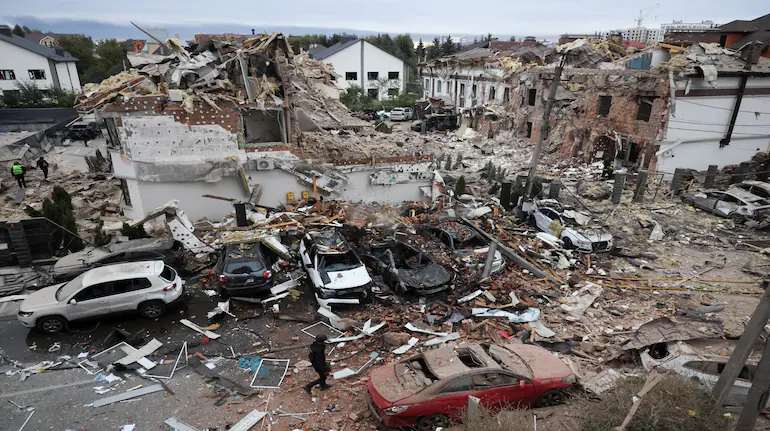
Kyiv endured another devastating night as Russia launched a coordinated barrage of missiles and drones targeting Ukraine’s capital. The attack triggered air raid alerts across the city, forcing thousands of residents into underground metro stations and bomb shelters while air defense systems attempted to intercept incoming projectiles.
Emergency officials reported casualties, collapsed residential buildings, fires across multiple districts, and widespread damage to civilian infrastructure. Rescue operations continued into the morning as emergency crews searched through debris for survivors trapped beneath damaged apartment blocks.
The latest bombardment underscores the increasingly intensive phase of the Russia-Ukraine conflict, in which long-range missile and drone attacks have become a defining feature of military operations on both sides.
What Happened During the Overnight Attack?
According to Ukrainian authorities, Russia launched a coordinated assault involving multiple types of long-range weapons, including:
- Ballistic missiles.
- Cruise missiles.
- Attack drones.
Air raid sirens sounded across Kyiv as incoming threats were detected, prompting city officials to urge residents to seek immediate shelter.
Explosions echoed throughout the capital for several hours while Ukrainian air defense systems attempted to intercept the incoming missiles and drones.
Despite defensive efforts, numerous projectiles reached their targets, damaging residential areas and civilian infrastructure across multiple districts.
Casualties and Rescue Operations
Officials confirmed that at least eight people lost their lives during the overnight attack, while dozens more suffered injuries of varying severity.
Medical teams and emergency responders worked through the night to:
- Rescue residents trapped beneath collapsed structures.
- Extinguish fires.
- Provide emergency medical treatment.
- Search damaged buildings for survivors.
- Secure unstable structures.
Several injured individuals required hospitalization, including critically wounded victims affected by collapsing buildings and blast damage.
Multiple Districts Across Kyiv Were Hit
The strikes affected numerous parts of the Ukrainian capital, demonstrating the wide geographic scope of the attack.
Authorities reported damage across several districts, including:
- Shevchenkivskyi.
- Desnianskyi.
- Holosiivskyi.
- Sviatoshynskyi.
- Darnytskyi.
- Pecherskyi.
- Solomianskyi.
- Obolonskyi.
- Podilskyi.
The widespread impact illustrates how modern missile barrages can simultaneously target numerous locations within a large metropolitan area.
Residential Buildings Suffered Extensive Damage
Many of the structures damaged during the attack were residential apartment buildings.
Emergency authorities reported:
- Partial building collapses.
- Roof fires.
- Destroyed apartments.
- Damaged private homes.
- Structural instability.
- Entrapped residents.
Several apartment complexes sustained severe damage after direct or nearby impacts, leaving residents displaced and requiring emergency shelter.
The destruction of housing continues to represent one of the most significant humanitarian consequences of the conflict.
Emergency Services Race Against Time
Search-and-rescue teams were deployed across the city immediately after the strikes.
Their operations included:
- Removing debris using heavy equipment.
- Searching collapsed floors for survivors.
- Evacuating injured civilians.
- Containing fires.
- Assessing structural safety.
Such rescue missions are often complicated by damaged infrastructure, unstable buildings, interrupted electricity supplies, and the possibility of additional air attacks.
How Ukraine’s Air Defense Responded
Ukraine has significantly strengthened its air defense network since the conflict began, integrating multiple layers of defensive systems designed to intercept drones, cruise missiles, and ballistic missiles.
Although many incoming threats are intercepted during large-scale attacks, the sheer number of simultaneously launched weapons can challenge even advanced defensive systems.
Military analysts note that combining drones with different classes of missiles forces defenders to allocate resources across multiple threat types at once.
Russia’s Expanding Missile and Drone Campaign
Recent months have seen Russia increase the frequency and scale of long-range strikes targeting Ukrainian cities.
These attacks often aim to:
- Damage critical infrastructure.
- Disrupt transportation.
- Pressure civilian populations.
- Reduce military logistics capacity.
- Overwhelm air defense systems.
Long-range precision weapons have become an increasingly important component of Russia’s broader military strategy.
Ukraine’s Long-Range Operations Inside Russia
The escalation has occurred alongside Ukraine’s own expansion of long-range drone operations.
In recent months, Ukrainian forces have increasingly targeted military installations, logistics centers, fuel depots, and energy infrastructure inside Russian territory.
These operations seek to:
- Disrupt supply chains.
- Reduce fuel availability.
- Damage military infrastructure.
- Increase operational costs.
- Pressure Russian logistics.
The growing range and sophistication of Ukrainian drone capabilities have altered the strategic dynamics of the conflict.
Why Kyiv Remains a Strategic Target
As Ukraine’s political, administrative, and symbolic capital, Kyiv remains one of Russia’s highest-profile military targets.
Strikes against the capital serve multiple objectives, including:
- Demonstrating long-range strike capability.
- Applying political pressure.
- Targeting command infrastructure.
- Disrupting civilian life.
- Testing Ukraine’s air defenses.
At the same time, attacks on Kyiv often receive significant international attention due to the city’s political importance.
The Humanitarian Impact of Urban Missile Warfare
Urban missile attacks present unique humanitarian challenges.
Even when military objectives exist nearby, densely populated cities contain residential neighborhoods, schools, hospitals, transportation systems, and commercial districts in close proximity.
The consequences frequently include:
- Civilian casualties.
- Temporary displacement.
- Property destruction.
- Psychological trauma.
- Disruption of public services.
- Long-term reconstruction needs.
Repeated overnight attacks also place significant psychological strain on civilians WHO must regularly seek shelter during air raid alerts.
Modern Missile and Drone Warfare Is Changing Conflict Dynamics
The Russia-Ukraine conflict has highlighted how modern warfare increasingly combines multiple technologies in coordinated operations.
Current strike packages often include:
- Reconnaissance drones.
- Loitering munitions.
- Cruise missiles.
- Ballistic missiles.
- Electronic warfare systems.
This combination is intended to complicate defensive planning while maximizing pressure on air defense networks.
Overview of the Overnight Kyiv Attack
| Category | Details |
|---|---|
| Primary Target | Kyiv, Ukraine |
| Weapons Used | Ballistic missiles, cruise missiles and attack drones |
| Confirmed Fatalities | At least eight people |
| Injuries | Dozens reported |
| Areas Affected | Multiple residential districts across Kyiv |
| Damage | Residential buildings, civilian infrastructure and fires |
| Emergency Response | Search, rescue, firefighting and medical assistance |
International Security Implications
The continued exchange of long-range strikes demonstrates that the conflict remains highly dynamic despite periodic diplomatic efforts aimed at reducing hostilities.
Security analysts increasingly view missile defense, drone Technology, electronic warfare, and infrastructure resilience as central elements shaping modern military doctrine.
The repeated targeting of major urban centers also reinforces the importance of strengthening civilian emergency preparedness, early warning systems, and rapid disaster response capabilities.
The latest overnight assault on Kyiv illustrates how long-range missile and drone warfare continues to redefine modern conflict. Beyond immediate military objectives, such attacks carry profound humanitarian consequences, challenge urban resilience, and underscore the importance of international efforts to reduce civilian suffering while pursuing durable pathways toward peace.
Future Outlook
Military analysts expect both Russia and Ukraine to continue relying heavily on long-range strike capabilities as the conflict evolves. Advances in missile technology, drone production, electronic warfare, and air defense systems are likely to play an increasingly decisive role in future operations. At the same time, protecting civilian infrastructure and strengthening emergency response mechanisms will remain critical priorities for Ukrainian authorities.
Diplomatic initiatives aimed at reducing hostilities continue alongside ongoing military operations, but the persistence of large-scale attacks suggests that achieving a lasting resolution will remain a complex challenge. Until broader political agreements emerge, cities such as Kyiv are expected to remain at the center of both military strategy and humanitarian concern.
For breaking news and live news updates, like us on Facebook or follow us on Twitter and Instagram. Read more on Latest World on thefoxdaily.com.





COMMENTS 0