In the vast deserts of northwestern China, something extraordinary is taking shape and it has the world’s sharpest nuclear analysts struggling to find comparisons. Satellite imagery reviewed by Reuters in May 2025 exposed a sprawling network of more than 80 concrete launch pads, three massive octagon-shaped Military installations, armored bunkers, fortified storage areas, and rail connections radiating outward from the Hami nuclear silo field in eastern Xinjiang. The scale is staggering. The implications are global. And this development could reshape Nuclear Deterrence as we have understood it since the Cold War.
What the Satellite Images Reveal
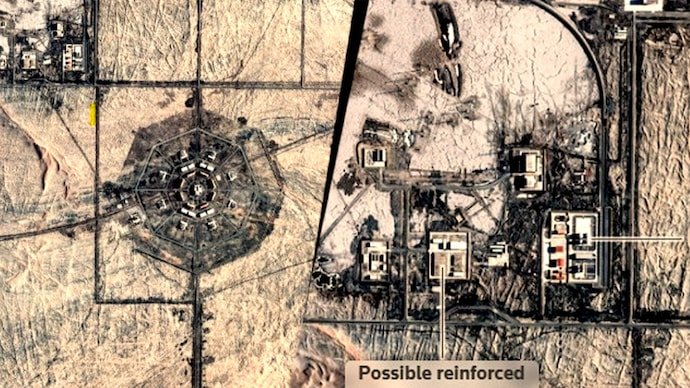
In May 2025, Reuters published satellite imagery showing construction unlike anything previously seen in nuclear infrastructure. The developments center on China’s Hami missile silo field one of three massive fields constructed since 2021 and extend across thousands of square kilometers of desert terrain.
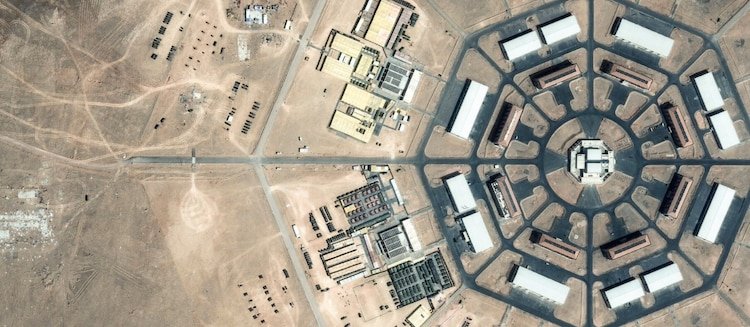
The imagery reveals a multi-layered defensive ecosystem. At its core are two large octagon-shaped facilities built over the past six years. The first lies approximately 140 kilometers southwest of the Hami silo field; the second sits roughly 230 kilometers away. Both contain accommodation blocks, infrastructure for large military vehicles, armored bunkers, fortified storage, airfields, and rail connections linking to nearby missile fields.
Recent captures from April and May 2025 recorded active military exercises around the northern octagon large tents, camouflaged positions, and what analysts identified as air-defense missile batteries. The southern octagon connects to a logistics network with railway lines, a rail terminal, fuel-storage facilities, and reinforced underground structures.
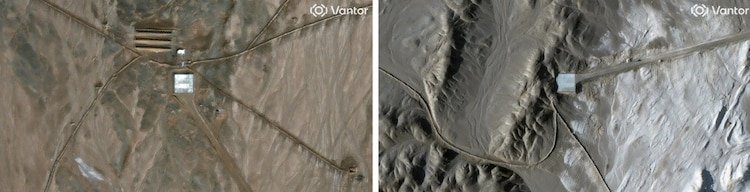
But the octagonal sites are just the beginning. The imagery shows more than 80 concrete launch pads scattered among rocky outcrops and dry creek beds in a dispersed pattern designed to complicate any adversary’s targeting. A web of roads and underground conduits radiates from the octagonal compounds, which experts believe may house fiber-optic communication lines. At the northernmost octagon, satellite dishes and two large towers suggest a dedicated space or microwave communications facility.
A third octagonal installation south of the Lop Nur nuclear test site appears to be a target range images show cratered terrain and mock-ups of Western fighter aircraft.
Expert Verdict: “Never Seen Anything Like It”
When Hans Kristensen speaks about nuclear infrastructure, the world listens. As director of the Federation of American Scientists’ Nuclear Information Project, Kristensen has spent decades analyzing nuclear arsenals through open-source intelligence. His assessment was unambiguous: “I have never seen anything quite like it. It’s an extraordinary effort.”
Tong Zhao, a senior fellow in nuclear policy at the Carnegie Endowment for International Peace, told Reuters that “taken together, I think there is a real possibility that the octagonal structures and the strange towers are linked to C3 command, control, and communications as well as maintenance and storage activities related to China’s nuclear operations at the Hami ICBM silo site.”
Alexander Neill, an adjunct fellow at the Pacific Forum, emphasized the scope: “We can see this infrastructure is being built on a grand scale, covering thousands of square kilometers… we’re looking at a very considerable enhancement and diversification of China’s strategic nuclear deterrent.”
The Numbers Behind China’s Nuclear Expansion
| Metric | 2020 | 2024/2025 | Projected 2030 |
|---|---|---|---|
| Total Nuclear Warheads | ~320 | ~600+ | 1,000+ |
| New Missile Silos | ~18 legacy | ~350 (3 new fields) | ~380+ |
| ICBMs Reaching Continental US | ~100 | ~462 launchers | 600+ |
| Operational SSBNs | 4 | 6 Type 094 | 6-8+ |
| Nuclear-Capable Bombers | 0 (dormant) | ~20 H-6N | 50+ |
The Pentagon’s 2025 China Military Power Report confirmed China’s stockpile “remained in the low 600s through 2024” but reaffirmed it “remains on track to have over 1,000 warheads by 2030.” Air Force General Kenneth Wilsbach has suggested China could approach 1,500 warheads by 2035 placing Beijing in the same league as the United States (~3,700 warheads) and Russia (~4,300 warheads). China’s arsenal remains smaller in absolute terms, but its rate of expansion is unmatched. China is the only NPT nuclear-armed state currently expanding its arsenal.
Second-Strike Capability: The Strategic Logic
At the heart of China’s nuclear doctrine lies second-strike capability the ability to absorb a nuclear first strike and still launch devastating retaliation. This is the foundation of deterrence. China has long maintained a policy of minimum deterrence and officially adheres to a “no first use” doctrine.
What makes the current construction so significant is that it represents a fundamentally different approach from the United States and Russia. The American and Russian models rely on sheer numbers, geographic dispersion, and hardened silo construction. The U.S. spreads 450 silos across five states; Russia distributes ICBMs across 12 missile divisions spanning eleven time zones.
China is building something different an active defensive architecture around its silo fields incorporating Missile Defense batteries, electronic warfare systems, mobile launch capabilities, hardened communications, and early warning infrastructure into a unified protective network. It is, in effect, building a fortress around its nuclear backbone. An adversary planning a first strike would need to account for not just the silos, but mobile systems relocating between pads, air defenses intercepting incoming missiles, electronic warfare disrupting guidance, and hardened command centers coordinating retaliation.
China’s Early Warning Revolution
A critical but overlooked component of second-strike capability is time. According to the Pentagon, China’s Huoyan-1 satellite network a constellation of geostationary infrared early-warning satellites can detect incoming ICBMs within approximately 90 seconds of launch and alert command centers within three to four minutes. For a trans-Pacific ICBM with roughly 30 minutes total flight time, this provides enough warning to launch retaliatory strikes before silos are hit.
The Huoyan system is supplemented by ground-based large phased-array radars in Heilongjiang, Fujian, and Xinjiang that track missiles in midcourse at distances of thousands of kilometers. The fiber-optic conduits visible in satellite imagery likely serve as the ground-based connective tissue linking these sensors to command centers.
The Full Triad: China’s 2025 Victory Day Parade
The desert infrastructure represents only one component of broader modernization. At the September 3, 2025 Victory Day parade, China showcased its complete nuclear triad for the first time land-based ICBMs, submarine-launched missiles, and air-launched weapons together.
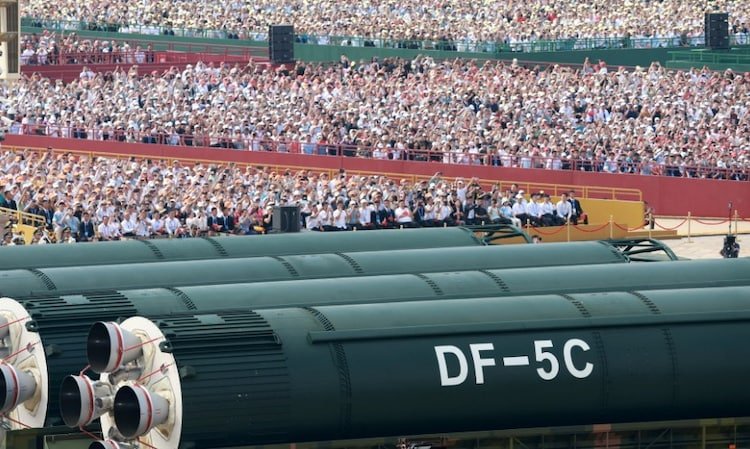
The parade featured the DF-5C liquid-fueled ICBM with range exceeding 15,000 kilometers; the DF-31BJ solid-fueled ICBM believed assigned to the three new silo fields; the new DF-61 road-mobile ICBM potentially carrying up to 12 warheads; the JL-3 submarine-launched ballistic missile with 10,000+ kilometer range; and the JL-1 air-launched ballistic missile completing the triad. The Pentagon’s 2025 report assessed China has “likely loaded more than 100 solid-propellant ICBM silos at its three silo fields with DF-31 class ICBMs.”
The Taiwan Factor: Why Now
No analysis can ignore the Taiwan Strait. China considers Taiwan inseparable territory; the island’s government maintains de facto independence. In early May 2025, Xi Jinping reportedly warned President Trump that mishandling Taiwan disputes could push relations to a “dangerous place.” Xi has directed China’s military to be prepared for a potential Taiwan operation by 2027.
The nuclear dimension raises the threshold for any U.S. intervention. If American planners believe a Taiwan Conflict could escalate to nuclear exchange and China’s second-strike capability guarantees unacceptable damage the deterrent shapes decision-making before any shot is fired. The desert buildup ensures no adversary believes a first strike could succeed.
How China Compares to the US and Russia
| Feature | China (2025) | United States (2025) | Russia (2025) |
|---|---|---|---|
| Total Warhead Stockpile | ~600 | ~3,700 | ~4,300 |
| Deployed Strategic Warheads | ~370 (est.) | 1,770 | 1,718 |
| ICBM Silos | ~350 new + 48 legacy | 450 (400 loaded) | ~180 silo-based |
| Mobile ICBMs | ~100 road-mobile | 0 (all silo-based) | ~144 road-mobile |
| Operational SSBNs | 6 Type 094 | 14 Ohio-class | 10-11 |
| Silo Defense Infrastructure | Extensive (air defense, EW, C3, mobile pads) | Minimal (isolation + hardening) | Moderate (Peresvet lasers) |
| Space-Based Early Warning | Huoyan-1 (5+ satellites) | SBIRS (since 2011) | Limited (Oko-1/EKS) |
| No First Use Policy | Yes (declared) | No | No |
What makes China unique is not arsenal size it remains the smallest among the three but its architectural philosophy. While the US and Russia rely on quantitative superiority and geographic dispersion, China is pioneering a qualitative approach integrating active defenses, hardened communications, and mobile capabilities into a protective cocoon around its nuclear forces.
Unknowns and the Arms Control Question
Critical questions remain unanswered. Analysts cannot definitively determine whether the 80+ launch pads are for mobile missiles, air-defense systems, electronic warfare, or all three. It is unknown whether the sites contain facilities for handling nuclear warheads. The opacity is not accidental Beijing has never disclosed its arsenal size or command structure.
Yet that position is becoming harder to sustain. In November 2023, China participated in its first formal arms control consultations with the United States. In September 2024, Beijing unusually notified Washington in advance of a DF-31AG test launch the first such notification in years, suggesting awareness that transparency can serve strategic stability.
Conclusion: The End of Chinese Nuclear Minimalism
China’s construction of launch pads, octagonal command centers, and hardened communications in Xinjiang represents more than infrastructure expansion it signals a strategic transformation. By wrapping its land-based forces in layers of active defense, redundant communications, and hardened architecture, Beijing is pursuing a novel deterrence approach fundamentally different from both the American model of quantitative superiority and the Russian model of geographic dispersion.
If current trajectories hold, China will possess more than 1,000 nuclear warheads, a fully operational triad, space-based early warning, and the most heavily defended silo fields on Earth by 2030. The message embedded in those Xinjiang pixels is unmistakable: the era of Chinese nuclear minimalism is ending. What replaces it and whether the world manages the transition without stumbling into arms racing or confrontation may define the security architecture of the 21st century.
For breaking news and live news updates, like us on Facebook or follow us on Twitter and Instagram. Read more on Latest World on thefoxdaily.com.





COMMENTS 0