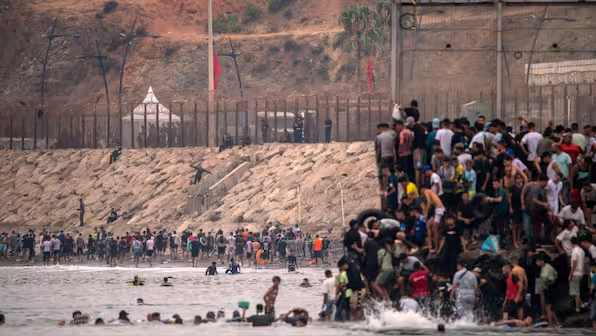
Spain is facing an unprecedented Migration Crisis after up to 60,000 migrants attempted to enter the Spanish enclave of Ceuta from neighboring Morocco within a single day. The extraordinary influx overwhelmed local authorities, stretched emergency services beyond capacity, and resulted in the deaths of at least 41 people during dangerous attempts to reach European territory.
The incident has rapidly evolved from a local border emergency into a major European issue. Spain has deployed military personnel, strengthened Border Security, and coordinated with Moroccan authorities, while several European governments have announced additional border checks or called for stricter migration policies.
Beyond the immediate humanitarian tragedy, the crisis highlights the growing challenges Europe faces in balancing border security, international humanitarian obligations, and the fight against organized human smuggling networks.
What Happened at the Ceuta Border?
Beginning on Thursday, thousands of migrants crossed from Morocco into Ceuta by both land and sea. Many swam around coastal barriers using inflatable tubes or makeshift flotation devices, while others crossed through border gates or gaps along the frontier.
Spanish authorities initially estimated around 50,000 arrivals, while local officials in Ceuta suggested the figure could have reached nearly 60,000 people an extraordinary number considering the city itself has a population of roughly 85,000 residents.
Within hours, emergency shelters reached capacity, forcing thousands of migrants to remain in parks, open spaces, and public streets while authorities attempted to restore order.
Where Is Ceuta and Why Is It Strategically Important?
Ceuta is one of Spain’s two autonomous cities located on the northern coast of Africa, alongside Melilla. Although geographically surrounded by Morocco, both cities are sovereign Spanish territories and therefore form part of the European Union.
This unique geographical position makes Ceuta one of the EU’s only permanent land borders with Africa and a key entry point for migrants hoping to reach Europe.
| Feature | Ceuta |
|---|---|
| Political Status | Autonomous city of Spain |
| Continent | Africa |
| Border | Shares a land border with Morocco |
| EU Status | Part of the European Union through Spain |
| Strategic Importance | One of Europe’s only land borders with Africa |
Why Are So Many Migrants Crossing Into Ceuta?
The reasons behind the surge are complex and involve several interconnected factors rather than a single cause.
Economic Hardship
Many migrants cited unemployment, poverty, and limited opportunities in their home countries as major reasons for attempting the dangerous journey to Europe.
Human Smuggling Networks
Spanish authorities have accused organized trafficking groups of spreading misleading information suggesting migrants would be allowed to remain in Spain if they reached Ceuta by sea.
Legal Developments
Officials linked the sudden increase in crossings to a recent Spanish Supreme Court ruling concerning the treatment of migrants intercepted at sea. According to the government, criminal networks misrepresented the decision to encourage more people to attempt the crossing.
However, some Human Rights organizations and activists questioned whether legal developments alone could explain such a large movement, arguing that many migrants were unlikely to be aware of the court’s ruling.
Humanitarian Consequences of the Crisis
The migration surge quickly became a humanitarian emergency.
Reception centers designed for far smaller numbers became overwhelmed almost immediately, leaving thousands without adequate shelter, food, or medical support.
Among those arriving were:
- Young adults seeking employment.
- Families with children.
- Unaccompanied minors.
- Individuals escaping economic hardship.
The most tragic aspect of the crisis was the loss of life. Many migrants reportedly drowned while attempting to swim around coastal barriers, while others died during chaotic crowd movements near the border.
Spain’s Emergency Response
The Spanish government rapidly mobilized military personnel, police units, emergency responders, and humanitarian organizations to stabilize the situation.
Authorities focused on several immediate priorities:
- Rescuing migrants in distress.
- Providing emergency medical care.
- Restoring border security.
- Registering new arrivals.
- Coordinating voluntary returns with Morocco.
Spanish Prime Minister Pedro Sánchez described the mass crossing as a serious challenge to Spain’s territorial integrity and emphasized the need to dismantle criminal smuggling networks responsible for encouraging dangerous journeys.
How Morocco Responded
Moroccan security forces increased enforcement along the border, deploying additional personnel to prevent further crossings.
Reports from the frontier indicated the use of crowd-control measures as authorities attempted to disperse large groups gathering near border areas.
Morocco also cooperated with Spain in facilitating the voluntary return of thousands of migrants who decided to leave Ceuta after finding limited accommodation and resources.
Why Europe Is Closely Watching the Crisis
The Ceuta emergency has implications far beyond Spain.
Because Spain belongs to the Schengen Area, migrants who legally enter Spanish territory may eventually Travel to many other European countries without routine internal border checks.
This reality has prompted neighboring governments to reassess border management and migration policies.
| Country/Institution | Reported Response |
|---|---|
| Spain | Military deployment and humanitarian response |
| France | Strengthened border monitoring |
| Italy | Called for tougher migration measures |
| European Commission | Emphasized stronger external border protection |
What Is the Schengen Area?
The Schengen Area allows passport-free travel across much of Europe, making internal movement easier for residents, tourists, and businesses.
However, this system also means that migration pressures affecting one member state can quickly become a concern for others.
As a result, major migration incidents often trigger discussions about external border protection, asylum procedures, and cooperation among EU member states.
Pressure on Ceuta and Melilla
Ceuta is not the only Spanish territory affected by migration pressures.
Melilla, Spain’s second autonomous city on the African continent, has also experienced repeated attempts by migrants to cross into European territory.
Together, Ceuta and Melilla represent unique geopolitical locations where European migration policy meets African migration routes.
Migration Between Africa and Europe: A Long-Term Challenge
The Ceuta crisis reflects broader migration trends that have shaped Europe for decades.
People migrate for many reasons, including:
- Economic opportunity.
- Political instability.
- Conflict.
- Climate-related challenges.
- Family reunification.
- Educational opportunities.
Managing these movements requires cooperation between origin, transit, and destination countries while respecting international humanitarian and refugee obligations.
Expert Insight: Why Smuggling Networks Thrive During Policy Uncertainty
Migration experts note that organized smuggling networks frequently exploit confusion surrounding Immigration policies, court decisions, or rumors of changing border rules.
False or exaggerated information can spread rapidly through Social Media and informal communication channels, encouraging people to undertake dangerous journeys based on unrealistic expectations.
This makes accurate public communication and international cooperation essential components of effective migration management.
What Happens Next?
Spanish authorities are expected to continue processing asylum claims, coordinating returns where permitted under law, and strengthening border security in cooperation with Morocco.
The European Union is also likely to continue discussions on migration policy, external border protection, anti-smuggling operations, and humanitarian assistance for vulnerable migrants.
The long-term challenge will be balancing effective border management with international commitments to protect those genuinely in need of asylum.
Conclusion
The mass migration into Ceuta represents one of the most significant border emergencies Spain has faced in recent years. While immediate efforts remain focused on humanitarian relief and restoring order, the crisis has also exposed broader questions about migration governance, organized trafficking networks, and the future of European border policy.
As investigations continue and authorities assess the factors that triggered the unprecedented crossings, the events in Ceuta are likely to influence migration discussions across Europe for years to come. The crisis serves as a reminder that sustainable migration management requires not only secure borders but also international cooperation, accurate information, and long-term solutions addressing the root causes that drive people to undertake dangerous journeys.
For breaking news and live news updates, like us on Facebook or follow us on Twitter and Instagram. Read more on Latest World on thefoxdaily.com.






COMMENTS 0