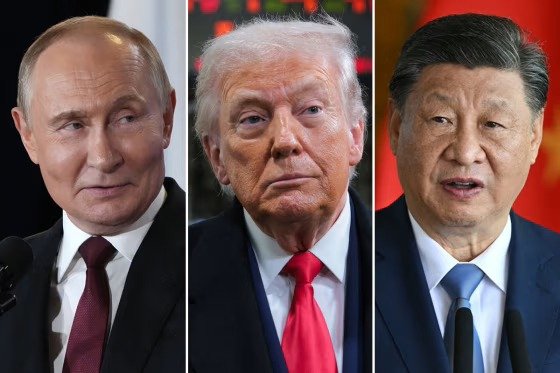
Three presidents. Three of the world’s most powerful leaders. And the heads of the three countries with the largest nuclear arsenals. A proposed meeting between US President Donald Trump, Russian President Vladimir Putin and Chinese President Xi Jinping in Shenzhen, China, is attracting international attention before the discussions have even begun.
The planned gathering, expected to take place on the sidelines of the Asia-Pacific Economic Cooperation (APEC) summit on November 18–19, 2026, has revived comparisons with the historic Yalta Conference of 1945.
That meeting brought together the leaders of the United States, Britain and the Soviet Union to discuss the future of Europe after World War II. It became closely associated with the division of influence between major powers and the emergence of Soviet dominance across much of Eastern Europe.
Ukrainian President Volodymyr Zelenskyy has warned against allowing the Shenzhen meeting to become a modern version of Yalta, where powerful countries discuss the future of smaller nations without their participation.
The concern is particularly significant for Ukraine, which remains at war with Russia. Kyiv fears that discussions between Trump, Putin and Xi could create pressure for decisions about its territory, security or political future without the Ukrainian government being directly involved.
Why the Shenzhen summit is being compared with Yalta
The original Yalta Conference took place in February 1945, when the defeat of Nazi Germany was approaching. US President Franklin D. Roosevelt, British Prime Minister Winston Churchill and Soviet leader Joseph Stalin met in Crimea to discuss the postwar settlement.
The discussions covered the occupation and administration of Germany, the political future of Europe, the establishment of the United Nations and arrangements for the postwar international order.
Although the leaders discussed cooperation and a framework for peace, the decisions and political realities that followed helped establish Soviet influence across Eastern Europe. The division of Europe became one of the defining features of the Cold War.
For critics of the proposed Shenzhen meeting, the historical comparison is not simply about three powerful leaders sitting around the same table. It is about the possibility that countries with enormous military and economic influence could negotiate arrangements affecting other nations without giving those countries meaningful control over the outcome.
Zelenskyy has expressed concern about precisely this possibility. He previously warned that the meeting should not become another version of Yalta, describing the danger as a redistribution of influence between major powers.
His concern reflects Ukraine’s position that its future cannot legitimately be negotiated without its participation. Any agreement involving Ukrainian territory, sovereignty or security would directly affect the country and its population.
Why Ukraine is particularly concerned about the meeting
Ukraine has been fighting Russia’s full-scale invasion since February 2022. The conflict has become a major international security issue, involving military assistance, economic sanctions, diplomatic negotiations and wider questions about Europe’s security architecture.
Putin has an obvious interest in any diplomatic process that could influence the terms of a settlement. Moscow has sought changes to the European security framework and has repeatedly presented its demands as central to resolving the conflict.
For Russia, a direct meeting with the US and Chinese presidents could provide an opportunity to discuss the war at the highest diplomatic level. It could also strengthen Moscow’s international standing by placing Putin alongside the leaders of the world’s two other major powers.
Ukraine, however, does not want decisions about its territory or security to be made through negotiations in which it is absent.
The concern is not limited to Kyiv. European governments also have a direct interest in the outcome of the war because any settlement could affect NATO’s security environment, relations with Russia and the long-term stability of the continent.
A framework negotiated by Washington, Moscow and Beijing without European involvement could create disagreements over how any proposed arrangement would be implemented or guaranteed.
There is also a practical question: even if the three leaders reached an understanding, Ukraine and its European partners would still have to consider whether they accepted the terms and were willing to support their implementation.
What does Trump want from the three-way meeting?
Trump appears interested in using the gathering to pursue major diplomatic objectives, particularly nuclear arms control. He has expressed support for a broader agreement involving the United States, Russia and China.
The issue has become more pressing following the expiration of the New Strategic Arms Reduction Treaty, commonly known as New START, in February 2026. The agreement had placed limits on the deployed strategic nuclear weapons of the United States and Russia.
Its expiration removed the treaty’s legally binding restrictions and verification framework, leaving the two countries without the same formal limits on their strategic nuclear arsenals.
Trump has argued that any future arms-control arrangement should include China. This would represent a significant change from previous US-Russia nuclear negotiations, which focused primarily on the two countries possessing the largest nuclear stockpiles.
However, Washington’s interest in bringing Beijing into nuclear discussions does not mean China is ready to accept the same obligations as the United States and Russia.
Trump may also see the meeting as an opportunity to demonstrate his ability to engage directly with the leaders of two major strategic competitors and present himself as a central figure in international diplomacy.
Whether the gathering produces concrete agreements or remains largely symbolic will depend on the willingness of the three governments to move beyond their competing priorities.
Why China may be reluctant about nuclear negotiations
For Xi Jinping, hosting Trump and Putin offers an opportunity to demonstrate China’s diplomatic influence. Shenzhen is an important technology and manufacturing centre, and the APEC gathering provides Beijing with an international platform to showcase its economic development and global role.
However, a trilateral meeting also carries risks for China.
China’s nuclear arsenal remains significantly smaller than those of the United States and Russia. Estimates from international security researchers put the Chinese stockpile at several hundred warheads, compared with more than 5,000 in each of the American and Russian arsenals when different categories of warheads are included.
Beijing has been expanding its nuclear capabilities, but it has not accepted that it should enter arms-control negotiations under the same conditions as Washington and Moscow.
Chinese officials and analysts have argued that the nuclear balance is fundamentally different because the US and Russia possess much larger arsenals. From Beijing’s perspective, accepting identical limits could restrict its ability to develop a deterrent while leaving the existing imbalance largely unchanged.
China is also concerned about the wider political implications of participating in negotiations that could be interpreted as recognising a US-Russia framework for managing global security.
That creates a difficult position for Xi. Hosting the summit could strengthen China’s diplomatic profile, but participating in substantive nuclear negotiations may expose disagreements that Beijing would prefer to handle separately.
Putin could gain diplomatic recognition from the summit
For Putin, the proposed meeting offers a different set of potential advantages.
Russia has faced extensive Western sanctions and diplomatic pressure since launching its full-scale invasion of Ukraine. A direct meeting with Trump and Xi would provide an opportunity to demonstrate that Moscow remains an important participant in international decision-making.
The format itself carries symbolic significance. A three-way gathering involving the presidents of the United States, China and Russia would place Putin alongside the leaders of the world’s two other major powers at a time when his government is seeking influence over the future of European security.
Moscow may also hope to use the meeting to advance its position on Ukraine. A discussion involving Trump could offer Putin an opportunity to seek support for a settlement based on Russian demands.
However, there is no guarantee that Trump or Xi will accept Moscow’s preferred terms. The three leaders have different strategic interests, and the absence of an agreed agenda makes it difficult to predict what the meeting could achieve.
Even a high-profile diplomatic encounter would not automatically produce a peace agreement or resolve the disagreements that have sustained the conflict.
Ukraine and Europe fear decisions made without them
The concerns surrounding the Shenzhen meeting extend beyond Ukraine. European governments are wary of any diplomatic arrangement that could reshape the continent’s security environment without their involvement.
Poland and other countries in Central and Eastern Europe have particular historical reasons to be sensitive to comparisons with Yalta. The 1945 settlement is widely associated with the period in which Soviet influence restricted the political independence of several countries in the region.
For these governments, a new arrangement between Washington and Moscow that overlooks European security interests could create serious concerns about the future of NATO and the wider European order.
Ukraine’s position is even more direct. Any agreement involving its territory, military capabilities or future security guarantees would have immediate consequences for the country.
European leaders also have an interest in ensuring that any peace arrangement is enforceable and does not leave Ukraine exposed to another conflict. Security guarantees, sanctions policy, reconstruction assistance and the future relationship between Russia and Europe could all become relevant to a settlement.
This is why the participation of affected countries matters. A diplomatic understanding between major powers may influence international politics, but it cannot automatically settle the political and legal questions facing nations that are not part of the negotiations.
Why a new Yalta may be difficult to achieve
Despite the historical comparisons, the political circumstances of 2026 are very different from those of 1945.
The original Yalta Conference took place as World War II was ending, with the Allied powers negotiating the occupation of defeated Germany and the structure of the postwar settlement. The proposed Shenzhen gathering involves three countries with competing interests and no shared agreement on the central issues they want to discuss.
The leaders also face different domestic and international pressures.
Trump is interested in nuclear arms control and maintaining his diplomatic relationship with both Moscow and Beijing. Putin wants to advance Russia’s position on Ukraine and strengthen his country’s international standing. Xi must balance China’s relationship with Russia against its economic and diplomatic interests in Europe and elsewhere.
These differences make a comprehensive agreement difficult.
China has shown caution about turning the meeting into a forum for discussing Ukraine, while US officials have indicated that the three-way format may not be appropriate for negotiating an end to the war. Russia, meanwhile, has an interest in ensuring that Ukraine remains part of the wider security discussion.
Even the precise agenda and format of the proposed gathering have remained under negotiation. That uncertainty limits expectations of an immediate diplomatic breakthrough.
Could the summit change the global balance of power?
The most immediate significance of the proposed meeting may be its symbolism rather than any agreement reached behind closed doors.
A gathering of the three nuclear powers would attract global attention and reinforce the importance of their relationships in international security. It could also provide a platform for discussions about nuclear weapons, artificial intelligence, trade and regional conflicts.
However, the idea that the three presidents could simply divide the world into separate spheres of influence overlooks the interests and independence of other countries.
Ukraine has demonstrated that it can resist decisions made by larger powers when those decisions conflict with its national interests. European governments also have their own political, economic and military capabilities, while countries across Asia and other regions are unlikely to accept every arrangement negotiated by Washington, Moscow and Beijing.
Any serious agreement on Ukraine would require consideration of Kyiv’s position. Similarly, discussions about European security would have to account for the governments and institutions responsible for that security.
The Shenzhen summit could therefore become an important diplomatic moment without producing a new global settlement.
What to watch as Trump, Putin and Xi prepare to meet
Several issues will determine whether the proposed gathering becomes more than a high-profile diplomatic event.
- Ukraine’s future: Whether the leaders discuss the war and whether Kyiv’s position is represented in any diplomatic process.
- Nuclear arms control: Whether Trump can persuade Xi to engage in discussions alongside the United States and Russia.
- China’s position: Whether Beijing supports a substantive trilateral agenda or prefers to limit the meeting to broader diplomatic exchanges.
- European security: Whether European governments are consulted on any proposals affecting the continent’s security arrangements.
- Russia’s international standing: Whether the gathering provides Putin with diplomatic recognition without delivering concrete concessions.
The meeting is being watched closely because it brings together leaders whose decisions can affect global security, economic relationships and the future of international diplomacy.
But the comparison with Yalta also highlights the central concern: powerful countries should not determine the future of other nations without their participation.
For Zelenskyy and Ukraine, the test will be whether the Shenzhen discussions respect national sovereignty and include the people directly affected by any potential agreement. For the rest of the world, the summit will offer an indication of how Trump, Putin and Xi intend to manage their competing interests in an increasingly uncertain international environment.
For breaking news and live news updates, like us on Facebook or follow us on Twitter and Instagram. Read more on Latest World on thefoxdaily.com.






COMMENTS 0