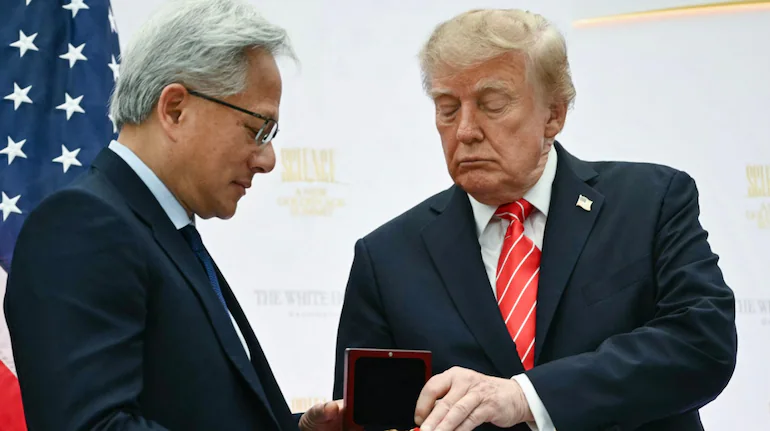
US President Donald Trump bought between $1 million and $5 million worth of Nvidia stock shortly before his administration reversed a major Biden-era artificial intelligence export policy, according to an analysis of his financial disclosures by anti-corruption group DeKleptocracy.
The reported purchase took place in May 2025, just days before the Department of Commerce announced that it would rescind the Biden administration’s Artificial Intelligence Diffusion Framework. The policy change removed a proposed system of restrictions that would have limited access to advanced American AI chips in several countries, including China.
The timing has attracted scrutiny because Nvidia is one of the world’s leading suppliers of advanced AI processors and has a significant commercial interest in selling its Technology to Chinese customers. The administration’s subsequent decisions to permit certain chip exports to China have added to questions about Trump’s personal investments.
However, the financial disclosures establish the reported transactions and their timing, not that Trump influenced government policy to benefit his investments. The White House has previously said independent financial institutions manage his portfolio and make investment decisions without his involvement.
Trump bought Nvidia shares days before the May 2025 policy reversal
According to the DeKleptocracy analysis, Trump’s financial disclosures show that he purchased Nvidia shares valued between $1 million and $5 million on May 6, 2025.
One week later, on May 13, the Department of Commerce announced that it would rescind the Biden administration’s AI Diffusion Rule. The framework had been introduced in January 2025, with its compliance requirements scheduled to take effect on May 15.
The timing has become a central part of the questions surrounding the president’s investments. Nvidia stood to benefit commercially from a less restrictive international framework for advanced AI technology, although the May decision did not itself grant unrestricted permission to export Nvidia’s most advanced processors to China.
Trump also disclosed investments in other major technology companies, including Apple, Meta and Microsoft. His broader trading activity has prompted scrutiny because government decisions can affect the commercial prospects and market valuations of publicly traded companies.
Nvidia shares gained value following the administration’s policy announcement. The company has remained at the centre of the debate over how the United States should balance the commercial interests of American technology firms with national security concerns involving China.
What was Biden’s AI Diffusion Framework?
The AI Diffusion Framework was introduced by the Biden administration in January 2025 as part of its effort to regulate the global distribution of advanced American AI computing technology.
The framework divided countries into different categories and established varying levels of access to advanced chips. Countries considered close US partners would receive more favourable treatment, while others faced tighter restrictions and additional requirements.
China was among the countries subject to the strictest limitations. US officials had argued that advanced AI processors could strengthen China’s ability to develop sophisticated artificial intelligence systems, including technologies with potential military and surveillance applications.
The framework was intended to preserve America’s technological advantage while limiting the possibility that sensitive computing capabilities could reach countries considered national security concerns.
However, the policy also attracted criticism from parts of the technology industry. Companies argued that broad restrictions could complicate international business, create uncertainty for customers and weaken the global position of American technology suppliers.
On May 13, 2025, the Department of Commerce announced that it would rescind the framework and pursue a different approach to semiconductor export controls. The department said the original rule would have created burdensome requirements for American companies and affected diplomatic relationships with countries placed in different categories.
The administration said it would introduce replacement measures rather than abandon semiconductor export controls altogether.
Trump later allowed Nvidia H200 chip sales to China
The controversy surrounding Trump’s Nvidia investments also involves a separate policy decision announced in December 2025.
On December 8, Trump announced that the United States would allow Nvidia to ship its H200 artificial intelligence processors to approved customers in China under specified conditions.
The H200 is a powerful AI accelerator designed for demanding computing tasks, including training and running large artificial intelligence models. Its potential availability in China represented a significant development for Nvidia’s efforts to serve customers in the market.
The US Department of Commerce subsequently changed its export licensing policy in January 2026. Under the revised rules, applications to export Nvidia H200 processors and certain comparable chips to China and Macau could be reviewed individually rather than being subject to a blanket presumption of denial.
The revised approach included conditions intended to protect US interests. Exporters must demonstrate that shipments would not reduce semiconductor production capacity available to American customers. Chinese recipients must also meet security and compliance requirements, and the chips must undergo independent testing in the United States.
Consequently, the policy did not create unrestricted access to the Chinese market. Individual export applications remained subject to government review and approval.
Trump made additional Nvidia purchases after the H200 announcement
Trump’s financial disclosures also indicate that he continued buying Nvidia shares after announcing the December 2025 decision on H200 exports.
According to the reported transactions, he made at least three Nvidia stock purchases in the days following the announcement. Each transaction was valued between $250,001 and $500,000.
The purchases were among his larger reported investments in the chipmaker. His disclosures also show dozens of transactions involving Nvidia shares since he returned to the White House.
The additional purchases have intensified scrutiny of the relationship between Trump’s personal investment portfolio and decisions affecting the technology sector.
Financial disclosure forms generally report transactions within value ranges rather than providing the exact amount paid for each purchase. They also do not, by themselves, establish who selected individual investments or whether a government decision was connected to a particular transaction.
The distinction is important when assessing potential conflicts of interest. The timing may raise questions about transparency and oversight, but it does not prove that the president used government authority to increase the value of his holdings.
White House says independent managers control Trump’s investments
The White House has previously defended Trump’s stock investments by saying that independent third-party financial institutions manage his portfolio.
A spokesperson said investment decisions are made by independent managers without Trump’s involvement. The administration has also rejected suggestions that the president’s investments create conflicts of interest.
The explanation is central to the debate over Trump’s financial disclosures. If investment decisions are made independently, the White House argues, the president is not personally selecting companies based on information about upcoming government policies.
However, critics have questioned whether the arrangement provides sufficient separation between presidential responsibilities and private financial interests. Unlike a traditional blind trust, the reported investment arrangement has not prevented public scrutiny of individual transactions and their timing.
The disclosures are particularly sensitive when they involve companies whose businesses could be directly affected by decisions made by the administration.
DeKleptocracy raises concerns over Trump’s financial interests
DeKleptocracy, the anti-corruption group that examined Trump’s financial disclosures, has questioned whether the president’s personal financial interests could overlap with government decisions benefiting Nvidia and the wider artificial intelligence industry.
The group argued that the relationship between private investments and public policy deserved closer scrutiny, particularly as Washington debates the national security implications of exporting advanced AI technology to China.
Its analysis also drew attention to the broader controversy surrounding Nvidia and concerns about whether restricted American chips could reach Chinese entities through intermediary companies.
DeKleptocracy wrote that the country should examine whether Trump’s financial interests influenced decisions involving the AI industry and technology exports to China.
These statements represent the group’s criticism and allegations, rather than established findings of wrongdoing. No evidence presented in the financial disclosures alone demonstrates that Trump’s stock purchases determined the administration’s export policy.
Nvidia faces separate scrutiny over China-related chip concerns
The debate over Trump’s investments comes as Nvidia faces separate scrutiny over its business relationships and the possible diversion of advanced chips to China.
Recent reports have focused on Megaspeed, a company whose business dealings with Nvidia have attracted attention from US authorities. Questions have also emerged about the reported relationship between Nvidia’s former chief executive Jensen Huang and Alice Huang, a businesswoman associated with Megaspeed who has been described in media reports as a suspected Chinese intelligence asset.
US intelligence-related allegations concerning Alice Huang remain contested. The US Justice Department has not announced a definitive conclusion establishing that she worked for the Chinese government, and Beijing has rejected the espionage claims.
Nvidia has also faced questions about whether advanced processors could have been diverted to restricted Chinese customers. The company has previously said that allegations involving chip diversion through a regional cloud customer were investigated and debunked.
The controversy has increased attention on the relationship between Nvidia’s commercial ambitions in China and US national security policy. American officials have to weigh the economic benefits of allowing exports against concerns that advanced computing technology could strengthen a strategic competitor.
Trump’s stock purchases are a separate issue from the allegations involving Nvidia’s business relationships. Nevertheless, the overlap between the company’s commercial interests, government export decisions and the president’s disclosed investments has added another dimension to the scrutiny.
Why Trump’s Nvidia stock purchases matter
The controversy highlights a wider question about financial transparency and the potential overlap between presidential decision-making and private investments.
Technology export controls are not ordinary commercial regulations. Decisions about which chips can be sold overseas can influence billions of dollars in revenue, affect global supply chains and shape competition between the United States and China.
Nvidia’s position in the AI industry makes these decisions particularly consequential. Access to advanced processors is essential for companies and governments seeking to build large-scale AI infrastructure, while restrictions can limit the ability of overseas competitors to obtain powerful computing equipment.
When a president holds investments in a company affected by those decisions, the timing of stock purchases and policy announcements can raise legitimate questions about transparency, even when there is no proof of improper conduct.
The available disclosures do not establish that Trump personally directed the May 2025 reversal or the later H200 export decision to benefit Nvidia or his own portfolio. The White House maintains that independent managers control the investments.
Further scrutiny is likely to focus on how the investment arrangements operate, whether the president receives information about individual transactions and what safeguards exist to prevent personal financial interests from influencing official decisions.
For now, the reported purchases and the timing of the policy changes have placed Trump’s Nvidia investments under renewed examination. The central question remains whether the administration’s financial safeguards provide enough transparency to maintain public confidence when presidential decisions have direct consequences for companies in which the president holds shares.
For breaking news and live news updates, like us on Facebook or follow us on Twitter and Instagram. Read more on Latest World on thefoxdaily.com.





COMMENTS 0