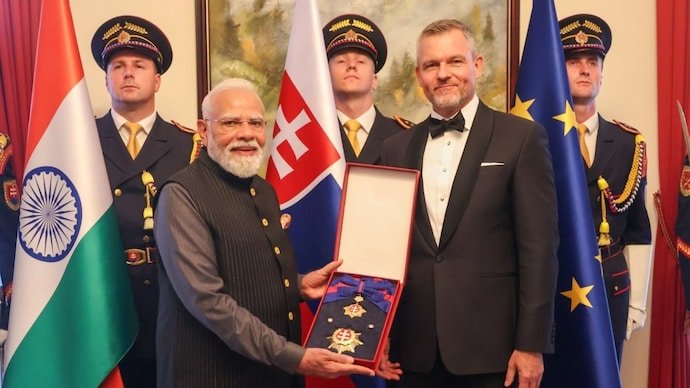
Prime Minister Narendra Modi was conferred Slovakia’s highest civilian honour, the Order of the White Double Cross (First Class), during a landmark visit to Bratislava. The award represents the 33rd international honour bestowed upon Modi by a foreign nation and coincides with the first visit by an Indian Prime Minister to Slovakia since the country’s independence.
The recognition comes at a time when India is actively strengthening partnerships across Europe, diversifying economic Relationships, and positioning itself as a major global power capable of engaging with nations across geopolitical divides.
Beyond the symbolism of the award itself, the visit highlights a broader story: the rapid transformation of India’s diplomatic footprint and the growing importance of Central Europe in New Delhi’s Foreign Policy strategy.
Why the Slovakia Honour Is Significant
The Order of the White Double Cross is Slovakia’s highest state honour awarded to foreign dignitaries who have made exceptional contributions to bilateral relations and international cooperation.
By awarding the distinction to Prime Minister Modi, Slovakia is signaling its desire to deepen political, economic, technological, and cultural ties with India.
While international awards often generate headlines, they also serve an important diplomatic function. Such recognitions communicate strategic priorities, reinforce partnerships, and create momentum for future cooperation.
In this case, the honour reflects years of growing engagement between India and Slovakia and highlights both countries’ interest in expanding cooperation in emerging sectors.
Accepting the award, Modi dedicated it to the people of India and described it as a recognition of the friendship between the two nations, emphasizing that diplomatic achievements are increasingly being viewed through the lens of broader national partnerships rather than individual recognition.
The First Indian Prime Minister to Visit Slovakia Since Independence
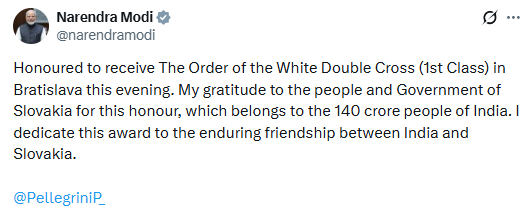
One of the most historic aspects of the visit was that Modi became the first Indian Prime Minister to travel to Slovakia since the nation became independent in 1993.
This milestone is particularly noteworthy because diplomatic relationships often gain new momentum when top-level political engagement occurs.
High-level visits create opportunities to resolve longstanding issues, launch new initiatives, and establish direct channels of communication between governments.
The visit demonstrates that India is increasingly focusing not only on major European powers such as France, Germany, and Italy but also on emerging partners across Central and Eastern Europe.
As global supply chains shift and geopolitical priorities evolve, countries such as Slovakia are becoming strategically important due to their manufacturing capabilities, technological expertise, and position within the European Union.
India-Slovakia Relations: A Partnership Entering a New Phase
Although India and Slovakia have maintained friendly relations for decades, recent years have seen a notable acceleration in bilateral engagement.
The relationship is evolving beyond traditional diplomatic exchanges and increasingly includes collaboration in:
- Trade and investment
- Digital transformation
- Defence cooperation
- Advanced manufacturing
- Innovation and technology
- Labour mobility
- Education and research
- Energy transition initiatives
Both countries recognize the potential benefits of closer cooperation as global economic patterns continue to shift.
India offers one of the world’s largest consumer markets and a rapidly expanding technology ecosystem, while Slovakia contributes industrial expertise, advanced manufacturing capabilities, and access to European markets.
Key Agreements Signed During the Visit
A major outcome of the visit was the signing of Memorandums of Understanding covering labour migration and digital technology.
These agreements may appear routine on the surface, but they address two areas of growing importance for both nations.
Labour Mobility Cooperation
Many European economies face workforce shortages across several sectors due to demographic changes and aging populations.
India, with its young workforce and expanding talent pool, is increasingly viewed as a valuable partner in addressing skilled labour requirements.
Structured labour mobility agreements can create benefits for both sides by providing opportunities for Indian professionals while helping European economies meet workforce demands.
Digital Technology Collaboration
Digital transformation has become a major pillar of India’s international engagement strategy.
India’s experience in building large-scale digital public infrastructure, digital payments systems, and technology platforms has attracted global attention.
Cooperation in digital technology could open opportunities in areas such as:
- Artificial intelligence
- Cybersecurity
- Digital governance
- Fintech innovation
- Smart manufacturing
- Digital public services
As economies increasingly rely on digital ecosystems, partnerships in these sectors are becoming strategically significant.
The Growing Importance of Central Europe in India’s Foreign Policy
One of the most overlooked aspects of India’s foreign policy evolution is its growing engagement with Central European nations.
Historically, Indian Diplomacy in Europe focused heavily on larger economies. However, changing global dynamics are encouraging a broader approach.
Countries such as Slovakia offer several advantages:
- Strong manufacturing ecosystems
- Membership in the European Union
- Strategic geographic location
- Growing innovation sectors
- Access to regional supply chains
For India, deeper ties with Central Europe support efforts to diversify trade relationships and strengthen economic resilience.
This strategy aligns with New Delhi’s broader objective of expanding partnerships beyond traditional geopolitical frameworks.
Why International Awards Matter in Diplomacy
Critics sometimes dismiss state honours as ceremonial gestures. In reality, such recognitions often carry considerable diplomatic significance.
International awards serve several purposes:
- Strengthening bilateral goodwill
- Recognizing contributions to international cooperation
- Encouraging future engagement
- Signaling strategic priorities
- Enhancing diplomatic visibility
For recipient nations, these honours can also reinforce perceptions of international influence and leadership.
The growing number of international recognitions received by Modi reflects India’s expanding diplomatic engagement across regions including Europe, the Middle East, Africa, Asia-Pacific, and Latin America.
The Strategic Context Behind India’s Rising Global Profile
The award arrives during a period when India’s international influence has expanded significantly.
Several factors have contributed to this trend:
- Rapid economic growth
- Strong technology sector development
- Increasing geopolitical importance
- Leadership in multilateral forums
- Supply chain diversification efforts
- Growing defence partnerships
- Climate and energy cooperation initiatives
India has increasingly positioned itself as a bridge between developed and developing economies, allowing it to engage with a wide range of international partners.
This balanced diplomatic approach has enhanced New Delhi’s ability to build relationships across diverse geopolitical blocs.
The Role of Cultural Diplomacy: Yoga and Soft Power
An important feature of the visit was the joint participation of Prime Minister Modi and Slovak President Peter Pellegrini in a special yoga session ahead of International Yoga Day.
While economic and strategic agreements often dominate headlines, cultural diplomacy remains a powerful tool in International Relations.
India has successfully leveraged cultural assets such as yoga, traditional knowledge systems, cuisine, literature, cinema, and heritage to strengthen international connections.
International Yoga Day, celebrated annually on June 21, has become one of India’s most successful global soft power initiatives.
The participation of world leaders in yoga-related events demonstrates how cultural diplomacy can complement traditional statecraft and create positive public engagement.
Trade and Investment Opportunities Between India and Slovakia
Economic cooperation is expected to become a major driver of future India-Slovakia relations.
Several sectors offer significant potential for collaboration:
| Sector | Opportunity for Cooperation |
|---|---|
| Automotive Manufacturing | Supply chain integration and technology exchange |
| Digital Technology | AI, cybersecurity, software development |
| Defence Industry | Joint production and technology partnerships |
| Renewable Energy | Green technology collaboration |
| Education | Research partnerships and academic exchanges |
| Healthcare | Pharmaceutical and medical technology cooperation |
As businesses seek new markets and diversified supply chains, opportunities for investment and commercial cooperation are likely to expand.
A Comparison with India’s Expanding European Outreach
The Slovakia visit fits into a broader pattern of enhanced engagement with European countries.
India has increasingly pursued strategic partnerships across the continent, focusing on trade, technology, Security, climate cooperation, and innovation.
Unlike earlier phases of diplomacy that concentrated primarily on major powers, India’s current approach emphasizes building a network of partnerships across Europe.
This diversified strategy reduces dependence on any single partner while creating multiple avenues for economic and diplomatic cooperation.
The Slovakia visit therefore represents not an isolated event but part of a larger transformation in India’s engagement with Europe.
The Bigger Insight: Why This Visit Matters Beyond the Award
The most important takeaway from the visit may not be the award itself.
The real significance lies in what the visit reveals about India’s evolving place in the world.
India is increasingly being viewed not merely as a large economy or regional power, but as a global stakeholder whose partnerships influence trade, technology, security, and development outcomes.
The growing interest from countries across different regions reflects recognition of India’s expanding economic weight, technological capabilities, and diplomatic relevance.
For smaller and medium-sized nations, partnerships with India offer opportunities to engage one of the world’s fastest-growing major economies while diversifying international relationships.
Future Outlook: A New Chapter in India-Slovakia Relations
Prime Minister Narendra Modi’s visit to Slovakia and the conferral of the Order of the White Double Cross represent a landmark moment in bilateral relations.
The award symbolizes mutual respect and growing trust between the two nations, but its importance extends beyond ceremonial recognition.
The agreements signed during the visit, combined with expanding cooperation in technology, trade, labour mobility, defence, and cultural exchange, suggest that India-Slovakia relations are entering a more ambitious phase.
Looking ahead, both countries are likely to deepen collaboration across strategic sectors while exploring new opportunities created by technological innovation and shifting global economic dynamics.
As India continues to strengthen its global partnerships, the Bratislava visit may be remembered not only for marking the Prime Minister’s 33rd international award but also for opening a new chapter in India’s engagement with Central Europe. In an increasingly interconnected world, such partnerships are becoming essential building blocks of modern diplomacy, economic growth, and long-term strategic cooperation.
For breaking news and live news updates, like us on Facebook or follow us on Twitter and Instagram. Read more on Latest World on thefoxdaily.com.






COMMENTS 0