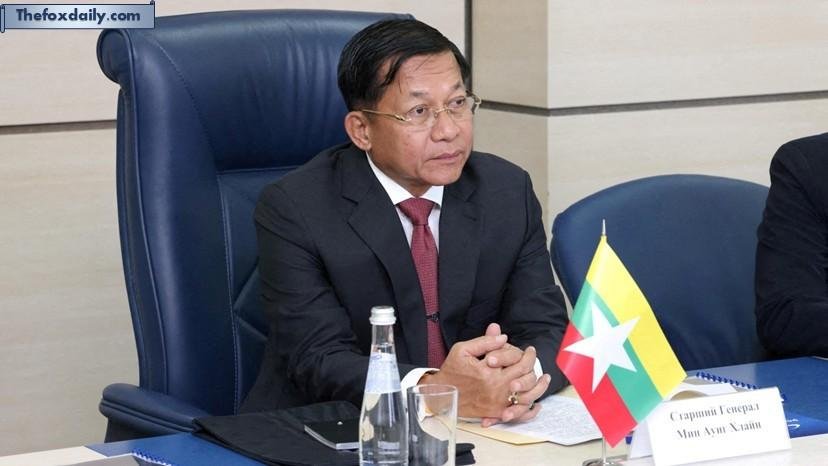
Myanmar President Min Aung Hlaing has begun a two-day official visit to Thailand aimed at strengthening bilateral ties through high-level meetings, business engagement and new agreements. While the visit reflects Myanmar’s efforts to rebuild regional relationships after years of diplomatic isolation, it has also intensified criticism from Human Rights organisations, which argue that official engagement risks legitimising a military-led government that continues to face international condemnation over the country’s ongoing conflict and human rights situation.
Min Aung Hlaing Arrives in Thailand for Official Talks
Myanmar President Min Aung Hlaing arrived in Thailand on Thursday for an official two-day visit that includes meetings with senior Thai leaders and participation in economic and diplomatic events.
According to the supplied material, the visit features discussions with Thai Prime Minister Anutin Charnvirakul, the signing of several memorandums of understanding (MoUs), and attendance at the Thailand-Myanmar Business Forum.
Beyond strengthening bilateral cooperation, the visit represents one of Myanmar’s most significant diplomatic engagements within Southeast Asia since the country’s political upheaval in 2021.
Why the Visit Has Attracted International Attention
The Thailand visit comes as Min Aung Hlaing continues efforts to improve Myanmar’s regional diplomatic standing more than five years after the military removed the elected civilian government led by Aung San Suu Kyi.
Following the military takeover in February 2021, Myanmar faced widespread international criticism, sanctions from several Western governments and reduced diplomatic engagement with many countries.
The latest visit is therefore being viewed from two different perspectives.
Supporters of regional dialogue argue that engagement is necessary to maintain communication and address practical issues affecting neighbouring countries. Human rights organisations, however, contend that such high-level meetings risk conferring political legitimacy on Myanmar’s current leadership.
Political Repositioning Since Becoming President
According to the supplied material, Min Aung Hlaing was sworn in as Myanmar’s president in April following elections conducted in phases during December and January.
Critics questioned the credibility of those elections, arguing that they were designed to consolidate military influence while presenting the appearance of a return to civilian Governance.
The supplied material attributes these criticisms to opponents of the military government and does not indicate that the election results have achieved broad international acceptance.
Since assuming the presidency, Min Aung Hlaing has expanded diplomatic outreach to neighbouring countries as part of efforts to rebuild regional relationships.
Myanmar’s Diplomatic Outreach Continues
The Thailand visit follows several regional engagements undertaken by Myanmar’s leadership this year.
According to the supplied material, Min Aung Hlaing has visited:
- China.
- India.
- Laos.
The report also notes that Myanmar has maintained close ties with Russia.
Despite these engagements, the country’s leadership remains largely isolated internationally, particularly among Western governments that imposed sanctions following the 2021 military takeover.
Human Rights Groups Criticise the Visit
Several rights organisations have sharply criticised Thailand’s decision to host the Myanmar leader.
According to the supplied material, Justice For Myanmar argued that the visit grants “false legitimacy” to Myanmar’s military leadership.
Fortify Rights also criticised the diplomatic engagement.
The report cites senior human rights specialist Chit Seng as saying that adopting the title of president following what he described as “fake elections” does not alter the Nature of Myanmar’s government.
Another Fortify Rights representative, Thanida Piyachot, rejected arguments supporting renewed engagement and argued that recognising the current leadership sends the wrong message to civilians affected by the conflict.
These views reflect the positions of the organisations quoted in the supplied material.
Conflict Inside Myanmar Continues
While diplomatic outreach has increased, fighting inside Myanmar has continued.
According to the supplied material, Myanmar’s military remains engaged in conflict with pro-democracy resistance groups and ethnic armed organisations seeking greater autonomy.
The ongoing violence has remained one of the principal reasons for continued international concern over the country’s political and humanitarian situation.
The conflict has also complicated regional efforts to encourage dialogue and stability.
Civilian Casualties and Arrests
The supplied material cites figures from the Assistance Association for Political Prisoners (AAPP), an independent organisation that documents arrests and casualties related to Myanmar’s conflict.
According to the organisation, as of Wednesday:
- More than 8,200 civilians had been killed.
- More than 31,645 people had been arrested by Myanmar’s security forces.
These figures are attributed to the AAPP and form part of the broader human rights concerns surrounding Myanmar.
Aung San Suu Kyi Remains at the Centre of International Concern
The status of former State Counsellor Aung San Suu Kyi continues to attract international attention.
According to the supplied material, Myanmar’s authorities recently allowed a representative of the International Committee of the Red Cross (ICRC) to visit the 81-year-old leader.
The visit marked the first known contact she has had with an independent international humanitarian organisation since her detention.
The ICRC confirmed that the meeting took place but did not disclose details regarding Suu Kyi’s Health or the discussions.
Background on Suu Kyi’s Detention
The supplied material states that Aung San Suu Kyi received prison sentences totalling 33 years in late 2022 on multiple charges.
Her supporters and several human rights organisations have argued that the cases were politically motivated.
According to the report:
- She was transferred from prison to house arrest on April 30.
- Her sentence was reduced to 18 years.
- More than 13 years of imprisonment remain under the current sentence.
The United Nations, several Western governments and international human rights organisations have repeatedly called for her release.
Thailand’s Position Within ASEAN
The visit also highlights differing views within the Association of Southeast Asian Nations (ASEAN) regarding engagement with Myanmar.
Following the 2021 military takeover, Myanmar’s leadership was barred from attending top-level ASEAN meetings after failing to implement a regional peace plan agreed in April that year.
According to the supplied material, Thailand has emerged as one of the strongest advocates within ASEAN for renewed engagement with Myanmar’s authorities.
Bangkok argues that continued dialogue is necessary to address practical regional challenges while promoting stability.
Thailand’s Case for Continued Engagement
During a visit to Indonesia earlier this week, Thai Prime Minister Anutin Charnvirakul said that peace and stability in Myanmar are important for ASEAN’s unity and the broader region.
According to the supplied material, he supported what he described as a “calibrated re-engagement approach” that keeps diplomatic communication open while responding to developments inside Myanmar.
He also suggested that the recent ICRC visit to Aung San Suu Kyi demonstrated progress in maintaining channels of engagement.
Human rights organisations cited in the supplied material disagree with that assessment.
Key Developments at a Glance
| Issue | Current Development | Why It Matters |
|---|---|---|
| Thailand visit | Min Aung Hlaing is on a two-day official visit | Expands Myanmar’s regional diplomatic outreach |
| Bilateral agenda | Talks, MoUs and business forum scheduled | Focuses on strengthening Thailand-Myanmar cooperation |
| Rights concerns | Human rights groups oppose high-level engagement | Argue the visit grants political legitimacy to Myanmar’s military leadership |
| Suu Kyi | ICRC representative recently visited her | First known humanitarian contact since detention |
| ASEAN policy | Thailand supports renewed engagement with Myanmar | Highlights differing regional approaches toward the crisis |
Why the Visit Matters Beyond Bilateral Relations
Although officially centred on economic cooperation and diplomatic discussions, the visit carries broader political significance.
For Myanmar’s leadership, meetings with neighbouring governments may help demonstrate that regional engagement continues despite ongoing international criticism.
For Thailand and ASEAN, the visit reflects the continuing challenge of balancing diplomatic engagement with concerns over democracy, humanitarian conditions and regional stability.
The differing responses illustrate the complex choices facing neighbouring countries that share borders, trade and security interests with Myanmar.
Confirmed Facts and Areas of Continuing Debate
The supplied material clearly establishes several developments.
- Min Aung Hlaing is visiting Thailand for official talks and business meetings.
- The visit includes planned bilateral agreements and participation in a business forum.
- Human rights organisations have criticised the visit.
- Myanmar’s military continues to face armed resistance and international scrutiny.
- The recent ICRC visit to Aung San Suu Kyi has drawn renewed attention to her detention.
Whether increased diplomatic engagement will improve prospects for peace or instead strengthen the political standing of Myanmar’s current leadership remains a matter of ongoing international debate rather than an established outcome.
What Could Happen Next?
The immediate results of the Thailand visit will likely become clearer after bilateral agreements are signed and discussions conclude.
Future developments may depend on whether regional engagement produces measurable progress on political dialogue, humanitarian access or efforts to reduce violence inside Myanmar.
At the same time, ASEAN members are likely to continue debating how best to engage with Myanmar while balancing diplomatic communication against concerns raised by international human rights organisations.
For now, the visit underscores two parallel realities: Myanmar’s leadership is actively seeking to rebuild regional relationships, while many international observers continue to question whether such engagement should proceed without meaningful progress on the country’s prolonged political and Humanitarian Crisis.
For breaking news and live news updates, like us on Facebook or follow us on Twitter and Instagram. Read more on Latest World on thefoxdaily.com.





COMMENTS 0