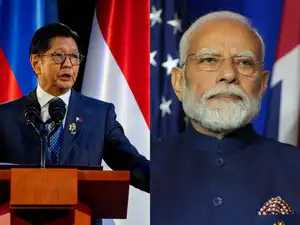
India and the Philippines discussed ways to strengthen cooperation in defence, security, trade and investment as Prime Minister Narendra Modi met Philippine President Ferdinand R. Marcos Jr. in Manila on Tuesday, November 17. The meeting took place on the sidelines of the ASEAN summit, where the two leaders reviewed the progress of their strategic partnership and explored opportunities to expand cooperation across several sectors.
The discussions reflected the growing importance of India-Philippines relations as New Delhi seeks to deepen its engagement with Southeast Asia. Defence and maritime security remain important areas of cooperation, while trade, investment, technology and infrastructure are also gaining attention.
According to the Ministry of External Affairs, the leaders acknowledged the momentum in bilateral cooperation, including in defence and security, space, railway infrastructure, fintech, trade and investment. They also exchanged views on regional and global developments of mutual interest. :chatgpt-content-reference{index=”0″}
Modi and Marcos Review Progress in Strategic Partnership
The meeting provided an opportunity for both leaders to assess progress since India and the Philippines elevated their relationship to a Strategic Partnership in August 2025, during Marcos Jr.’s state visit to India.
Both countries have been working to expand cooperation under this framework, with a focus on defence, maritime security, economic relations and people-to-people exchanges. The leaders had also met in New Delhi in September 2026 on the sidelines of the BRICS Summit, where they agreed to strengthen collaboration across several areas.
The latest discussions in Manila build on that engagement and come as the Philippines holds the ASEAN chairmanship for 2026. Modi also acknowledged the Philippines’ role as India’s country coordinator for ASEAN dialogue relations since 2024 and its continued support for stronger India-ASEAN ties. :chatgpt-content-reference{index=”1″}
Defence and Maritime Security Remain Key Areas of Cooperation
Defence Cooperation has emerged as a significant pillar of the India-Philippines relationship, particularly as both countries seek to strengthen maritime security and expand their engagement in the Indo-Pacific region.
One of the most important milestones was the Philippines’ purchase of India’s BrahMos supersonic cruise missile system under a $375-million agreement signed in 2022. The Philippines became the first foreign country to acquire the missile system, with the first batch delivered in April 2024.
The agreement marked an important development in India’s defence export ambitions and gave the bilateral relationship a stronger military dimension. The two countries have also expanded engagement between their armed forces through discussions and maritime cooperation.
Maritime security is particularly relevant to the Philippines because of its location in the South China Sea, where territorial and maritime disputes have remained a source of regional tension. India has supported freedom of navigation and respect for international law in the Indo-Pacific, while seeking to strengthen partnerships with countries across Southeast Asia.
Further cooperation could include defence training, information sharing, maritime exercises and exchanges between the armed forces. The extent of future collaboration will depend on discussions between the two governments and the implementation of existing agreements. :chatgpt-content-reference{index=”2″}
Trade and Investment Ties Gain Attention
Alongside defence, trade and investment featured prominently in the discussions between Modi and Marcos Jr. Both countries have opportunities to expand economic engagement through established industries as well as emerging sectors such as digital technology, pharmaceuticals, infrastructure and financial technology.
Bilateral trade between India and the Philippines has increased in recent years. Official trade figures cited in recent reporting show that merchandise trade grew from approximately $2.03 billion in 2020-21 to $3.34 billion in 2024-25.
Indian businesses have an established presence in areas such as pharmaceuticals and information technology services, while opportunities exist for greater cooperation in agriculture, transport, logistics and digital services. Stronger investment links could help companies in both countries access new markets and build commercial partnerships.
The proposed Preferential Trade Agreement is another area of potential importance. Progress on trade negotiations could help address market-access issues and create opportunities for businesses, although any agreement would depend on further discussions and decisions by both governments.
Investment cooperation is also relevant as the Philippines looks to attract capital into infrastructure development, digitalisation, transport and logistics. Indian companies could explore opportunities in these areas as economic engagement between the two countries expands. :chatgpt-content-reference{index=”3″}
Space, Railways and Fintech Among Wider Cooperation Areas
The discussions were not limited to defence and trade. Both leaders also recognised the potential to expand cooperation in space, railway infrastructure, fintech, education, tourism, science and technology, innovation and people-to-people relations.
Space cooperation could create opportunities for technical exchanges and collaboration in areas where both countries see value in sharing expertise. Railway infrastructure and transport connectivity could also become important as the Philippines continues to develop its infrastructure network.
Fintech is another promising area, given India’s experience with digital financial services and payment infrastructure. Greater exchanges between institutions and companies could support innovation and help businesses explore new financial technology solutions.
Education, tourism and cultural exchanges could strengthen the relationship beyond government-level engagement. More academic partnerships, professional exchanges and travel opportunities could help deepen public and business connections between the two countries.
Modi’s Manila Visit Highlights India’s Act East Policy
Modi’s meeting with Marcos Jr. took place during his November 16-17 visit to the Philippines, which included participation in the 23rd ASEAN-India Summit and the 21st East Asia Summit. The Philippines is hosting the meetings as ASEAN chair for 2026.
India’s relationship with ASEAN is a central part of its Act East Policy, which aims to strengthen economic, diplomatic and strategic engagement with Southeast Asian countries. The region is important to India because of its trade connections, maritime routes, investment opportunities and role in the wider Indo-Pacific.
The ASEAN-India relationship has developed over several decades. Dialogue relations began in 1992, were upgraded to a full dialogue partnership in 1995 and reached the summit level in 2002. The partnership was elevated to a strategic partnership in 2012.
India’s participation in the ASEAN and East Asia summits provides an opportunity to discuss regional connectivity, economic cooperation, maritime security and wider geopolitical developments with Southeast Asian countries and other participating nations. :chatgpt-content-reference{index=”4″}
ASEAN-India Cooperation Enters an Important Phase
The Philippines’ role as ASEAN chair gives Manila an important position in strengthening dialogue between India and the regional grouping. Its responsibility as India’s country coordinator for the 2024-2027 term also provides an institutional channel for advancing bilateral and regional cooperation.
India and ASEAN are marking 2026 as the ASEAN-India Year of Maritime Cooperation. The focus reflects the importance of secure sea routes, maritime connectivity and cooperation in the Indo-Pacific.
The year 2027 will also mark 35 years of India-ASEAN dialogue relations and five years since the Comprehensive Strategic Partnership was established. The milestones provide an opportunity for both sides to review progress and identify new areas of cooperation.
During the ASEAN-India Summit, Modi proposed initiatives to expand regional cooperation, including maritime connectivity, tourism, critical minerals and technical exchanges in civil nuclear energy. These areas reflect India’s interest in broadening its engagement with Southeast Asian economies beyond traditional trade and diplomatic relations.
Regional Security and Indo-Pacific Developments in Focus
India’s growing engagement with the Philippines also needs to be viewed in the context of wider developments in the Indo-Pacific. Maritime security, freedom of navigation and the protection of important commercial shipping routes remain significant concerns for countries in the region.
The South China Sea is particularly important because it carries substantial international maritime traffic and is the subject of overlapping territorial claims. The Philippines has sought cooperation with several regional and international partners on maritime security, while India has continued to support a rules-based maritime order.
For New Delhi, stronger relations with Manila complement its wider engagement with ASEAN members and other Indo-Pacific partners. Cooperation in defence, trade and technology can contribute to a broader network of regional partnerships.
At the same time, India-Philippines cooperation is not limited to security concerns. Economic development, infrastructure, investment and people-to-people connections remain important parts of the relationship.
What the Meeting Means for India-Philippines Relations
The Modi-Marcos meeting in Manila underlines the expanding scope of cooperation between the two countries. Defence and maritime security remain prominent, supported by developments such as the BrahMos agreement and increased engagement between their armed forces.
Trade and investment discussions indicate that both governments are also interested in strengthening economic links. Cooperation in pharmaceuticals, digital services, fintech, infrastructure and tourism could provide additional opportunities for businesses and institutions in both countries.
The meeting also reinforces the importance of the Philippines in India’s broader Southeast Asia strategy. As ASEAN chair in 2026, Manila has an important role in facilitating regional dialogue and supporting cooperation between India and the 11-member grouping.
The next phase of the relationship will depend on how effectively both governments translate their discussions into practical outcomes. Progress on defence cooperation, trade negotiations, investment projects and technology exchanges will be important indicators of the partnership’s development.
For India, stronger ties with the Philippines offer another channel to advance its Act East Policy and deepen its role in the Indo-Pacific. For the Philippines, closer engagement with India provides opportunities to diversify economic and strategic partnerships while expanding cooperation across a wider range of sectors.
For breaking news and live news updates, like us on Facebook or follow us on Twitter and Instagram. Read more on Latest Business on thefoxdaily.com.





COMMENTS 0