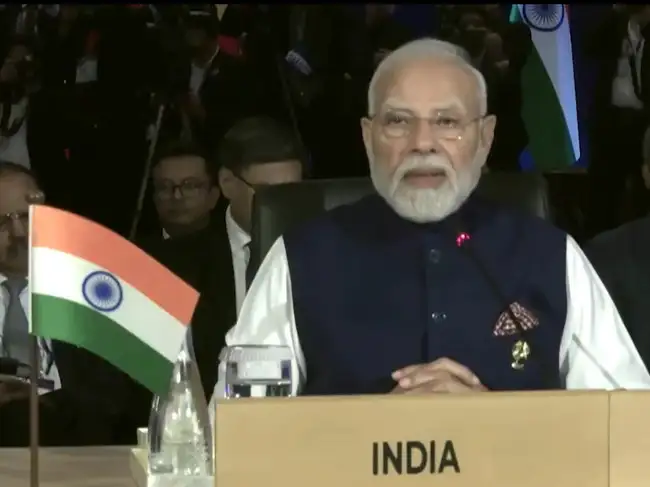
Prime Minister Narendra Modi has stressed that the world needs peace, stability and predictability, highlighting the importance of stronger regional cooperation amid an increasingly uncertain global environment. Speaking at the 23rd ASEAN-India Summit in Manila, Modi underlined India’s commitment to strengthening its relationship with the Association of Southeast Asian Nations (ASEAN) and expanding cooperation across areas that directly affect economic growth and regional connectivity.
His remarks placed the India-ASEAN partnership within a wider conversation about stability, development and the importance of reliable international relationships. At a time when geopolitical tensions, economic uncertainty and disruptions to global supply chains can affect countries across regions, closer cooperation between India and Southeast Asia has become increasingly significant.
Modi also highlighted practical initiatives intended to bring people and businesses closer, including skill-building opportunities, scholarships and direct air connectivity. These efforts reflect India’s approach of combining diplomatic engagement with cooperation that can create visible benefits for citizens.
Why Modi Emphasised Peace, Stability and Predictability
The Prime Minister’s message that the world needs peace, stability and predictability reflects the importance of a secure regional environment for economic development. Countries depend on stable international relations to maintain trade, attract investment, strengthen supply chains and expand cooperation in technology, education and infrastructure.
For India and ASEAN, these priorities have particular importance because both sides are closely connected through trade, investment, maritime routes and regional security interests.
Instability in the Indo-Pacific can affect shipping, energy supplies, commercial activity and the movement of goods. It can also create uncertainty for businesses planning long-term investments across national borders.
By stressing stability, Modi reinforced the idea that regional prosperity depends not only on economic agreements but also on predictable relationships and cooperation among neighbouring countries.
India Seeks a Stronger Partnership With ASEAN
The ASEAN-India relationship has developed into an important part of India’s engagement with Southeast Asia. ASEAN brings together eleven member countries: Brunei, Cambodia, Indonesia, Laos, Malaysia, Myanmar, the Philippines, Singapore, Thailand, Timor-Leste and Vietnam.
The grouping represents a diverse region with major economic, strategic and cultural importance. Its members occupy a central position in the Indo-Pacific, connecting important trade routes and markets.
For India, closer engagement with ASEAN supports its broader Act East policy, which seeks to strengthen political, economic and cultural relations with Southeast Asian countries.
The partnership covers several areas, including trade, investment, education, digital cooperation, connectivity, tourism and maritime engagement. Stronger cooperation can create opportunities for Indian businesses while giving Southeast Asian partners access to India’s expanding market and growing capabilities.
Modi’s remarks at the summit highlighted the importance of ensuring that this relationship continues to deliver practical outcomes rather than remaining limited to diplomatic discussions.
Scholarships and Skill Development to Strengthen People-to-People Ties
One of the important aspects of India’s engagement with ASEAN is cooperation in education and skill development. Scholarships and training opportunities can help students and young professionals gain access to new knowledge, technical capabilities and international experience.
Such initiatives also create lasting connections between societies. Students who study or train in another country often develop professional and cultural relationships that continue long after their programmes end.
For India and ASEAN, these links can support cooperation in areas such as information technology, healthcare, engineering, entrepreneurship and emerging technologies.
Skill development is particularly important as countries prepare their workforces for changes in the global economy. Digitalisation, automation and new technologies are creating demand for specialised skills, making international knowledge-sharing increasingly valuable.
By highlighting scholarships and skill-building initiatives, Modi presented people-to-people engagement as an important part of the broader strategic partnership.
Direct Flights Can Bring India and Southeast Asia Closer
Connectivity was another important element of the Prime Minister’s message. Direct flights between India and ASEAN countries can make travel easier for tourists, students, business professionals and families.
Better air links can also support commercial relationships by reducing travel time and making it easier for companies to build partnerships across borders.
For the tourism industry, improved connectivity can encourage more visitors to explore destinations in India and Southeast Asia. The region has strong potential for religious tourism, cultural travel, heritage experiences, business tourism and leisure holidays.
Direct flights also have a wider significance for people-to-people relations. Easier travel allows citizens to experience one another’s cultures, build personal connections and develop a better understanding of the region.
However, connectivity is not limited to aviation. Effective regional cooperation also depends on reliable maritime links, efficient logistics, modern infrastructure and smoother movement of goods and services.
India’s Development Vision and ASEAN’s Prosperity Are Connected
Modi linked India’s development ambitions with the prosperity of ASEAN, underlining the mutual benefits of closer economic cooperation.
India’s expanding economy offers opportunities for Southeast Asian countries in trade, manufacturing, technology and investment. At the same time, ASEAN provides Indian businesses with access to dynamic markets and important regional supply chains.
Cooperation can be particularly valuable in sectors where both sides have complementary strengths. These include digital services, pharmaceuticals, electronics, renewable energy, infrastructure, agriculture and advanced manufacturing.
A stronger partnership can also help businesses diversify their supply chains and reduce excessive dependence on a limited number of markets or production centres.
The broader idea is that India’s economic progress and ASEAN’s development need not be separate goals. Stronger trade, investment and connectivity can create benefits for both sides.
Why the ASEAN-India Partnership Matters in the Indo-Pacific
The ASEAN-India relationship also has strategic importance because of the region’s position in the Indo-Pacific. Southeast Asia connects the Indian Ocean with the Pacific and includes some of the world’s most important maritime routes.
These waterways are essential for international trade, energy transportation and the movement of goods. Maintaining secure and predictable maritime activity is therefore important for countries across the region.
India has consistently emphasised its support for ASEAN centrality in the regional architecture. This means recognising ASEAN’s role as an important platform for dialogue and cooperation among Indo-Pacific countries.
Closer engagement can help India and Southeast Asian nations work together on maritime security, disaster response, connectivity and other shared challenges.
Modi’s emphasis on peace and stability therefore carries significance beyond bilateral diplomacy. It reflects the broader interest of regional countries in maintaining an environment where economic cooperation and development can continue without unnecessary disruption.
What the Manila Summit Signals for India’s Regional Engagement
The 23rd ASEAN-India Summit provided an opportunity to review the partnership and discuss ways to strengthen cooperation. Modi’s message placed particular emphasis on practical initiatives that can connect people, support skills and expand economic opportunities.
The focus on scholarships, skill development and direct flights also shows why people-to-people engagement remains an important part of India’s regional diplomacy. Strong international partnerships are more sustainable when their benefits are visible to students, workers, businesses and ordinary citizens.
For ASEAN, closer engagement with India offers opportunities to deepen economic links with one of the world’s major emerging markets. For India, the partnership strengthens its presence in Southeast Asia and supports its wider engagement with the Indo-Pacific.
The challenge will be to translate summit-level commitments into measurable progress. Better connectivity, stronger trade, effective educational exchanges and consistent cooperation will determine how much the partnership delivers in practice.
A Shared Interest in a Stable and Prosperous Region
Modi’s statement that the world needs peace, stability and predictability captured the wider significance of the Manila summit. Economic development depends on reliable international relationships, secure trade routes and cooperation that can withstand changing geopolitical conditions.
India and ASEAN have strong reasons to deepen their partnership. Their economic interests, regional connections and shared development priorities create opportunities for closer cooperation across multiple sectors.
By highlighting connectivity, scholarships, skill development and mutual prosperity, the Prime Minister reinforced India’s commitment to building a relationship that extends beyond diplomatic meetings.
The long-term success of the partnership will depend on how effectively both sides turn these priorities into opportunities for their citizens. A more connected India and Southeast Asia could strengthen regional growth while contributing to the peace and predictability that Modi says the world needs.
For breaking news and live news updates, like us on Facebook or follow us on Twitter and Instagram. Read more on Latest India on thefoxdaily.com.





COMMENTS 0