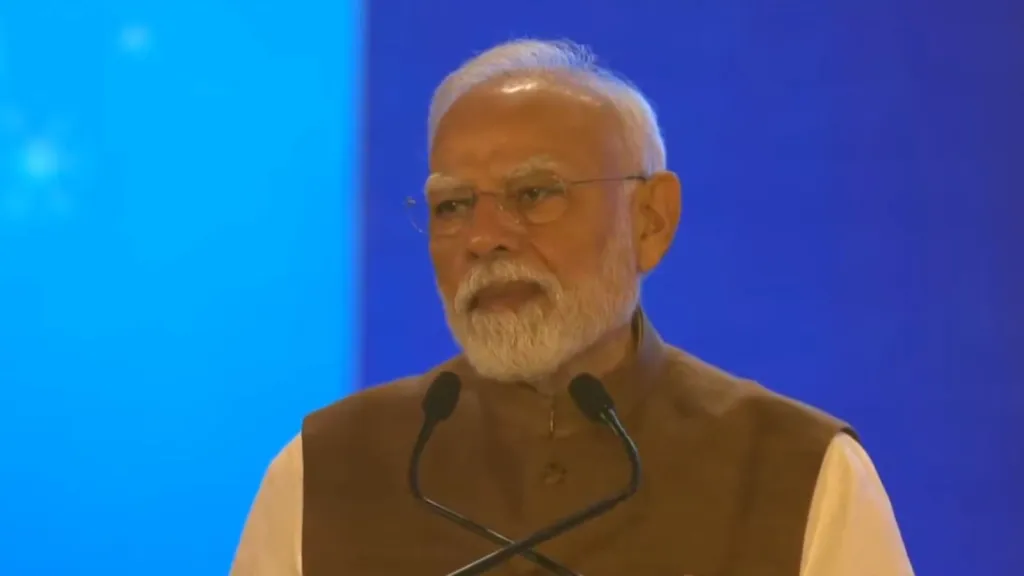
Prime Minister Narendra Modi on October 27, 2026, called on researchers, industry leaders, startup founders and young innovators to develop technologies that address India’s needs while contributing solutions to global challenges. Inaugurating the government’s Emerging Science, Technology and Innovation Conclave (ESTIC) 2026 at Bharat Mandapam in New Delhi, he urged participants to set measurable research and innovation targets over the next three years.
Modi said the conclave should move beyond discussions and generate tangible outcomes, including new technologies, prototypes, pilot projects and market-ready products. He linked the goal to the vision of a developed India, or Viksit Bharat, emphasising the role of scientific research, technological discoveries and innovation in achieving that ambition.
The Prime Minister also highlighted India’s progress in nuclear technology, artificial intelligence, semiconductor manufacturing and research funding. He said emerging technologies should ultimately improve people’s lives by strengthening healthcare, transforming agriculture, expanding opportunities in education and employment, and supporting disaster mitigation.
PM Modi Calls for Measurable Research and Innovation Targets
Addressing participants at ESTIC 2026, Modi encouraged researchers and industry representatives to identify specific technological outcomes they could deliver within three years. He asked them to decide which technologies they would develop, which prototypes they would build, which pilot projects they would undertake and which products they would bring forward.
The Prime Minister said scientific and technological innovation should contribute directly to India’s development rather than remain limited to discussions or theoretical possibilities.
“Over the next three years, they should decide which technology, which prototype, which pilot project, or which product they would develop? Let us pursue innovations that help transform India into a developed nation.”
Modi expressed the hope that the conclave would become a platform for measurable achievements. The emphasis on defined targets reflects an approach in which research outcomes can be assessed through technological development, practical testing and the creation of products that address real-world needs.
He described scientific research and discovery as essential foundations for Viksit Bharat. In a message shared on October 27, he reiterated that a developed India would depend on strong scientific capabilities and a sustained spirit of innovation.
The call places researchers, universities, startups and industry at the centre of efforts to translate scientific knowledge into practical applications. It also highlights the importance of cooperation between research institutions and businesses in moving innovations from laboratories towards wider use.
India’s Role in Global Science and Technology
Modi said India’s relationship with global Science and Technology had evolved over the decades. He recalled a period when the country largely adopted technologies developed elsewhere, sometimes making limited improvements before putting them to use.
He urged India to move beyond that approach by developing technologies that can influence the direction of scientific progress and help address challenges faced by countries around the world.
“Decades ago, there was a time when science and technology for India meant catching up with the world. Whenever there was any innovation in the world, the technology would come to us in a few years. We used to adopt it or make minor improvements to it and take it forward…”
The Prime Minister said India should now focus on shaping the future of science and technology while building the capacity to provide solutions to global problems.
Union Minister of State for Science and Technology Jitendra Singh echoed this ambition in his remarks at the inauguration. He described India as moving from following global developments towards playing a role in creating technologies and scientific solutions alongside international partners.
“India today is no longer a follower. India today beckons others to follow her. India today is no longer only a collaborator. India today is a global co-creator.”
Singh also contrasted India’s position in the 21st century with its technological standing in the previous century, presenting the country’s current direction as focused on future readiness and innovation.
The remarks from both leaders placed technological development and research capacity at the centre of India’s aspirations to contribute more substantially to international scientific progress.
Nuclear Technology and India’s Push for Self-Reliance
Modi highlighted India’s nuclear technology capabilities while referring to the approaching birth anniversary of Homi J. Bhabha on October 30. Bhabha is widely credited as the father of India’s nuclear programme.
The Prime Minister pointed to India’s development of fast breeder reactor technology as an example of the country’s efforts to strengthen self-reliance in nuclear power. According to his remarks, India developed this technology without depending on imported nuclear fuel, and a 500-megawatt prototype reactor had reached first criticality.
First criticality is an important milestone in the commissioning of a nuclear reactor. It indicates that a sustained, self-supporting nuclear fission chain reaction has been achieved. It does not, by itself, mean that a reactor has reached full commercial operation.
Fast breeder reactors are designed to produce additional fissile material while generating energy, potentially allowing more efficient use of nuclear fuel resources. Such technology is relevant to India’s long-term nuclear ambitions and its efforts to develop domestic capabilities across the nuclear energy sector.
By highlighting the reactor milestone, Modi presented nuclear technology as an example of how sustained research and indigenous engineering can support strategic technological independence.
The reference also connected India’s current research priorities with the legacy of Bhabha, whose work helped establish the foundations of the country’s nuclear science programme.
India’s AI Impact Summit and Indigenous AI Model
The Prime Minister also pointed to developments in artificial intelligence as evidence of India’s growing technological ambitions. He said the country organised its first AI Impact Summit during 2026 and launched its own model.
The remarks placed artificial intelligence alongside nuclear technology and semiconductor manufacturing among the areas in which India is seeking to strengthen its capabilities.
AI development can support applications across sectors such as healthcare, education, agriculture and public services. However, turning technological advances into useful outcomes depends on factors including research quality, computing infrastructure, access to relevant data, skilled professionals and the ability to deploy systems responsibly.
Modi’s emphasis on measurable outcomes at ESTIC 2026 is relevant to this broader challenge. Developing an AI model is one milestone, while demonstrating its effectiveness in practical settings and making its benefits accessible to users are separate stages of technological development.
The Prime Minister’s comments also connected domestic AI development with India’s wider ambition to contribute to global technological solutions rather than depend exclusively on systems developed elsewhere.
India-Made Semiconductor Chips Being Shipped to the World
Modi said India-made chips were being shipped to the world, highlighting semiconductor manufacturing as another area of technological progress.
Semiconductors are essential components in a wide range of modern technologies, including smartphones, computers, communication systems, vehicles and industrial equipment. Building domestic capabilities in this sector can support supply-chain resilience and create opportunities for research, manufacturing and related industries.
However, the semiconductor ecosystem extends beyond the production of individual chips. It also includes chip design, fabrication, packaging, testing, specialised equipment and the development of skilled technical workers.
The Prime Minister’s reference to chip shipments presented semiconductor activity as part of India’s effort to strengthen its position in advanced manufacturing. His broader message was that technological progress should result in practical products and capabilities that can serve both domestic and international markets.
At the conclave, the focus on prototypes, pilot projects and products reinforced the importance of moving scientific achievements towards real-world applications.
PM Modi Says Science Must Improve People’s Lives
Modi stressed that scientific progress should not be judged solely by how advanced a technology appears. Instead, he said its significance should be assessed by whether it addresses major problems and improves people’s lives.
“For us, emerging science and technology means solutions that strengthen the health sector, transform agriculture, create new opportunities for education and employment, and assist in disaster mitigation.”
The statement outlined several practical priorities for emerging technologies in India.
- Healthcare: Research and innovation can contribute to better medical services, improved diagnostic capabilities and technologies that address healthcare challenges.
- Agriculture: Scientific advances can support agricultural productivity, improve resource use and help address challenges faced by farmers.
- Education and employment: New technologies can create learning opportunities, support skill development and open pathways to new forms of work.
- Disaster mitigation: Scientific tools can help improve preparedness, risk assessment, monitoring and responses to natural or other disasters.
Modi said he was pleased that such priorities were receiving attention within India’s startup ecosystem. His remarks highlighted the potential role of startups in turning scientific research into solutions that can be tested, developed and deployed.
The emphasis on public benefit also provides a practical measure for evaluating innovation. Beyond technical novelty, research projects can be assessed by their ability to address identified needs, reach intended users and deliver useful outcomes.
Research Funding and the Anusandhan National Research Foundation
The Prime Minister highlighted measures intended to strengthen India’s research ecosystem, including the Anusandhan National Research Foundation. He said the government was continuing to build the country’s research capabilities and support innovation.
Research funding is important for scientific development because new technologies often require long periods of investigation, experimentation and testing before they can be commercialised. Support for researchers and research institutions can help develop new knowledge while creating opportunities to turn discoveries into practical applications.
Modi also referred to a pledge made at the previous year’s event to allocate Rs 1 lakh crore towards research and innovation through the Research Development and Innovation Fund.
The funding initiative was presented as part of the effort to strengthen India’s capacity to conduct research and develop technologies with commercial or wider societal applications.
Public investment can support the early stages of research, but moving innovations towards the market also requires technical validation, infrastructure, industry partnerships and access to additional capital. The Prime Minister’s remarks on measurable outcomes reflected the importance of connecting research support with tangible developments.
Rs 24,000 Crore Commitment for Technologies Moving from Lab to Market
Modi said approximately Rs 12,000 crore had been committed towards technologies that were ready to transition from laboratories to the market. He added that the private sector was contributing another Rs 12,000 crore, bringing the total commitment to Rs 24,000 crore within one year.
The figures highlighted the intended role of both public and private funding in supporting technologies at a stage when they may be ready for commercial development but still require resources to reach wider adoption.
Technologies emerging from research laboratories often face challenges before they can become commercially viable products. These may include prototype development, performance testing, manufacturing readiness, regulatory requirements and the cost of scaling production.
Funding directed towards this transition can help bridge the gap between scientific discovery and commercial use. Private-sector participation can also connect research teams with industrial expertise, potential customers and established production or distribution networks.
The combined commitment described by Modi was intended to support this movement from laboratory research towards market-ready technologies. The remarks did not specify individual projects receiving the funding, but the stated priority was to support innovations capable of advancing towards practical deployment.
ESTIC 2026 Brings Researchers, Industry and Scientific Leaders Together
The inauguration took place on the evening of the first day of ESTIC 2026 at Bharat Mandapam in New Delhi. Modi shared the stage with Jitendra Singh, Principal Scientific Adviser Ajay K. Sood and three Nobel laureates participating in the event: Professor Joachim Frank, Sir Richard J. Roberts and Professor Kostya Novoselov.
The gathering brought together representatives from research, industry and the startup ecosystem, along with young people involved in science and innovation. Its stated focus on measurable technological outcomes placed attention on the relationship between scientific discovery and practical development.
The participation of internationally recognised scientists also provided a setting for discussions around research and technological progress. Modi’s remarks emphasised that India should use its scientific capabilities not only to meet domestic needs but also to contribute to solutions for global challenges.
The Prime Minister’s call for three-year goals gave the conclave a forward-looking emphasis. By asking participants to identify technologies, prototypes, pilot projects and products they intend to develop, he sought to connect scientific ambition with outcomes that can be assessed over time.
What Modi’s ESTIC 2026 Message Means for India’s Innovation Goals
The Prime Minister’s address brought together several themes in India’s science and technology agenda: indigenous technological development, stronger research institutions, support for innovation funding, startup participation and the translation of scientific advances into practical solutions.
Nuclear technology, artificial intelligence and semiconductors served as examples of fields in which India is seeking to expand its capabilities. The references to healthcare, agriculture, education, employment and disaster mitigation showed how the government wants emerging technologies to contribute to everyday needs as well.
The funding figures cited by Modi highlighted the importance of financial support for research and the transition from laboratory development to market deployment. The proposed three-year targets, meanwhile, emphasised the need to define specific outcomes rather than rely solely on broad ambitions.
Achieving these goals will depend on how effectively research institutions, startups, industry and public funding programmes work together. Scientific discoveries must be developed, tested and adapted to meet practical requirements before they can deliver widespread benefits.
At ESTIC 2026, Modi’s central message was that India should move beyond adopting technologies developed elsewhere and strengthen its role in creating them. He urged researchers and innovators to pursue measurable projects that support the vision of Viksit Bharat while producing solutions relevant to India and the wider world.
For breaking news and live news updates, like us on Facebook or follow us on Twitter and Instagram. Read more on Latest India on thefoxdaily.com.






COMMENTS 0