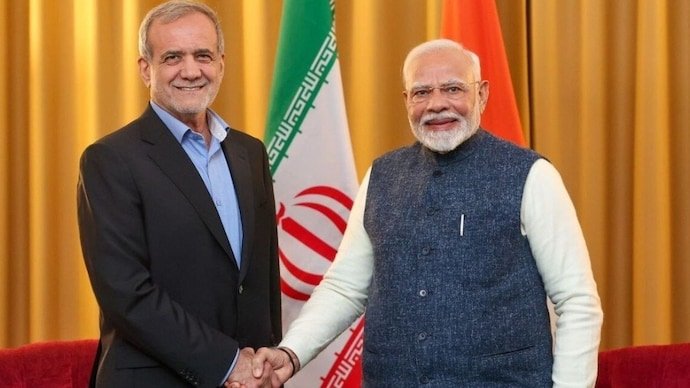
As geopolitical tensions in West Asia continue to reshape regional security and Global energy markets, Prime Minister Narendra Modi on Tuesday spoke with Iranian President Masoud Pezeshkian to discuss the evolving situation following recent diplomatic efforts aimed at reducing hostilities in the region.
During the conversation, President Pezeshkian briefed Prime Minister Modi on recent developments and the progress made toward easing tensions. The Prime Minister welcomed the emerging understanding between the concerned parties and reiterated India’s longstanding position that conflicts should be resolved through dialogue, Diplomacy and peaceful engagement.
The discussion comes at a strategically important moment for India, whose economic interests, Energy Security and maritime trade are closely linked to stability in the Gulf region. Beyond bilateral ties with Iran, the conversation reflects India’s broader diplomatic approach of maintaining constructive relations with multiple stakeholders while advocating peaceful conflict resolution.
Key Highlights of the PM Modi–Iran President Conversation
| Topic | Discussion | Strategic Importance |
|---|---|---|
| Regional Situation | Iran briefed India on recent developments | Enhances diplomatic coordination |
| Peace Process | India welcomed efforts to reduce tensions | Supports regional stability |
| Dialogue | PM Modi reiterated diplomacy as the preferred solution | Consistent Indian foreign policy |
| Freedom of Navigation | Emphasis on protecting maritime trade | Critical for global commerce and energy security |
| West Asia Stability | Need for sustained peace efforts | Benefits regional and global economies |
Why the Conversation Matters
The phone call carries significance beyond routine diplomatic engagement. West Asia remains one of the world’s most strategically important regions, influencing:
- Global energy supplies.
- International shipping routes.
- Regional security.
- Global financial markets.
- India’s energy imports.
India has consistently maintained balanced relations with countries across the region while emphasizing peaceful dialogue and adherence to international law.
India’s Longstanding Position on West Asia
Successive Indian governments have generally followed a policy centered on strategic autonomy, allowing New Delhi to maintain constructive engagement with diverse regional partners despite political differences among them.
India’s approach rests on several guiding principles:
- Resolution of disputes through dialogue.
- Respect for sovereignty and territorial integrity.
- Avoidance of military escalation.
- Protection of civilian lives.
- Ensuring uninterrupted international trade.
Prime Minister Modi reiterated these principles during his conversation with President Pezeshkian, reinforcing India’s consistent diplomatic messaging.
Freedom of Navigation: Why India Is Concerned
One of the key issues highlighted during the conversation was the importance of safeguarding freedom of navigation.
This principle ensures that commercial vessels can move safely through international waterways without unlawful interference.
For India, this issue is particularly important because:
- A significant share of India’s crude oil imports comes from Gulf countries.
- Indian exports rely heavily on maritime trade.
- Millions of Indian citizens live and work across West Asia.
- Supply chain disruptions can affect inflation and economic growth.
Ensuring secure sea lanes therefore remains a core national interest.
The Strategic Importance of the Strait of Hormuz
Although the leaders discussed the broader regional situation, the reference to protecting international commerce highlights the importance of the Strait of Hormuz.
The narrow waterway connects the Persian Gulf to international shipping routes and serves as one of the world’s busiest energy corridors.
| Feature | Importance |
|---|---|
| Global Oil Transit | Large share of internationally traded crude oil passes through the Strait |
| Natural Gas | Major route for LNG exports |
| Commercial Shipping | Critical corridor for international trade |
| India’s Interests | Supports energy security and maritime commerce |
Any prolonged disruption in this corridor can influence energy prices, freight costs and global supply chains.
India-Iran Relations: A Broader Perspective
India and Iran share longstanding civilizational, cultural and economic ties that extend over centuries.
Modern bilateral cooperation has included areas such as:
- Energy cooperation.
- Connectivity projects.
- Trade.
- Cultural exchanges.
- Regional security dialogue.
While international geopolitical developments have periodically affected bilateral engagement, both countries continue to maintain diplomatic communication on issues of mutual interest.
Diplomacy During Regional Uncertainty
The conversation comes as diplomatic efforts continue to preserve a fragile understanding intended to reduce tensions in West Asia.
Periods following military confrontations often require sustained political engagement to prevent renewed escalation.
In such situations, dialogue between major regional stakeholders and important international partners becomes increasingly valuable for maintaining stability.
Why Dialogue Remains Central to India’s Foreign Policy
India has consistently argued that sustainable peace cannot be achieved solely through military means.
Its diplomatic approach generally favors:
- Negotiated settlements.
- Regional cooperation.
- International law.
- Confidence-building measures.
- Humanitarian considerations.
This position has remained largely consistent across multiple international crises.
Funeral of Iran’s Former Supreme Leader
The phone conversation also followed President Pezeshkian’s invitation to Prime Minister Modi to attend the funeral ceremonies of former Iranian Supreme Leader Ayatollah Ali Khamenei.
According to government sources, India will be represented by:
- Minister of State for External Affairs Pabitra Margherita.
- Bihar Governor Lt Gen (Retd) Syed Ata Hasnain.
The decision reflects diplomatic protocol while ensuring India’s representation at an important state event.
Timeline of Recent Developments
| Event | Development |
|---|---|
| Regional Conflict | Military hostilities heightened tensions across West Asia |
| Diplomatic Efforts | Understanding reached to reduce tensions |
| India-Iran Call | Prime Minister Modi and President Pezeshkian discuss regional developments |
| Upcoming Funeral | India to send official representatives to Iran |
Economic Significance for India
Developments in West Asia have direct implications for India’s economy.
Stable regional conditions help:
- Ensure uninterrupted energy supplies.
- Reduce volatility in oil prices.
- Support international trade.
- Protect overseas Indian communities.
- Strengthen investment confidence.
Conversely, prolonged instability can increase transportation costs, insurance premiums and inflationary pressures.
Expert Insight: India’s Balancing Strategy
India’s engagement with Iran reflects its broader foreign policy objective of maintaining strategic autonomy. Rather than aligning exclusively with one regional bloc, New Delhi has sought to cultivate Relationships with multiple partners while focusing on practical interests such as energy security, connectivity, trade and regional stability.
This balanced approach enables India to remain an important diplomatic actor capable of engaging with countries that may have differences among themselves. Such flexibility has become increasingly valuable as geopolitical competition intensifies across West Asia.
What to Watch Next
Several developments could shape the regional landscape in the coming weeks:
- Implementation of recent diplomatic understandings.
- Security conditions around major shipping routes.
- Progress in regional dialogue.
- International efforts to preserve maritime stability.
- Future India-Iran diplomatic engagement.
Continued communication among regional stakeholders will be essential to sustaining confidence and preventing renewed escalation.
Future Outlook
India is expected to continue advocating diplomacy as the preferred path toward lasting peace in West Asia while protecting its strategic interests in energy security and maritime trade. As one of the world’s fastest-growing major economies, India’s emphasis on stable shipping routes and uninterrupted international commerce will likely remain a central pillar of its foreign policy.
If regional diplomatic efforts continue to gain momentum, opportunities may emerge for broader economic cooperation, improved connectivity and greater stability across the Gulf. However, sustained progress will depend on continued restraint by all parties and successful implementation of confidence-building measures aimed at reducing tensions.
Conclusion
The conversation between Prime Minister Narendra Modi and Iranian President Masoud Pezeshkian highlights India’s consistent commitment to peaceful conflict resolution, regional stability and secure international trade. At a time of continued geopolitical uncertainty in West Asia, New Delhi has reaffirmed that dialogue and diplomacy remain the most effective means of addressing complex regional challenges.
By emphasizing freedom of navigation, support for international commerce and sustained diplomatic engagement, India has once again underscored its role as a responsible stakeholder seeking stability in a region that remains vital to global energy markets and international economic security.
For breaking news and live news updates, like us on Facebook or follow us on Twitter and Instagram. Read more on Latest India on thefoxdaily.com.





COMMENTS 0