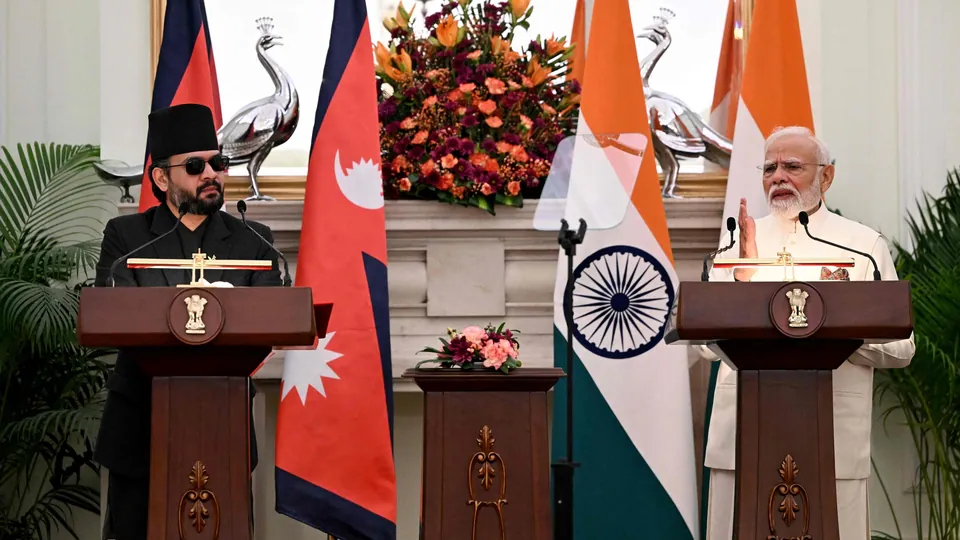
India and Nepal have agreed to deepen bilateral cooperation across eight key sectors, including satellite technology, security, healthcare, governance, traditional medicine and urban development, following talks between Prime Minister Narendra Modi and Nepalese Prime Minister Balendra Shah in New Delhi on November 23, 2026. The agreements mark a significant step in expanding the two neighbouring countries’ institutional and development partnerships.
The eight memorandums of understanding (MoUs) cover cooperation between government institutions, police and security academies, research organisations and technical agencies. The two sides also announced a series of infrastructure and connectivity initiatives, including a new cross-border railway service, an international bridge, check posts and energy projects.
Alongside the agreements, Modi announced a development cooperation package worth 24,000 crore Nepali rupees to support Nepal’s post-flood reconstruction and long-term development. The announcements reflect an effort to strengthen a relationship that extends beyond diplomatic engagement into trade, transport, energy, public services and people-to-people connections.
India-Nepal Talks: Eight MoUs Aim to Expand Cooperation
The eight MoUs signed during the meeting cover a broad range of sectors, combining traditional areas of cooperation with newer priorities such as satellite communication and technical urban planning.
One important aspect of the agreements is their focus on institutional capacity building. Rather than limiting cooperation to government-level commitments, several MoUs establish partnerships between specific Indian and Nepalese institutions. These arrangements are intended to support training, research, technical knowledge-sharing and professional development.
The agreements also extend to law enforcement and forensic investigation, reflecting the importance of cooperation between the two countries’ security institutions.
Complete List of Eight MoUs Signed Between India and Nepal
The agreements signed during the November 23 meeting cover the following areas:
- Forensic sciences and research: The National Forensic Sciences University in Gandhinagar, Gujarat, and Nepal Police’s Crime Investigation Department signed an MoU for academic and research collaboration. The partnership is expected to strengthen cooperation in forensic science and investigative capabilities.
- Police training and security: Rashtriya Raksha University (RRU), India, and Nepal’s National Police Academy (NPA) agreed to cooperate. The partnership provides a framework for institutional collaboration and professional training in areas connected with policing and security.
- Administrative reforms and civil servant training: India’s National Centre for Good Governance, under the Department of Administrative Reforms and Public Grievances, signed an agreement with Nepal Administrative Staff College. It focuses on capacity-building training programmes for Nepalese civil servants, including exposure to governance practices and administrative reforms.
- Ayurveda and traditional medicine: The governments of India and Nepal agreed to cooperate in Ayurveda and other traditional systems of medicine. The agreement creates a framework for collaboration in a field that has longstanding cultural and medical connections between the two countries.
- Satellite communication: The Indian Space Research Organisation (ISRO) and Nepal’s Ministry of Information and Communication signed an MoU to establish a satellite communication network using the South Asia Satellite. The initiative aims to expand the use of satellite-based communication services in Nepal.
- Sustainable urban development: Both governments signed an agreement on technical cooperation in sustainable urban development. The partnership is intended to facilitate the exchange of expertise and technical knowledge related to urban planning and development.
- Healthcare and medicine safety: India’s Ministry of Health and Family Welfare and Nepal’s Ministry of Health and Food Safety agreed to cooperate in health and medicine. The agreement provides a basis for collaboration in healthcare-related areas, including medicine safety.
- Livestock and fisheries: The two governments signed an MoU to strengthen cooperation in livestock and fisheries development, sectors important to agricultural livelihoods, food production and rural economies.
Together, the agreements create several channels for cooperation between Indian and Nepalese institutions. Their implementation will determine how quickly the commitments translate into practical benefits, including better-trained officials, stronger investigative capabilities, improved technical coordination and wider access to specialised knowledge.
India and Nepal Announce Major Connectivity and Infrastructure Projects
Beyond the eight MoUs, Modi and Shah announced several infrastructure initiatives covering railway connectivity, border facilities, roads, hydropower and petroleum transportation. These projects are particularly important because India and Nepal share an open border and have closely connected economies, making cross-border movement and infrastructure essential to bilateral trade and daily life.
The announced initiatives include:
- Sarayu-Kamala Express rail service: The launch of a new rail service connecting Ayodhya in India with Janakpur in Nepal. The connection is expected to strengthen transport links between two places with significant religious and cultural importance.
- Integrated Check Post at Banbasa: The foundation stone was laid for a new Integrated Check Post at Banbasa. Such facilities are designed to support the movement of people and goods across international borders through organised customs, immigration and related infrastructure.
- Progress on three other Integrated Check Posts: The two sides highlighted progress in the construction of facilities at Bhairahawa, Sunauli and Dodhara Chandani. These projects are intended to improve border infrastructure and facilitate cross-border movement.
- Dharchula-Darchula bridge: A new cross-border motorable bridge connecting Dharchula in India with Darchula in Nepal was inaugurated. The bridge is expected to improve local connectivity between communities on both sides of the border.
- Lower Arun Hydroelectric Project: The foundation stone was laid for the 669 MW Lower Arun Hydroelectric Project. The project represents an important part of the energy cooperation agenda between the neighbouring countries.
- Motihari-Amlekhgunj Pipeline Phase II: Phase II of the Motihari-Amlekhgunj Pipeline was dedicated. The pipeline is part of the petroleum transportation infrastructure linking India and Nepal.
- Petroleum terminal in Jhapa: The foundation stone was laid for a petroleum terminal at Jhapa, intended for the proposed Siliguri-Jhapa petroleum pipeline. The initiative could further expand the infrastructure supporting fuel transportation between the two countries.
Why the New Railway and Border Infrastructure Matter
Transport and border infrastructure are central to the India-Nepal relationship. The two countries share extensive economic, cultural and social links, with movement across the border supporting trade, tourism, employment and family connections.
The Sarayu-Kamala Express rail service is significant because it connects Ayodhya and Janakpur, two destinations associated with the Ramayana tradition. Better railway connectivity could make travel more convenient for visitors and pilgrims while strengthening tourism-related economic activity.
Meanwhile, the new bridge between Dharchula and Darchula is important for communities living in a geographically challenging border region. Improved road connectivity can make movement easier and support access to markets, services and local economic opportunities.
Integrated Check Posts serve a different but equally important purpose. They bring border-related facilities together, helping authorities manage the movement of passengers and commercial goods. Progress at Banbasa, Bhairahawa, Sunauli and Dodhara Chandani could support more organised cross-border trade and reduce logistical difficulties.
However, the actual impact of these projects will depend on construction timelines, operational arrangements and coordination between the two governments. Announcements and foundation-stone ceremonies represent important milestones, but their long-term value will be measured by how effectively the infrastructure is completed and used.
Lower Arun Hydroelectric Project Strengthens Energy Cooperation
The 669 MW Lower Arun Hydroelectric Project is among the major energy-related announcements made during Shah’s visit. Hydropower is an important area of potential cooperation because Nepal has significant river resources, while India has a large and growing demand for electricity.
Cross-border energy cooperation can create opportunities for Nepal to develop its hydropower sector and potentially export electricity, while India can diversify its sources of power supply. Such arrangements can also encourage investment in generation and transmission infrastructure.
The project’s progress will depend on implementation, financing, technical arrangements and the infrastructure needed to deliver electricity. Its inclusion in the latest package nevertheless highlights the importance both governments attach to energy cooperation.
The petroleum initiatives announced during the meeting point towards another dimension of the relationship. The Motihari-Amlekhgunj Pipeline and the proposed Siliguri-Jhapa pipeline are intended to strengthen fuel transportation links, helping support Nepal’s energy supply infrastructure.
India Announces NPR 24,000 Crore Development Cooperation Package
One of the major financial announcements during the visit was Modi’s declaration of a Development Cooperation Package worth 24,000 crore Nepali rupees. The package is intended to support Nepal’s post-flood reconstruction and long-term development priorities.
The announcement is significant because it links India’s development partnership with Nepal’s recovery and infrastructure requirements. Natural disasters can damage public infrastructure, disrupt livelihoods and place additional pressure on government finances. Reconstruction support can therefore play an important role in restoring essential services and strengthening long-term resilience.
However, the announcement does not by itself establish how the entire package will be distributed. Details about individual projects, funding arrangements, implementation schedules and the sectors receiving support will be important in assessing its eventual impact.
The use of Nepali rupees in the announcement also makes it important to distinguish the package’s stated value from amounts expressed in Indian currency. The announced figure is 24,000 crore Nepali rupees.
Modi Says India and Nepal Are Partners in Each Other’s Progress
Following his talks with Shah, Modi said the two countries had taken several important decisions to strengthen their bilateral relationship.
“We took several important decisions to further bolster India-Nepal ties,” Modi said.
Emphasising the close relationship between the neighbours, the Indian Prime Minister added:
“India and Nepal are partners in each other’s progress and source of support for each other in difficult times.”
Modi also praised Shah’s vision for Nepal’s development, referring to the Nepalese Prime Minister’s address at the United Nations a few months earlier.
“A few months ago, when he addressed the UN as the world’s youngest prime minister, we got a glimpse of his far-sighted vision. Today, I have seen his clear vision for Nepal’s development,” Modi said.
His remarks highlighted India’s stated approach of viewing Nepal’s development as closely connected to the broader regional relationship. The agreements announced during the visit reflect this approach through cooperation in public administration, healthcare, security, technology and infrastructure.
Why Balen Shah’s India Visit Matters for Bilateral Relations
Shah’s visit comes at a time when India and Nepal are seeking to strengthen cooperation across several interconnected areas. Their relationship is shaped by geography, an open border, cultural connections, trade and shared development interests.
For Nepal, cooperation with India can support infrastructure development, access to technical expertise, energy projects and improved connectivity with a major neighbouring economy. Partnerships in satellite communication, public administration and healthcare can also help strengthen institutional capabilities.
For India, a stable and development-oriented relationship with Nepal is important for regional connectivity, economic cooperation and cross-border infrastructure. Improved transport and energy links can benefit communities and businesses on both sides.
The eight MoUs also demonstrate that the relationship is not limited to large infrastructure projects. Cooperation between police academies, forensic research institutions, administrative training organisations and healthcare agencies can create long-term institutional links that continue beyond individual political meetings.
Implementation Will Determine the Impact of the Agreements
The November 23 meeting produced an extensive set of announcements, ranging from satellite communication and forensic science to railways, hydropower and petroleum infrastructure. The NPR 24,000 crore development cooperation package adds a significant reconstruction and development component to the visit.
Yet the success of these commitments will depend on what happens after the signing ceremonies. Each MoU will require practical coordination between the relevant institutions, while infrastructure projects will need sustained financing, construction and operational planning.
For people living near the border, the most visible benefits could come from improved bridges, rail services and check posts. For Nepalese institutions, the agreements on training, healthcare, forensic research and satellite communication could create opportunities to strengthen public services and technical capabilities.
The visit has therefore established a broad framework for deeper India-Nepal cooperation. Whether it becomes a lasting milestone in bilateral relations will ultimately depend on how effectively both governments turn the announced agreements and projects into functioning services and completed infrastructure.
For breaking news and live news updates, like us on Facebook or follow us on Twitter and Instagram. Read more on Latest India on thefoxdaily.com.





COMMENTS 0