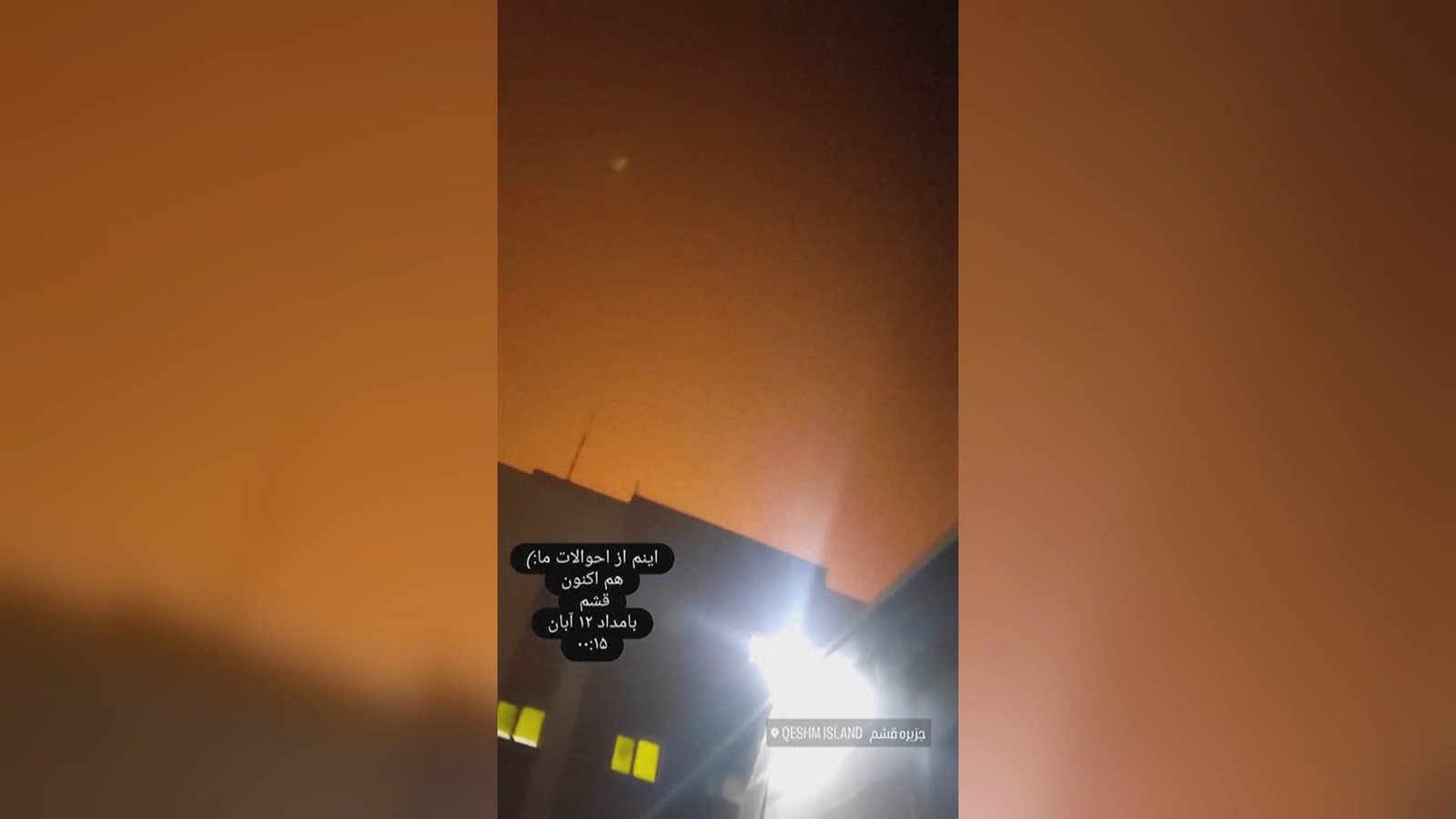
The US military has conducted limited strikes on Iran’s Qeshm Island in what American officials have described as a defensive operation intended to protect US assets in the Middle East. The strikes took place on Monday, according to three US officials, following an incident in which Iran allegedly fired at a US aircraft.
The operation represents another military development in the ongoing confrontation between Washington and Tehran, even as both countries continue to consider diplomatic proposals aimed at ending the conflict. Although US officials characterized the latest action as limited and defensive, it highlights the possibility of further military escalation if negotiations fail.
One US official told CNN that the attack was carried out in response to Iranian fire directed at a US aircraft. Another official described the operation as a defensive measure against Iranian surface-to-air missiles allegedly being used against American assets.
The strikes do not appear to represent the larger combat operation that US officials have previously considered. However, the Wall Street Journal, which first reported the operation, said similar strikes had reportedly been conducted in secret before the latest incident.
Why Did the US Strike Qeshm Island?
According to US officials, the military operation was intended to protect American assets from Iranian threats. One official said the strikes followed Iran firing at a US aircraft, while another described the action as a response to the use of surface-to-air missiles against US assets.
The administration reportedly chose not to publicize the operation immediately because officials did not want to exaggerate the significance of what they considered a defensive move. A person familiar with the matter told CNN that the decision to keep the attack under wraps was deliberate.
The limited nature of the operation distinguishes it from a broader military campaign. Nevertheless, the decision to strike Iranian territory demonstrates that Washington remains prepared to use military force when it believes American personnel or equipment are under threat.
The timing also carries political and diplomatic significance. The operation took place on the eve of Election Day in the United States, while the administration was publicly discussing the possibility of reaching an agreement with Tehran.
The latest developments indicate that diplomatic engagement and military readiness are continuing simultaneously. While American officials have described progress in negotiations, the strikes show that the confrontation has not been fully resolved.
Explosions Reported on Qeshm Island Near the Strait of Hormuz
Iran’s state-affiliated Fars News Agency reported that several explosions were heard on Qeshm Island during the early hours of Tuesday morning local time. Residents of nearby Hengam Island and the port city of Bandar Abbas also reportedly heard the blasts.
Qeshm Island is located close to the Strait of Hormuz, one of the world’s most important maritime routes for international energy supplies. The island is approximately 14 miles from Bandar Abbas and occupies a strategically significant position near the narrow waterway.
The location has become particularly important during the conflict because Iran has attempted to assert control over maritime traffic passing through the Strait of Hormuz. The United States, meanwhile, has rejected Iran’s claimed authority over the international waterway.
Qeshm Island has previously been targeted by the US during the war. Its geographical position makes developments there especially significant for regional security, military operations and international shipping.
Iran Claims It Shot Down Two US Reconnaissance Drones
The latest strikes came amid a series of Iranian claims involving US military aircraft and drones operating in the region. Over the preceding week, Iran said it had targeted several American drones.
Late Monday, the Islamic Revolutionary Guard Corps claimed that it had shot down two US reconnaissance drones over Qeshm Island. However, it remains unclear whether the alleged drone incident was directly connected to the American strikes.
The competing accounts underline the uncertainty surrounding the sequence of military events. US officials described their operation as a response to Iranian fire against American assets, while Iranian military statements have presented their own claims about US aircraft and surveillance operations.
Iranian Deputy Foreign Minister Kazem Gharibabadi said Tehran reserved the right to defend itself following the strikes. However, he appeared to downplay the immediate significance of the operation by describing it as part of an ongoing war.
The exchange of military claims raises concerns about further confrontations, particularly around the Strait of Hormuz, where military activity can have consequences beyond the immediate parties involved.
Strait of Hormuz Remains at the Centre of the Conflict
Qeshm Island’s strategic importance is closely connected to the Strait of Hormuz, a critical passage for global oil shipments. Before the war, approximately 20 million barrels of oil passed through the waterway every day, making it one of the most important routes in the international energy market.
Any disruption to shipping through the strait can affect oil supplies, transportation costs and energy prices across multiple regions. The waterway connects major oil-producing countries in the Persian Gulf with international markets, making its security a major concern for governments and energy companies.
Iran’s efforts to exercise control over traffic through the strait have become a central issue in negotiations with Washington. Tehran has linked the reopening of the waterway to its demands for concessions from the United States.
Washington has rejected Iran’s claimed authority over the strait. This disagreement remains one of the major obstacles to a diplomatic settlement, alongside questions involving sanctions, frozen Iranian assets and the broader terms for ending the conflict.
Iran Says Strait of Hormuz Could Reopen Within Two Days
Diplomatic discussions between Iran and the United States have continued through regional intermediaries, with Qatari negotiators playing a central role in efforts to bridge differences between the two sides.
Iran has said it could reopen the Strait of Hormuz within two days if Washington agrees to seven demands presented by Tehran. Iranian officials and state media have identified several elements of those demands, including the lifting of the US maritime blockade, the release of frozen Iranian assets and an end to the war on all fronts.
The United States has not accepted Iran’s conditions, and the two sides continue to review proposals intended to bring the conflict to an end.
Qatari mediators travelled between Doha and Tehran over the past week as part of the diplomatic effort. A diplomat briefed on the discussions told CNN that the Qatari mediators returned to Doha on Monday evening after talks in the Iranian capital.
The diplomat said the United States and Iran were separately examining the latest suggestions put forward by mediators. Another diplomat familiar with the discussions said the mediators expected responses from both countries within two days.
The latest diplomatic proposals are intended to narrow the differences between Washington and Tehran. However, the conditions surrounding the Strait of Hormuz, the maritime blockade and the wider end of hostilities remain unresolved.
Iran Says US Response to Its Demands Is Unsatisfactory
Hours after the Qatari mediators returned to Doha, Iranian security official Mohsen Rezaei said the US response to Tehran’s demands was not satisfactory.
In a statement posted on X, Rezaei insisted that Washington must explicitly address all seven Iranian conditions before the Strait of Hormuz could be reopened. He said Iran would not restore normal access through the waterway unless the United States complied with its demands.
It remains unclear whether Rezaei’s statement represented the formal response that Qatari mediators were expecting from Tehran or whether it reflected Iran’s broader position during the negotiations.
The remarks nevertheless indicate that significant disagreements remain despite diplomatic contacts over the past week. Iran’s position links the reopening of a major international shipping route directly to concessions from Washington, while the United States continues to reject Tehran’s claimed authority over the waterway.
The latest US strikes could further complicate these discussions by adding another military incident to an already difficult diplomatic process.
Trump Says Agreement With Iran Could Still Happen
Despite the renewed military activity, US President Donald Trump suggested on Monday that diplomacy with Tehran remained possible. In a social media post published before news of the Qeshm Island strikes emerged, Trump said an agreement with Iran could happen.
Trump also argued that oil prices were falling because markets believed a wider war with Iran might not take place. He said Tehran wanted a settlement as soon as possible and suggested that an agreement remained possible.
His comments came as negotiators continued discussions through Qatari intermediaries. The administration’s public position has therefore combined diplomatic optimism with continued warnings that military options remain available.
Trump did not specifically address the newly reported Qeshm Island strikes during an appearance on Fox News on Monday night. However, he discussed the possibility of further action against Iran’s suspected underground nuclear facilities.
Trump Raises Possibility of Striking Pickaxe Mountain
During the Fox News interview, Trump said the United States might have to target Pickaxe Mountain, a suspected underground nuclear site associated with Iran’s nuclear programme.
Israel believes Tehran has stored part of its enriched uranium stockpile and advanced enrichment centrifuges at the site. Trump said the United States could carry out an attack there quickly if it decided to do so.
He has previously raised the possibility of striking Pickaxe Mountain. In July, he said the United States could hit the location, although his latest remarks again left open the possibility of future military action.
The comments add another dimension to the confrontation because Iran’s nuclear facilities remain a major security concern for the United States and Israel. Any decision to target an underground nuclear site could have implications for the wider conflict and the diplomatic negotiations.
Trump’s remarks also indicate that Washington has not ruled out additional operations, even while pursuing a possible agreement with Tehran.
Iran Warns Against Further US Military Action
Iranian officials have responded to the latest developments with warnings that the country will not accept military pressure without responding. Mohammad Bagher Ghalibaf, the speaker of Iran’s parliament and a leading figure in negotiations with Washington, issued a fresh warning early Tuesday.
Ghalibaf said Iran would not surrender to threats or military action. He also warned that any miscalculation by an opposing force could trigger an unpredictable military and strategic response.
Iran’s Supreme Leader Mojtaba Khamenei had issued a similar warning on Saturday, saying that a major new attack against the country would be met with a response without geographical limitations.
A senior Iranian security official in Tehran also told CNN that Iran could consider targeting infrastructure beyond oil facilities, including artificial intelligence infrastructure.
These statements suggest that Tehran is warning of a potentially wider response if the United States or its allies launch additional attacks. The threats also raise concerns about the vulnerability of critical infrastructure across the region and beyond.
With both sides maintaining military options, the possibility of further escalation remains despite ongoing diplomatic contacts.
Trump Describes the Conflict as a ‘Very Soft War’
In his Fox News appearance, Trump defended his decision to launch the war against Iran while suggesting that there had been little recent fighting. He questioned the description of the situation as an active war and characterized it as a very limited confrontation.
Trump said the United States was not engaged in continuous fighting and argued that a major escalation could still be avoided if Tehran agreed to a settlement. He also suggested that Iran wanted to reach an agreement.
His description contrasts with the continued military activity reported by officials, including the latest strikes on Qeshm Island and Iranian claims involving US reconnaissance drones.
The president’s comments also came after he had previously said earlier in the month that the United States would not attack Iran before the US midterm elections. However, he did not clearly confirm whether military operations could resume afterward.
That uncertainty has contributed to concerns among people living across the Middle East, where further military action could affect regional security, transport routes and economic activity.
JD Vance Says Washington and Tehran Have Made Progress
US Vice President JD Vance said on Monday that Washington and Tehran had made progress towards finding a way to end the conflict.
Speaking to reporters ahead of the US midterm elections, Vance said discussions had produced some movement but emphasized that Iran remained unpredictable. He also said Trump retained both military and non-military options as negotiations continued.
Vance added that he had recently spoken with the president about the conflict and that both men felt positive about the possibility of reaching an agreement.
His comments reflected the administration’s effort to keep diplomatic channels open while maintaining pressure on Iran. However, the vice president did not announce a final agreement or indicate that the major disagreements between the two countries had been resolved.
The latest developments suggest that negotiations remain active, but their outcome depends on whether Washington and Tehran can reach an understanding on the demands surrounding the Strait of Hormuz and the wider conflict.
Oil Prices Rise After News of Qeshm Island Strikes
News of the US strikes on Qeshm Island pushed oil prices higher during early Asian trading on Tuesday. Prices had been falling before the reports emerged as markets assessed the latest diplomatic developments and the possibility of an agreement between Washington and Tehran.
The rise highlights the sensitivity of energy markets to military developments around the Strait of Hormuz. Because the waterway handles a substantial share of global oil shipments, any threat to maritime traffic can influence expectations about supply and prices.
Before the strikes were reported, Trump had pointed to falling oil prices as evidence that markets expected a settlement rather than a wider war. However, the latest military action introduced fresh uncertainty into that outlook.
Gasoline and diesel prices in the United States were still on track to be the most expensive recorded for any US Election Day in history, according to the supplied report. The energy situation therefore remained a domestic economic issue as well as an international security concern.
What Happens Next in the US-Iran Conflict?
The immediate direction of the conflict will depend heavily on the next steps taken by Washington and Tehran. Qatari mediators are waiting for responses from both sides to the latest diplomatic suggestions, with officials expecting feedback within two days.
Iran has made clear that reopening the Strait of Hormuz is linked to its seven demands, while the United States has rejected Tehran’s claim to control the international waterway. The maritime blockade, frozen Iranian assets and the terms for ending the war remain important points of disagreement.
At the same time, the Qeshm Island strikes demonstrate that military operations have not been entirely suspended. US officials have described the latest attack as a limited defensive measure, but Iranian officials have warned that further military action could produce a broader response.
Trump and Vance have both indicated that an agreement remains possible, while Iranian officials continue to insist that Washington must address Tehran’s conditions. The latest diplomatic discussions could therefore prove important in determining whether the conflict moves towards a negotiated settlement or another phase of military confrontation.
For now, the situation remains uncertain. The US strikes on Qeshm Island, Iran’s warnings, the unresolved dispute over the Strait of Hormuz and the continuing negotiations show that the conflict remains active on both military and diplomatic fronts.
For breaking news and live news updates, like us on Facebook or follow us on Twitter and Instagram. Read more on Latest India on thefoxdaily.com.



COMMENTS 0