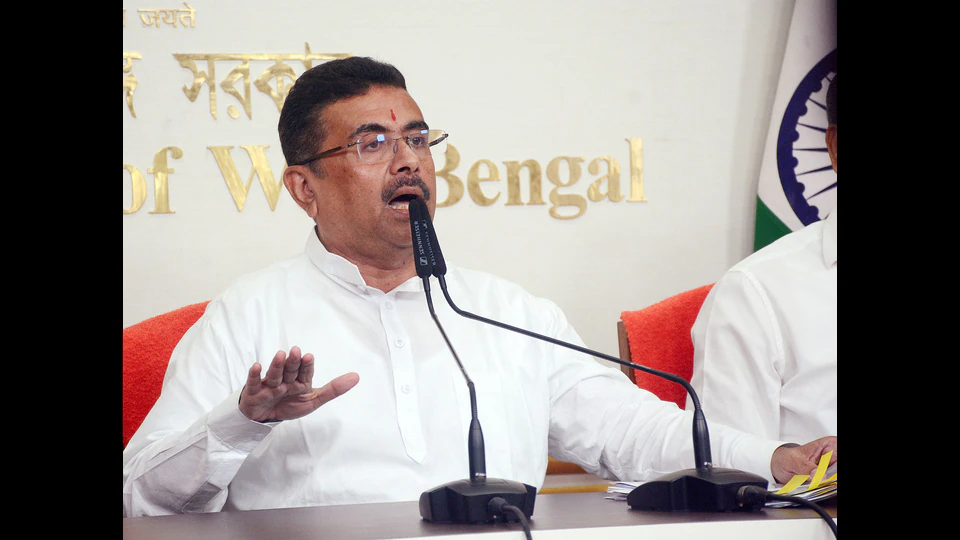
West Bengal Chief Minister Suvendu Adhikari has announced that his government will introduce a bill to change the state’s official English name from West Bengal to Paschim Banga during the upcoming legislative assembly session. The proposed legislation is scheduled to be tabled on December 9, potentially ending a long-running debate over the state’s name and how it is represented in English.
The 10-day assembly session will begin on December 4, with the state government planning to introduce eight bills covering several departments. The announcement came after a cabinet meeting at Nabanna, the state secretariat, on Monday. Alongside the proposed renaming, the cabinet approved financial assistance for cow shelters, changes to unemployment allowances, higher meal budgets for people with disabilities living in state-run homes and a shift to monthly electricity billing.
Adhikari said the proposed change would make Paschim Banga the official English name while retaining the Bengali name in its original form, written using the English alphabet. However, the renaming is not yet final: the government must first introduce the bill and secure its passage through the legislative process.
West Bengal Name Change Bill to Be Introduced on December 9
Announcing the legislative agenda, Adhikari said eight bills concerning different government departments would be presented during the assembly session. The bill proposing the change from West Bengal to Paschim Banga is scheduled for December 9.
The departments expected to bring legislation include animal husbandry, panchayat and rural development, refugee rehabilitation, labour, mass education and finance. The government has not provided a complete breakdown of all eight bills in the announcement, but the proposed renaming is among the most politically and historically significant measures on the agenda.
Adhikari said the Bengali name would be represented in English letters once the bill was passed. This distinction matters because the proposal is specifically aimed at changing the state’s English-language official name rather than introducing an entirely different identity for the state.
For now, West Bengal remains the state’s official English name. The cabinet’s announcement signals the government’s intention, but the assembly’s approval and any further constitutional or administrative steps required for an official name change will determine whether the proposal becomes effective.
Why Has West Bengal’s Name Been a Subject of Debate?
The question of West Bengal’s name is closely connected to the Partition of British India in 1947. Before Partition, Bengal was an undivided province. Its eastern and western parts were separated, with the eastern portion becoming part of Pakistan as East Pakistan and the western portion remaining within India as West Bengal.
The names West Bengal and Paschim Banga emerged from this historical division. The eastern region was also commonly referred to as East Bengal and Purba Banga, even after it became part of Pakistan. It later became the independent country of Bangladesh in 1971.
The proposed name Paschim Banga draws on the Bengali-language expression for the western part of Bengal. It would retain the state’s historical and regional association with Bengal while replacing the English name that has been used since Partition.
The issue has also involved practical considerations. Under the name West Bengal, the state appears near the end of alphabetical lists of Indian states. Previous discussions about renaming it have included arguments that a change could improve its position in official listings and better reflect its linguistic and cultural identity.
However, a name change is more than a symbolic decision. It can affect official records, government departments, public institutions, legal documents, maps, administrative databases and communication with central and international agencies. The proposed bill will therefore be an important first step, rather than an immediate change to every official reference.
Cabinet Approves Monthly Assistance of Up to ₹1 Lakh for Cow Shelters
Alongside the renaming proposal, the cabinet approved a monthly financial assistance scheme for individuals and institutions caring for ageing cows. Under the decision announced by Adhikari, eligible cow shelters could receive a maximum of ₹1 lakh per month.
The chief minister said the measure was intended to support people and organisations looking after old and unproductive cattle, which can become a financial burden for dairy owners once they stop producing milk or are no longer economically useful.
Adhikari said the animal husbandry department would prepare a standard operating procedure to determine how the assistance would be implemented and how cow shelters would qualify. The announcement did not specify the full eligibility conditions, application process or total budget allocated to the programme.
He also reiterated his government’s position against cow slaughter, saying it would not permit illegal slaughter in the state. When asked about animals taken to licensed slaughterhouses, he referred to the West Bengal Animal Slaughter Control Act, 1950, indicating that the government would operate within the existing legal framework.
West Bengal Government Reiterates Animal Slaughter Rules
Adhikari’s remarks come after the state home department issued a notification on May 13 referring to the West Bengal Animal Slaughter Control Act, 1950, and an August 2018 order of a Calcutta High Court division bench. The earlier court proceedings concerned a petition seeking restrictions on slaughter in public places.
According to the notification, the slaughter of specified categories of cattle, including bulls, bullocks, cows, calves and buffaloes, requires a written fitness certificate. The certificate must be jointly issued by the relevant municipal chairperson or panchayat sabhapati and a government veterinary surgeon.
The notification sets out conditions under which an animal may be certified as fit for slaughter. These include being over 14 years of age for work or breeding, or having become permanently incapacitated because of age, injury, deformity or an incurable disease.
Adhikari said there had been cases of illegal slaughter in some districts and that people involved had been arrested and jailed. The proposed cow-shelter assistance is intended to provide an alternative for owners struggling to maintain ageing animals.
The effectiveness of the scheme will depend on its implementation, including the availability of funds, transparent selection of shelters and monitoring of how the assistance is used. The government is yet to announce the detailed operating rules.
Unemployment Allowance to Increase for Graduates From January 2027
The cabinet also approved an increase in the monthly allowance for unemployed graduates from ₹1,500 to ₹2,000, with the revised amount scheduled to take effect from January 2027.
Adhikari said the state government would initially raise assistance for graduates while continuing to provide ₹1,500 per month to eligible unemployed people without graduation certificates. The benefit is expected to continue until recipients reach the age of 45, according to the chief minister’s announcement.
The decision forms part of the BJP government’s broader Bharosa scheme, under which it has promised a monthly allowance of ₹3,000 to unemployed people. Adhikari acknowledged that implementing the full promise would require additional time because of pressure on the state’s finances.
He said the government planned to increase the allowance under the wider scheme from the financial year 2028-29. Until then, graduates would receive ₹2,000 from January 2027, while those without graduation certificates would continue to receive ₹1,500.
The revised assistance will be an increase over the ₹1,500 monthly benefit available under the Banglar Yuva Sathi scheme introduced by the previous Mamata Banerjee government. Under that scheme, unemployed people up to the age of 40 were eligible for assistance.
The change in the age limit and the proposed increase in payments could expand the period during which beneficiaries receive support. However, the allowance remains a form of financial assistance and does not replace the need for employment opportunities, recruitment or measures to improve access to stable work.
10,146 Government Jobs Announced Across Departments
Adhikari also announced that 10,146 government jobs would be filled soon across different departments, including the police. He said the government had removed entry examination fees for these recruitment opportunities.
The announcement comes alongside the government’s emphasis on employment support and recruitment. However, the chief minister did not provide a detailed department-wise distribution of the vacancies, recruitment calendar or examination schedule in the statement.
The removal of examination fees could reduce one financial barrier for applicants, particularly those from economically weaker backgrounds. The actual impact will depend on when recruitment notifications are issued, how vacancies are distributed and how quickly the selection process is completed.
Meal Budget for People With Disabilities Raised to ₹110 a Day
Another cabinet decision concerns people with disabilities living in state-run residential homes. The government has increased the daily meal budget per person from ₹56 to ₹110, more than doubling the previous allocation.
The increase is intended to improve the resources available for food in these institutions. A higher per-person allocation could help residential homes manage meal expenses and provide better food provisions, although the practical outcome will depend on procurement costs and the quality of implementation.
The decision adds a social-welfare component to a cabinet agenda that also includes employment assistance, cattle care and administrative changes.
WBSEDCL to Replace Quarterly Electricity Bills With Monthly Billing
The cabinet has also decided to replace the quarterly electricity billing system of West Bengal State Electricity Distribution Company Limited (WBSEDCL) with monthly billing.
Adhikari said the change followed requests from consumers and that WBSEDCL would bear the additional cost associated with moving to a monthly billing system. The announcement did not specify when the new billing cycle would begin or whether any changes would be made to payment deadlines and other consumer procedures.
Monthly billing could make electricity expenses easier for households and businesses to track because consumers would receive bills at shorter intervals instead of facing a larger accumulated amount every three months. It may also help consumers identify unusually high consumption sooner.
Adhikari linked the state’s rising electricity consumption to the reopening of businesses and industries that had previously shut down. He said West Bengal would begin purchasing power from December to meet its electricity requirements.
The chief minister’s comments indicate that the government expects demand to remain high enough to require additional power procurement. However, the announcement did not include details about the quantity of electricity to be purchased, the sources of supply or the expected financial implications.
Eight-Bill Assembly Session to Test the Government’s Legislative Agenda
The December 4 assembly session will provide the state government with an opportunity to advance its policy agenda through legislation. The proposed Paschim Banga bill will be a major focus because it seeks to alter a name that has been part of the state’s official identity for nearly eight decades.
The other cabinet decisions cover areas with more immediate implications for residents, including unemployment assistance, government recruitment, support for ageing cattle, food budgets in residential institutions and electricity billing.
Several of the announcements still require detailed rules, administrative orders or implementation schedules. The cow-shelter scheme needs eligibility guidelines, the employment allowance changes need to be operationalised, and the electricity billing transition will require WBSEDCL to communicate the revised process to consumers.
The government has also indicated that its full promise of ₹3,000 per month for unemployed people will take longer to implement, with the planned increase pushed to the 2028-29 financial year. This makes the distinction between immediate cabinet decisions and longer-term commitments important for beneficiaries.
None of the Trinamool Congress factions had publicly commented on the new policy announcements by 5 pm on Monday. The response from the opposition and the debate in the assembly could shape the political discussion around the proposed name change and the government’s wider legislative programme.
For now, the most significant next date is December 9, when the Paschim Banga bill is scheduled to be introduced. Its passage will determine whether West Bengal moves closer to adopting Paschim Banga as its official English name.
For breaking news and live news updates, like us on Facebook or follow us on Twitter and Instagram. Read more on Latest India on thefoxdaily.com.






COMMENTS 0