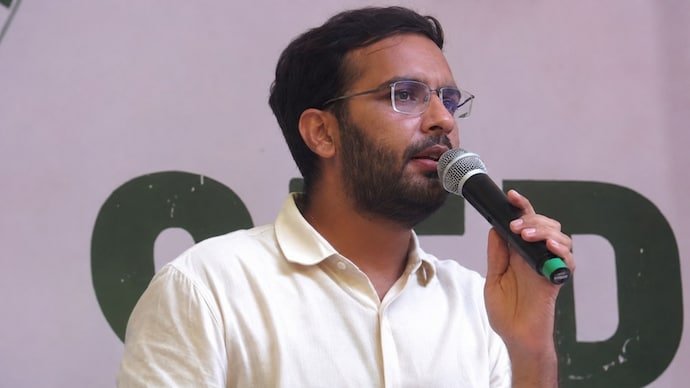
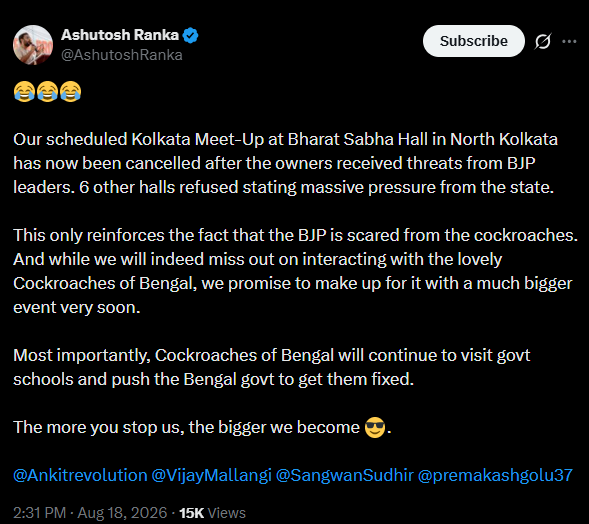
A planned Kolkata meet-up of the Cockroach Janta Party (CJP) was cancelled on Tuesday after the organisation alleged that the owners of the proposed venue and several alternative halls came under pressure not to host the event. CJP co-convenor Ashutosh Ranka attributed the cancellations to alleged threats from BJP leaders, though the allegation has not been independently established.
The dispute comes at a politically sensitive moment for the organisation. The CJP, which emerged from the youth-led protest movement around student and examination issues earlier this year, has increasingly shifted attention towards its “School Theek Karo” campaign, in which volunteers document problems at government schools and demand action from authorities.
Ranka said the organisation had planned to meet supporters at Bharat Sabha Hall in North Kolkata. According to his account, the venue was cancelled after its owners allegedly received threats. He further claimed that six other halls approached as alternatives also declined to host the gathering because of what he described as “massive pressure from the state”.
The cancellation has now become part of a broader confrontation between the CJP and political authorities, with the organisation also threatening further agitation over the death of the father of one of its volunteers in Bankura district.
Why the CJP Kolkata event was cancelled
Ranka announced the cancellation on X, saying that the scheduled Kolkata meet-up at Bharat Sabha Hall could not go ahead after the hall owners allegedly received threats from BJP leaders.
He also said the CJP attempted to find another venue but was unsuccessful. According to his statement, six additional halls refused to host the gathering, with their owners citing pressure from the authorities or political figures.
Those claims are allegations from the CJP and should be distinguished from independently established facts. The available account does not establish which individuals allegedly issued the threats, what form the alleged pressure took, or whether any government or BJP authority formally instructed venue owners to cancel the programme.
That distinction matters because the cancellation itself and the explanation for it are two separate questions. A venue can withdraw from an event for a range of reasons, while an allegation of political intimidation requires separate evidence.
The proposed gathering was intended to give Ranka an opportunity to interact with CJP supporters in Kolkata. Instead, the organisation now says it will hold a larger event in the future.
Ranka says CJP will return with a bigger event
Rather than treating the cancellation as the end of its Kolkata programme, Ranka framed it as evidence that the movement was attracting political attention.
He said the CJP would miss the opportunity to meet its supporters in person but promised a substantially larger gathering at a later stage. The language reflected the organisation’s broader style of political mobilisation, which relies heavily on Social Media, volunteer networks and public campaigns.
The CJP has built much of its recent visibility around direct action rather than conventional party structures. Its earlier nationwide mobilisation brought student grievances into the political spotlight, while its more recent activities have focused on local issues that volunteers say deserve greater administrative attention.
That shift is significant. A campaign centred on government schools can reach communities far beyond the student groups that initially formed the core of the CJP movement. School Infrastructure is also a highly visible local issue, making visits to neglected schools easier to connect with everyday concerns.
What is the “School Theek Karo” campaign?
The CJP’s “School Theek Karo”, or “fix the schools”, campaign is aimed at drawing attention to the condition of government-run educational institutions.
Under the campaign, activists have been visiting schools and documenting issues they say require attention. The focus has included government schools in rural and less accessible areas, where campaigners argue that basic educational infrastructure can become an overlooked political issue.
Ranka said the cancellation of the Kolkata event would not affect that campaign in Bengal. Instead, he indicated that CJP volunteers would continue visiting government schools and pressing the state administration to address problems identified during those visits.
The campaign also illustrates a change in the CJP’s political messaging. Its earlier national Protests were closely associated with examination-related grievances and demands for accountability. The school campaign is more decentralised: instead of concentrating activity in one major demonstration, volunteers can operate in different districts and document individual schools.
That approach can create a different kind of political pressure. A large rally can generate immediate attention, but a sustained campaign based on specific schools, photographs, local complaints and follow-up demands can keep an issue active for much longer.
Bankura death adds to tensions in Bengal
The Kolkata venue dispute comes days after a much more serious incident involving a CJP volunteer’s family in Bankura.
According to the account presented by the CJP and reported by news agencies, volunteer Abdul Hafiz had visited Karishunda Paschimpara Primary School as part of the “School Theek Karo” campaign. Later that night, assailants allegedly entered his home and attacked members of his family.
Hafiz reportedly managed to escape after being assaulted. His father, Sheikh Mohammad Mafik, was subsequently attacked and died while undergoing treatment.
The CJP has alleged that the attackers were associated with the BJP. That is an allegation and should not be treated as an established finding unless supported by the Investigation or judicial proceedings.
The case has nevertheless intensified political tensions around the CJP’s activities in West Bengal because the alleged attack followed the volunteer’s participation in the school campaign.
There is also a separate development in the case that has changed the immediate political context. Reports indicate that police have arrested eight people in connection with the killing, including a person identified as a BJP worker. Arrest, however, does not establish guilt; the allegations against those arrested will ultimately have to be tested through the Criminal Justice process.
CJP gives West Bengal administration a 10-day ultimatum
Following Mafik’s death, the CJP announced a 10-day deadline for authorities to arrest all those it holds responsible and address its other demands.
Ranka warned that failure to meet the demands would lead to a gherao of the Bankura district administration office, followed by a broader agitation.
The organisation has also sought a court-monitored investigation into the conduct of personnel at the Indas police station. The CJP has alleged that the family did not receive adequate assistance from the police, although those allegations remain claims by the organisation rather than established findings.
The family has also made a request that gives the dispute a wider social dimension. Hafiz reportedly declined financial compensation offered by the state and instead sought the construction of a school in his father’s name.
If such a school is eventually established, it would give the campaign a particularly direct connection to the incident: a movement that began by documenting shortcomings in government schools would see one of its supporters asking for a lasting educational institution as a memorial to his father.
The Kolkata cancellation is not the first CJP venue dispute
The organisation says the Kolkata episode follows an earlier dispute over a CJP gathering in New Delhi.
On August 13, a meeting of CJP volunteers at a banquet hall in the capital was reportedly cut short before supporters reconvened at a public park. CJP leaders alleged at the time that the venue owners had cited pressure from above.
The pattern is important, but it should be interpreted carefully. The fact that the CJP has reported problems securing venues in more than one location does not, by itself, prove that the same political actors were responsible in each case.
What it does demonstrate is that venue access has become part of the organisation’s wider political narrative. For a movement that depends heavily on public meetings and volunteer mobilisation, the ability to secure ordinary private spaces can become politically significant.
At the same time, repeated allegations of pressure place the burden on the organisation and authorities to provide evidence. Identifying the people WHO allegedly made threats, documenting communications with venue owners and establishing whether any official intervention occurred would be critical to determining what happened.
Why the dispute matters beyond one cancelled meeting
The immediate issue is whether a political organisation can hold a meeting at a private venue without intimidation or interference. But the larger question concerns the space available for political organising and civic campaigns.
Private halls regularly host political meetings, community events, cultural programmes and organisational gatherings. If venue owners genuinely fear consequences for hosting a particular group, that could have a chilling effect on public participation. Conversely, if cancellations are being interpreted as political intimidation without sufficient evidence, that can also deepen polarisation and obscure the actual facts.
For that reason, the strongest way forward is evidence rather than competing accusations.
The CJP would need to substantiate its allegations about threats and pressure. Venue owners, if willing, could clarify why they withdrew. Authorities could also establish whether any official communication was sent to the halls involved. Those details would help separate a genuine political-interference allegation from an ordinary venue dispute.
CJP’s growing focus on local issues
The Kolkata episode also highlights how the CJP is trying to expand beyond its original protest identity.
The movement gained national attention through student-led mobilisation and demonstrations over examination and Education-related grievances. After its major protest phase, its public messaging has increasingly included local campaigns and direct engagement with communities.
The “School Theek Karo” campaign fits that strategy particularly well. Government schools exist in virtually every part of the country, and their condition can be assessed through concrete observations rather than abstract political arguments.
That does not mean every complaint made by campaigners is automatically valid. School infrastructure issues need to be checked against official records and local circumstances. But the strategy gives activists a clear framework for asking authorities to respond to specific problems.
It also creates the possibility of sustained grassroots activity. Instead of relying exclusively on large demonstrations in major cities, volunteers can visit schools, speak to residents, document conditions and follow up on demands.
What happens next in West Bengal?
The next phase of the dispute is likely to depend on developments in two separate areas: the investigation into Mafik’s death and the CJP’s efforts to continue its school campaign.
The criminal case will be particularly important. Arrests can establish that investigators have taken action, but they do not resolve questions about motive, responsibility or the final legal outcome. A transparent investigation and subsequent court proceedings will be necessary to establish those facts.
The CJP’s 10-day ultimatum creates a second pressure point. If the organisation believes its demands have not been met, it has indicated that it could move from public statements to demonstrations around the Bankura district administration.
Meanwhile, the cancelled Kolkata meet-up may not end the organisation’s efforts to build a presence in the city. Ranka has already indicated that the CJP intends to organise a larger event in the future.
The broader significance of the episode therefore lies less in the loss of one venue and more in what follows. If the CJP can continue its school campaign despite the cancellation, its Bengal activities could become more sustained and locally focused. If the allegations of political pressure are substantiated, the controversy could develop into a larger question about political space and freedom of assembly. If they are not substantiated, the episode may instead remain an example of how quickly competing political narratives can form around a cancelled event.
What readers should take away
The cancellation of the CJP’s Kolkata meet-up is currently based on a straightforward fact and a disputed explanation: the event did not take place, while the claim that BJP leaders threatened hall owners remains an allegation by Ashutosh Ranka.
That distinction is especially important because the incident has occurred alongside a serious criminal case involving the death of a CJP volunteer’s father and an escalating campaign over government-school conditions in West Bengal.
For the CJP, the immediate challenge is to maintain momentum without allowing allegations to replace evidence. For authorities, the challenge is equally clear: complaints involving political intimidation, police conduct and violence should be addressed transparently so that the facts can be established independently.
What happens next will depend on whether the promised larger Kolkata event goes ahead, how the Bankura investigation progresses and whether the “School Theek Karo” campaign expands across more parts of Bengal. Those developments will determine whether the cancelled meeting becomes a brief political controversy or another chapter in the CJP’s growing campaign in the state.
For breaking news and live news updates, like us on Facebook or follow us on Twitter and Instagram. Read more on Latest India on thefoxdaily.com.






COMMENTS 0