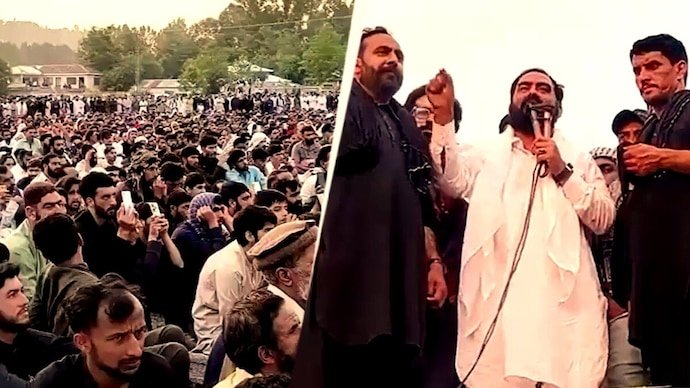
Political unrest in Pakistan-occupied Jammu and Kashmir (POK) has entered a new phase after one of the movement’s leading figures openly challenged Pakistan’s official position on the region. During a massive public gathering in Rawalakot, protest leader Sardar Aman Khan declared that the territory is neither “Azad Kashmir” nor a disputed region but an “occupied territory,” drawing loud applause from thousands of demonstrators.
The statement comes as Protests across Pakistan-administered Kashmir continue for more than a month, evolving from demonstrations against shortages of Food, medicines and essential supplies into a broader movement demanding political reforms, economic relief and greater accountability from authorities.
While Pakistan has yet to officially respond to Khan’s remarks, the speech has attracted significant attention because it directly contradicts Islamabad’s long-established political narrative regarding the territory.
Rawalakot Rally Marks a Turning Point
The latest protest was held at Eidgah Ground in Rawalakot, where thousands of residents gathered despite weeks of political tension. Addressing the crowd, Sardar Aman Khan made one of the strongest public statements yet against Pakistan’s position on the region.
“This is not a disputed territory. It is an occupied territory.”
The crowd responded with prolonged applause and slogans, reflecting growing public dissatisfaction among sections of the local population.
Observers note that while criticism of governance and economic conditions has been common in the region, openly rejecting Pakistan’s official terminology in a mass public gathering represents a significant political development.
Why the Statement Is Significant
Pakistan officially refers to the territory under its administration as “Azad Jammu and Kashmir” (AJK), meaning “Free Jammu and Kashmir.” The term has remained central to Islamabad’s diplomatic and constitutional position for decades.
By rejecting both the description of the region as “Azad” and the characterization of it as merely “disputed,” protest leaders have introduced a sharper political message that extends well beyond economic grievances.
The remarks are likely to generate wider debate because they challenge the official narrative presented by Pakistani authorities both domestically and internationally.
How the Protest Movement Began
The current demonstrations initially emerged over practical concerns affecting everyday life.
Residents alleged that restrictions on the movement of essential commodities—including flour, food grains and medicines—created severe hardships for local communities.
As shortages persisted, protests gradually expanded to include broader economic and governance-related issues.
Today, organizers say the movement represents a wider campaign demanding reforms rather than a single-issue protest.
Key Demands Raised by Protesters
According to protest organizers, the movement now revolves around a comprehensive charter of demands covering multiple aspects of governance and public welfare.
- Improved access to food and essential supplies.
- Affordable electricity tariffs.
- Lower Inflation and cost of living.
- Employment opportunities for young people.
- Greater transparency in governance.
- Political representation and accountability.
- Better public services.
- Relief from rising economic pressures.
Protest leaders argue that the movement reflects years of accumulated public frustration rather than only recent shortages.
Economic Hardships Fuel Public Anger
Like many regions across South Asia, Pakistan-administered Kashmir has experienced increasing economic pressures in recent years.
High inflation, rising energy costs and disruptions in supply chains have placed additional burdens on households already facing limited employment opportunities.
Local residents participating in demonstrations argue that shortages of essential commodities have made living conditions even more difficult.
For many families, concerns about food security and Healthcare have become immediate priorities alongside broader political demands.
Political Messaging Has Become More Assertive
One notable feature of the recent demonstrations is the evolution of protest rhetoric.
Earlier rallies primarily focused on economic issues such as electricity bills and food availability.
More recent gatherings, however, have increasingly included political statements questioning administrative arrangements, governance and the future direction of the region.
Several speeches have also emphasized questions surrounding political identity and local decision-making.
Demonstrations Near the Line of Control
Some of the largest protests have taken place in areas close to the Line of Control (LoC), the military control line separating the Indian and Pakistan-administered parts of Jammu and Kashmir.
During recent rallies, speakers urged authorities to address growing public dissatisfaction before tensions escalate further.
At one point during the gathering, protest leaders asked participants whether they should march toward the Line of Control, prompting loud chants from sections of the crowd.
Such developments have drawn attention because demonstrations near sensitive border regions often carry broader political and security implications.
Understanding Pakistan-Occupied Kashmir
Pakistan-administered Jammu and Kashmir, commonly referred to in India as Pakistan-occupied Kashmir (POK), has remained a subject of competing claims between India and Pakistan since 1947.
India maintains that the entire former princely state of Jammu and Kashmir, including territories currently administered by Pakistan, is an integral part of India.
Pakistan, meanwhile, administers the region separately and refers to part of it as Azad Jammu and Kashmir while administering Gilgit-Baltistan under a different governance framework.
The differing constitutional and political positions continue to shape diplomatic relations between the two countries.
| Issue | Current Situation |
|---|---|
| Duration of protests | More than one month |
| Main protest location | Rawalakot and nearby areas |
| Primary concerns | Food shortages, inflation, governance, political rights |
| Political message | Challenge to Pakistan’s official narrative on the region |
| Government response | No official response to recent remarks reported |
Why the Situation Matters
Large-scale public protests in politically sensitive regions often extend beyond local governance issues.
When demonstrations begin combining economic grievances with constitutional and political demands, they can influence domestic debates, Policy discussions and international attention.
Analysts generally note that sustained public dissatisfaction becomes increasingly difficult to address solely through administrative measures if broader political concerns remain unresolved.
Humanitarian Concerns Remain Central
Although political messaging has become more prominent, many residents continue to emphasize practical concerns affecting daily life.
Protest organizers allege that restrictions on the movement of essential goods have disrupted access to food and medicines in several areas.
If shortages continue, humanitarian concerns could become a more significant dimension of the ongoing unrest.
Ensuring uninterrupted access to healthcare supplies, food distribution and public services remains critical for civilian well-being irrespective of the political context.
Potential Implications for Regional Stability
Political developments in Pakistan-administered Kashmir are closely watched because of the region’s strategic importance.
Extended periods of unrest can influence governance priorities, economic activity and security planning.
Continued demonstrations may also attract greater international attention if concerns over humanitarian conditions or civil liberties become more prominent.
However, the future direction of the movement will largely depend on whether meaningful dialogue takes place between authorities and protest representatives.
Future Outlook
The protests in Pakistan-administered Kashmir have evolved from demonstrations over essential supplies into a wider movement encompassing governance, economic hardship and political identity. The public remarks by Sardar Aman Khan represent one of the strongest challenges yet to Pakistan’s official narrative regarding the region, adding a new political dimension to an already volatile situation.
Whether the demonstrations continue to expand or gradually subside may depend on how authorities respond to the protesters’ demands, particularly those related to food security, inflation and public services. Without visible progress on these issues, public dissatisfaction could deepen further.
As events continue to unfold, the situation in Pakistan-administered Kashmir is likely to remain under close observation because of its humanitarian, political and regional significance, making it one of the most closely watched developments in South Asia.
For breaking news and live news updates, like us on Facebook or follow us on Twitter and Instagram. Read more on Latest World on thefoxdaily.com.





COMMENTS 0