- Why Trump’s Team Discarded Everything Chinese
- The Long History of US-China Spy Fears
- The Rise of “Clean Device Diplomacy”
- Why China Faces Exceptional Scrutiny
- The Optics Were Awkward But Symbolically Powerful
- Tensions Behind the Diplomatic Smiles
- Trade Talks Overshadowed by Strategic Distrust
- The New Cold War Comparison
- Why This Story Resonated Online
- What the Incident Says About the Future of Diplomacy
- Conclusion
When US President Donald Trump departed Beijing after his closely watched visit to China, the most striking image was not from a trade negotiation room or a state banquet. It was a trash bin sitting near the stairs of Air Force One.
Before boarding the presidential aircraft, American officials reportedly collected and discarded every item handed out by Chinese authorities during the trip from credentials and badges to burner phones, memorabilia, and official gifts. According to reports from members of the travelling press corps, the directive was uncompromising: nothing originating from China would be allowed onboard Air Force One.
At first glance, the scene appeared almost absurd. Diplomats exchanging smiles in public while quietly throwing away each other’s gifts behind the scenes sounds less like traditional statecraft and more like a Cold War spy thriller. Yet the incident highlights something far more serious the enormous level of distrust that now defines US-China relations.
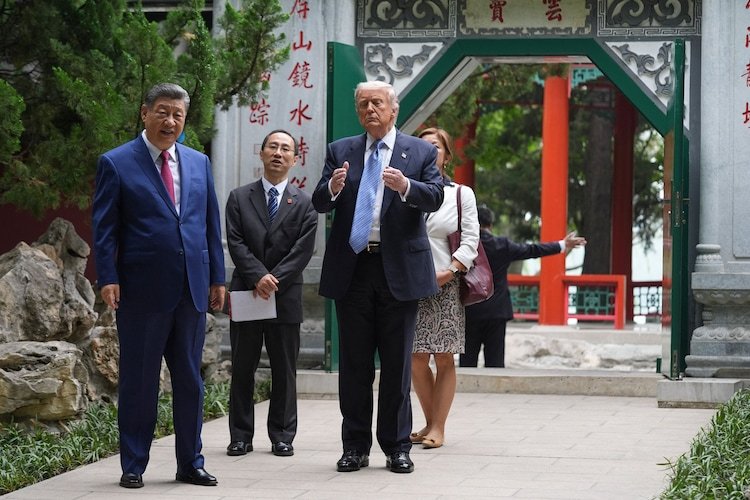
Despite public displays of cordiality between Trump and Chinese President Xi Jinping, the Beijing visit exposed how deeply espionage fears, cyberwarfare concerns, and technological rivalry now shape interactions between Washington and Beijing.
Why Trump’s Team Discarded Everything Chinese
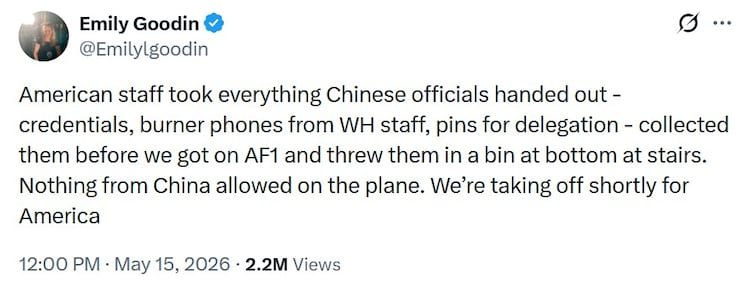
The decision was rooted primarily in security protocol.
US presidential trips to geopolitical rivals involve extraordinarily strict counterintelligence measures. China, in particular, has long been viewed by American intelligence agencies as one of the world’s most sophisticated cyber espionage actors.
Even seemingly harmless objects can theoretically be used for surveillance or digital intrusion. Security agencies worry that electronic devices, gifts, badges, or even conference souvenirs could contain:
- Tracking components
- RFID chips
- Hidden microphones
- Malware-loaded electronics
- Remote-access capabilities
- Data harvesting tools
For that reason, American delegations often adopt a “zero trust” approach during visits to countries considered high-risk from an intelligence standpoint.
In practical terms, this means:
- No personal devices
- No local electronics
- No foreign USB drives
- No unfamiliar accessories
- No externally sourced communication hardware
What made this episode unusual was not necessarily the protocol itself, but the visibility of it. Normally, such precautions happen discreetly behind closed doors. This time, the disposal reportedly occurred in full public view near Air Force One.
The Long History of US-China Spy Fears
The distrust between Washington and Beijing did not emerge overnight.
For decades, the United States and China have accused each other of espionage, cyberattacks, intellectual property theft, and electronic surveillance.
Trump himself acknowledged this reality during the visit when he reportedly remarked that both countries spy on each other extensively.
That blunt admission reflects a broader geopolitical truth: modern superpower rivalry is increasingly fought through invisible digital networks rather than traditional Military confrontation.
Cybersecurity experts have repeatedly warned about sophisticated hacking campaigns allegedly linked to Chinese state-backed groups. US officials have accused Chinese hackers of targeting:
- Government infrastructure
- Defense contractors
- Telecommunications networks
- Energy systems
- Research institutions
- Technology companies
Meanwhile, China routinely accuses the United States of conducting extensive cyber espionage through intelligence agencies such as the NSA.
In other words, suspicion runs both ways.
The result is a diplomatic environment where even ceremonial gifts are treated as potential security liabilities.
The Rise of “Clean Device Diplomacy”
One of the most revealing aspects of the Beijing visit was the reported use of burner phones and burner email accounts by Trump’s delegation.
This practice has become increasingly common during high-risk diplomatic travel.
Instead of carrying personal smartphones loaded with sensitive contacts, private messages, and confidential documents, officials use temporary “clean devices” containing minimal data. These devices are often destroyed, wiped, or discarded after the trip.
The strategy dramatically reduces the potential damage if a device is compromised.
Faraday bags were also reportedly used to isolate devices from wireless signals. These bags block:
- Wi-Fi signals
- Bluetooth connections
- GPS tracking
- RFID communication
- Cellular signals
This level of caution shows how cybersecurity has become central to modern diplomacy.
Twenty years ago, state visits focused largely on physical security threats. Today, digital infiltration may be considered equally dangerous.
Why China Faces Exceptional Scrutiny
Many countries engage in intelligence gathering. So why does China trigger such extraordinary caution from American officials?
The answer lies in scale, capability, and strategic competition.
China is not merely another diplomatic rival. It is America’s biggest long-term geopolitical challenger across multiple fronts:
- Technology
- Artificial intelligence
- Semiconductor manufacturing
- Military modernization
- Trade dominance
- Rare earth supply chains
- Cyber warfare capabilities
This broader rivalry shapes every interaction between the two countries.
American intelligence agencies have repeatedly described China as one of the most active cyber espionage threats facing the United States. Concerns intensified after multiple allegations involving intellectual property theft, hacking campaigns, and surveillance operations targeting Western governments and corporations.
As a result, American officials often operate in China under protocols that resemble intelligence operations more than traditional diplomacy.
The Optics Were Awkward But Symbolically Powerful
Diplomatic gifts traditionally symbolize goodwill and mutual respect. Publicly throwing them away creates an uncomfortable visual contradiction.
On one hand, Trump and Xi Jinping projected friendliness during meetings and photo opportunities. On the other, the visible disposal of Chinese-issued items revealed how little trust actually exists beneath the surface.
The contrast perfectly captures the modern US-China relationship:
- Economically intertwined
- Politically cooperative when necessary
- Strategically suspicious at nearly every level
It is a relationship built on simultaneous dependence and rivalry.
The United States relies heavily on Chinese manufacturing and supply chains. China relies heavily on American consumer markets and advanced technologies. Yet both nations increasingly view each other as strategic threats.
That contradiction explains why even seemingly small gestures during diplomatic visits now carry outsized symbolic meaning.
Tensions Behind the Diplomatic Smiles
Reports of clashes between Chinese officials and the US Secret Service further underscored the tense atmosphere surrounding the visit.
According to accounts from journalists accompanying the delegation, disputes reportedly emerged over security access, firearms protocols, and crowd control during events in Beijing.
Such incidents may appear minor, but they reveal how carefully choreographed state visits can quickly become strained when competing security systems collide.
American protective agencies prioritize unrestricted security access around the president. Chinese authorities, meanwhile, tightly control movement and enforcement within their territory.
That creates inevitable friction.
The episode involving a White House aide reportedly being knocked over amid a crowd of reporters added to the sense of operational chaos behind the polished diplomatic imagery.
Modern summit meetings often look smooth on television. Behind the scenes, they can resemble high-pressure logistical combat zones.
Trade Talks Overshadowed by Strategic Distrust
Ironically, Trump’s visit to Beijing was originally expected to focus heavily on trade and economic cooperation.
The US hoped to secure progress on:
- Rare earth supplies
- Trade imbalances
- Agricultural exports
- Boeing agreements
- Technology access
While some agreements reportedly emerged, the visit ultimately highlighted a much larger issue: the US-China relationship is no longer driven primarily by economics.
It is increasingly defined by national security concerns.
Even during moments of economic negotiation, cybersecurity fears remain omnipresent.
That shift marks a major transformation in global geopolitics. For decades, economic integration was expected to reduce tensions between major powers. Instead, the US-China relationship demonstrates that deep trade ties can coexist with profound strategic mistrust.
The New Cold War Comparison
Many analysts now compare US-China tensions to a modern version of the Cold War.
The comparison is imperfect China and the US remain deeply economically connected in ways the Soviet Union and America never were. However, certain similarities are becoming difficult to ignore:
| Cold War Era | Modern US-China Rivalry |
|---|---|
| Nuclear competition | Technology and AI competition |
| Espionage networks | Cyber espionage operations |
| Ideological rivalry | Governance and economic system rivalry |
| Military alliances | Indo-Pacific strategic blocs |
| Propaganda battles | Information warfare and social media influence |
The disposal of Chinese gifts may appear trivial compared to these larger issues, but symbolic moments often reveal deeper geopolitical realities.
In this case, the trash bin near Air Force One became a metaphor for the collapsing trust between the world’s two largest powers.
Why This Story Resonated Online
The incident quickly exploded across social media because it combined several elements people find irresistible:
- Superpower rivalry
- Spy-thriller imagery
- Trump’s larger-than-life political style
- Technology paranoia
- Diplomatic awkwardness
There was also an almost cinematic quality to the scene.
A presidential delegation arriving with burner phones, using signal-blocking bags, discarding foreign items, and operating under strict surveillance precautions sounds less like routine diplomacy and more like a Hollywood intelligence drama.
But beneath the memes and jokes lies a sobering reality: cybersecurity fears have become deeply embedded in international politics.
What the Incident Says About the Future of Diplomacy
The Beijing episode offers a glimpse into how diplomacy itself is changing.
Future state visits between major powers may increasingly resemble high-security technological operations rather than traditional diplomatic exchanges.
Cybersecurity teams, intelligence agencies, digital surveillance experts, and electronic countermeasure specialists now play critical roles alongside diplomats.
This transformation reflects a world where information has become one of the most valuable strategic assets.
The fear is no longer limited to physical espionage. It now includes:
- Data interception
- Network infiltration
- Biometric tracking
- Digital surveillance
- AI-driven intelligence collection
In that environment, even a simple conference badge can be viewed as a potential vulnerability.
Conclusion
The decision by Donald Trump’s delegation to discard every Chinese-issued item before boarding Air Force One was not merely an overdramatic security ritual. It was a visible expression of the deep strategic distrust now shaping US-China relations.
Behind the public handshakes and diplomatic smiles lies an increasingly intense rivalry involving cybersecurity, surveillance, technology, trade, and geopolitical influence.
The incident also revealed how modern diplomacy has entered a new era one where digital threats are treated with the same seriousness as physical ones.
In previous decades, world leaders worried primarily about bombs, assassinations, or military confrontation. Today, they worry about compromised phones, hidden trackers, data theft, and cyber infiltration.
That shift may ultimately define 21st-century geopolitics.
And in Beijing, for one brief moment near the stairs of Air Force One, that invisible global struggle became impossible to ignore.
For breaking news and live news updates, like us on Facebook or follow us on Twitter and Instagram. Read more on Latest World on thefoxdaily.com.




COMMENTS 0