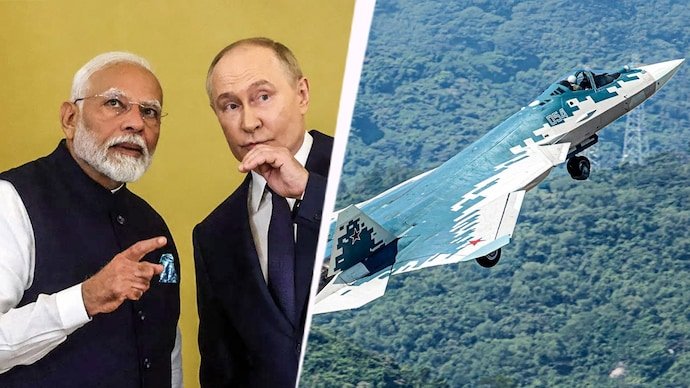
The future of air warfare is increasingly being shaped by stealth technology, advanced sensors, Artificial Intelligence, and network-centric combat systems. For India, maintaining air superiority in an evolving strategic Environment has become one of the most important defense priorities of the coming decade.
Against this backdrop, Russian President Vladimir Putin‘s renewed offer to jointly develop and manufacture the Sukhoi Su-57 stealth fighter with India has reignited a debate that has remained dormant since New Delhi withdrew from the Fifth Generation Fighter Aircraft (FGFA) program in 2018.
The proposal comes at a time when the Indian Air Force (IAF) operates no fifth-generation fighter aircraft, while neighboring countries continue investing heavily in next-generation military technologies. With India’s indigenous Advanced Medium Combat Aircraft (AMCA) still years away from operational deployment, policymakers now face a strategic question: should India revisit the Su-57 or continue relying exclusively on its indigenous roadmap?
Why Fifth-Generation Fighter Jets Matter More Than Ever
Modern air combat is no longer defined solely by speed, maneuverability, or weapon payload. The ability to detect an adversary first while remaining undetected has become a decisive battlefield advantage.
Fifth-generation fighter aircraft combine multiple technologies that fundamentally change aerial warfare:
- Stealth characteristics that reduce radar visibility.
- Advanced sensor fusion systems.
- Electronic warfare capabilities.
- Networked battlefield communication.
- Precision strike functionality.
- Enhanced situational awareness.
Recent conflicts have demonstrated that aircraft capable of operating inside heavily defended airspace possess a significant operational advantage. As air defense systems become more sophisticated, stealth platforms are increasingly viewed as essential rather than optional.
The Indian Air Force’s Emerging Capability Gap
The Indian Air Force remains one of the world’s largest and most capable air arms. However, its modernization efforts face several challenges.
Many frontline fighter squadrons continue to rely on fourth-generation and 4.5-generation aircraft. While platforms such as the Rafale, Su-30MKI, and upgraded Mirage 2000 remain highly capable, they do not fully replicate the stealth advantages offered by fifth-generation fighters.
The concern is not immediate obsolescence but future readiness. Military planners must prepare for threats expected over the next 20 to 30 years rather than focusing only on current operational requirements.
This long-term perspective is driving India’s interest in acquiring or developing a fifth-generation platform.
What Makes the Su-57 Important?
The Sukhoi Su-57 is Russia’s most advanced fighter aircraft currently in operational service. Designed as a multirole stealth fighter, it was developed to compete with other fifth-generation platforms such as the American F-35 Lightning II and china‘s emerging stealth fighter programs.
The aircraft combines several advanced features:
- Reduced radar cross-section.
- Internal weapons bays.
- Supercruise capability.
- Advanced avionics.
- Long-range engagement capability.
- High maneuverability.
Unlike some Western designs that prioritize stealth above all else, Russian aerospace philosophy traditionally seeks a balance between stealth, agility, speed, and firepower.
This approach makes the Su-57 somewhat unique among fifth-generation fighters.
The Forgotten FGFA Program
Putin’s latest proposal is not entirely new. India and Russia previously explored a joint fifth-generation fighter initiative through the FGFA program.
The project envisioned a customized version of the Su-57 tailored to Indian requirements. However, after years of discussions, India chose not to proceed.
Several factors reportedly contributed to the decision:
- Concerns regarding stealth performance.
- Questions about engine development.
- Dissatisfaction with technology transfer arrangements.
- Cost-sharing disagreements.
- Differences over aircraft customization.
At the time, Indian defense planners concluded that the proposed arrangement did not fully align with the Air Force’s operational expectations.
The decision also reflected India’s growing focus on indigenous defense manufacturing.
Why the Situation Is Different Today
Much has changed since 2018.
Global military competition has intensified. Stealth technology has become increasingly central to defense planning. Air forces across the world are accelerating investments in next-generation combat systems.
Meanwhile, India’s AMCA program remains under development. Although significant progress has been made, complex aerospace projects typically require years of testing, certification, and production before reaching operational squadrons.
This creates a period during which India may lack a dedicated fifth-generation capability.
Putin’s offer appears designed to address precisely this challenge.
The AMCA: India’s Long-Term Vision for Air Power
The Advanced Medium Combat Aircraft is arguably one of India’s most ambitious defense projects.
More than simply a fighter aircraft, AMCA represents India’s aspiration to become a major aerospace power capable of independently designing advanced combat platforms.
The project is expected to incorporate:
- Stealth technology.
- Artificial intelligence integration.
- Advanced electronic warfare systems.
- Indigenous weapons integration.
- Future upgrade potential.
The program aligns closely with India’s broader objectives of strategic autonomy and defense self-reliance.
Successful completion of AMCA would significantly strengthen India’s aerospace ecosystem while reducing long-term dependence on foreign suppliers.
Could the Su-57 Become a Bridge Solution?
One possibility attracting attention among defense analysts is the idea of using the Su-57 as an interim capability.
Under this approach, India could acquire or jointly manufacture a limited number of Su-57 fighters while continuing to prioritize AMCA development.
Such a strategy could provide several advantages:
- Immediate access to fifth-generation technology.
- Operational experience with stealth warfare.
- Training opportunities for pilots and engineers.
- Development of future combat doctrines.
- Enhanced deterrence capabilities.
This would allow India to gain practical experience operating fifth-generation fighters before AMCA enters service.
The Technology Transfer Factor
Perhaps the most significant element of Putin’s proposal is not the aircraft itself but the promise of extensive technology sharing.
Technology transfer has long been a central requirement of India’s defense procurement strategy.
India increasingly seeks partnerships that contribute to domestic industrial development rather than simple equipment purchases.
If Russia is genuinely prepared to provide meaningful access to critical technologies, the proposal could become far more attractive from an industrial perspective.
The benefits would extend beyond the fighter program itself and could strengthen India’s broader aerospace manufacturing base.
How the F-35 Changes the Conversation
The Su-57 is not the only fifth-generation option discussed in strategic circles.
The American F-35 remains the world’s most widely deployed stealth fighter and has become a benchmark for fifth-generation combat aviation.
While the aircraft offers highly advanced capabilities, Western defense partnerships often come with stricter conditions regarding software access, source codes, modifications, and technology sharing.
For a country that prioritizes strategic independence, these considerations are often as important as raw military performance.
| Factor | Su-57 | F-35 | AMCA |
|---|---|---|---|
| Status | Operational | Operational | Under Development |
| Origin | Russia | United States | India |
| Technology Transfer Potential | High | Limited | Full Domestic Control |
| Immediate Availability | Yes | Yes | No |
| Industrial Benefits | Joint Production Possible | Limited | Maximum |
Regional Implications for South Asia
The induction of fifth-generation fighters into the region would significantly influence the military balance.
Stealth aircraft complicate enemy planning, reduce response times, and increase uncertainty for adversaries.
For India, acquiring such capabilities could strengthen deterrence while enhancing flexibility across multiple operational theaters.
At the same time, it could accelerate regional modernization efforts, encouraging neighboring countries to pursue comparable technologies.
The Economic and Industrial Dimension
Major defense acquisitions are also economic decisions.
Fighter aircraft programs involve investments worth billions of dollars across manufacturing, infrastructure, maintenance, training, and lifecycle support.
A genuine joint-production arrangement could generate:
- High-skilled employment.
- Technology absorption.
- Supply chain development.
- Research and development growth.
- Export opportunities.
These industrial benefits may ultimately carry as much weight as the aircraft’s combat performance.
The Strategic Choice Facing India
India is not choosing merely between one fighter jet and another. It is deciding how to balance immediate military requirements with long-term technological independence.
The decision involves several competing priorities:
- Operational readiness.
- National Security requirements.
- Indigenous capability development.
- Budgetary constraints.
- Geopolitical relationships.
The answer may not necessarily be an either-or choice. India could potentially pursue a hybrid strategy that addresses near-term operational needs while continuing to invest heavily in indigenous programs.
Future Outlook
Putin’s renewed Su-57 proposal arrives at a pivotal moment for India’s defense modernization journey. The offer reflects Russia’s desire to deepen strategic cooperation while also addressing a genuine capability gap facing the Indian Air Force.
Whether India ultimately chooses the Su-57, pursues alternative foreign options, or remains fully committed to AMCA, the underlying challenge remains unchanged: securing a credible fifth-generation combat capability in an increasingly contested security environment.
The coming years are likely to determine not only the future composition of the Indian Air Force but also the direction of India’s aerospace industry for decades to come.
Conclusion
Russia’s offer to jointly develop and produce the Su-57 with India has reopened one of the most consequential debates in Indian defense planning. The proposal arrives at a time when stealth technology is becoming central to modern warfare, regional military competition is intensifying, and India’s indigenous AMCA program remains under development.
The decision ahead is about far more than purchasing aircraft. It concerns strategic autonomy, technological advancement, industrial development, and long-term national security. Whether India chooses to revisit the Su-57, explore other foreign options, or focus exclusively on indigenous solutions, the outcome will play a critical role in shaping the country’s air power and defense posture throughout the twenty-first century.
For breaking news and live news updates, like us on Facebook or follow us on Twitter and Instagram. Read more on Latest World on thefoxdaily.com.





COMMENTS 0