
- What Happened: Key Details of the Earthquake
- Tsunami Threat: Why Warnings Were Issued Quickly
- Government Response: Rapid Action to Minimize Risk
- Impact on Infrastructure and Daily Life
- Nuclear Safety: No Immediate Threat Detected
- Why Japan Is So Vulnerable to Earthquakes
- Lessons from the 2011 Tohoku Disaster
- A Critical Insight: Preparedness vs Uncertainty
- What Happens Next?
- Conclusion: A Reminder of Nature’s Power and Human Preparedness
A powerful earthquake measuring between 7.4 and 7.5 magnitude has struck off japan’s northeastern coast, prompting urgent tsunami warnings and mass evacuations across vulnerable coastal areas. The quake, detected off the eastern coast of Honshu, has once again highlighted the constant seismic threat facing Japan and the efficiency of its disaster response systems.
Within minutes of the tremor, authorities issued alerts warning of possible tsunami waves as high as three meters in certain regions. Emergency systems were activated, transport services halted, and residents urged to move to higher ground.
What Happened: Key Details of the Earthquake
The earthquake occurred offshore near Japan’s northeastern coastline, an area frequently impacted by Seismic Activity due to its location along the Pacific Ring of Fire.
- Magnitude: 7.4–7.5 (varies by reporting agencies)
- Location: Off the east coast of Honshu
- Tsunami Warning: Up to 3 meters in parts of Iwate, Hokkaido, and Aomori
- Initial Wave Observations: Below warning levels but still rising in some areas
Although early tsunami waves recorded at Ports were smaller than feared, authorities have emphasized that conditions can change rapidly.
Tsunami Threat: Why Warnings Were Issued Quickly
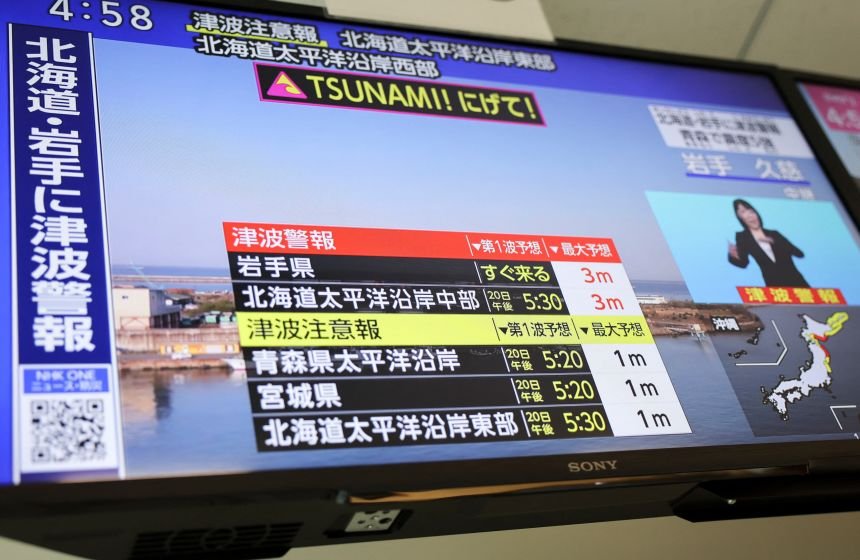
Tsunami warnings are issued not based on observed waves, but on the potential risk following undersea earthquakes. In this case, the quake’s strength and location triggered immediate concern.
Initial observations include:
- 0.8-meter wave at Kuji Port
- 0.4-meter wave at Miyako Port
While these are below the maximum warning threshold, experts caution that multiple waves can follow and later waves can be stronger.
Government Response: Rapid Action to Minimize Risk
Japan’s Leadership responded swiftly. Prime Minister Sanae Takaichi called for immediate evacuations in affected regions, emphasizing safety over uncertainty.
“Residents in areas under tsunami warning must move to higher ground or designated evacuation buildings immediately.”
An emergency task force has been established to assess damage, coordinate rescue operations, and provide real-time updates.
This rapid response reflects Japan’s extensive disaster preparedness framework, built through decades of experience with earthquakes and tsunamis.
Impact on Infrastructure and Daily Life
The earthquake has already disrupted key Infrastructure, particularly in northern Japan.
- Bullet train services suspended due to power outages
- Regional train lines halted across affected prefectures
- Evacuations initiated in coastal communities
In Tokyo, tremors were felt for several minutes, underscoring the quake’s intensity even at a distance from the epicenter.
Nuclear Safety: No Immediate Threat Detected
One of the most critical concerns following any major earthquake in Japan is the safety of nuclear facilities.
Operators of key plants, including Fukushima Daiichi and Fukushima Daini, have reported no abnormalities. As a precaution, workers have been evacuated and systems are being closely monitored.
Radiation levels remain within normal ranges, providing some reassurance in the early hours following the quake.
Why Japan Is So Vulnerable to Earthquakes
Japan sits on the Pacific Ring of Fire, one of the most seismically active zones in the world. This region is characterized by tectonic plate boundaries where earthquakes and volcanic activity are frequent.
| Factor | Impact |
|---|---|
| Tectonic Plate Boundaries | Frequent seismic activity |
| Subduction Zones | High risk of powerful undersea quakes |
| Ocean Proximity | Increased tsunami vulnerability |
| Dense Coastal Population | Higher potential impact on communities |
This geographical reality makes disaster preparedness not just important but essential for survival.
Lessons from the 2011 Tohoku Disaster
The 2011 earthquake and tsunami remain a defining moment in Japan’s modern History. That disaster exposed vulnerabilities but also led to sweeping improvements in early warning systems, infrastructure resilience, and public awareness.
Today’s response shows how those lessons have been applied:
- Faster warning systems
- Improved evacuation protocols
- Stronger building standards
- Better coordination between agencies
While no system can eliminate risk entirely, Japan’s preparedness significantly reduces potential damage and loss of life.
A Critical Insight: Preparedness vs Uncertainty
One of the most striking aspects of this event is the balance between preparedness and unpredictability.
Japan’s systems are among the best in the world, yet earthquakes remain inherently unpredictable. This creates a constant tension:
- Preparedness ensures rapid response
- Uncertainty demands constant vigilance
This dual reality defines life in earthquake-prone regions.
What Happens Next?
Short-Term
- Continued monitoring of tsunami activity
- Damage assessments and rescue operations
- Gradual restoration of transport services
Medium-Term
- Infrastructure inspections and repairs
- Economic impact evaluation
- Review of emergency response effectiveness
Long-Term
Events like this often lead to further improvements in disaster management systems, reinforcing Japan’s resilience against future threats.
Conclusion: A Reminder of Nature’s Power and Human Preparedness
The strong earthquake off Japan’s coast is a stark reminder of the country’s vulnerability to natural disasters. Yet, it is also a testament to how preparation, Technology, and swift action can mitigate risk.
While the full impact is still being assessed, early indications suggest that Japan’s systems are once again proving effective under pressure.
In a region where earthquakes are inevitable, resilience is not optional it is a way of life.
For breaking news and live news updates, like us on Facebook or follow us on Twitter and Instagram. Read more on Latest World on thefoxdaily.com.




COMMENTS 0