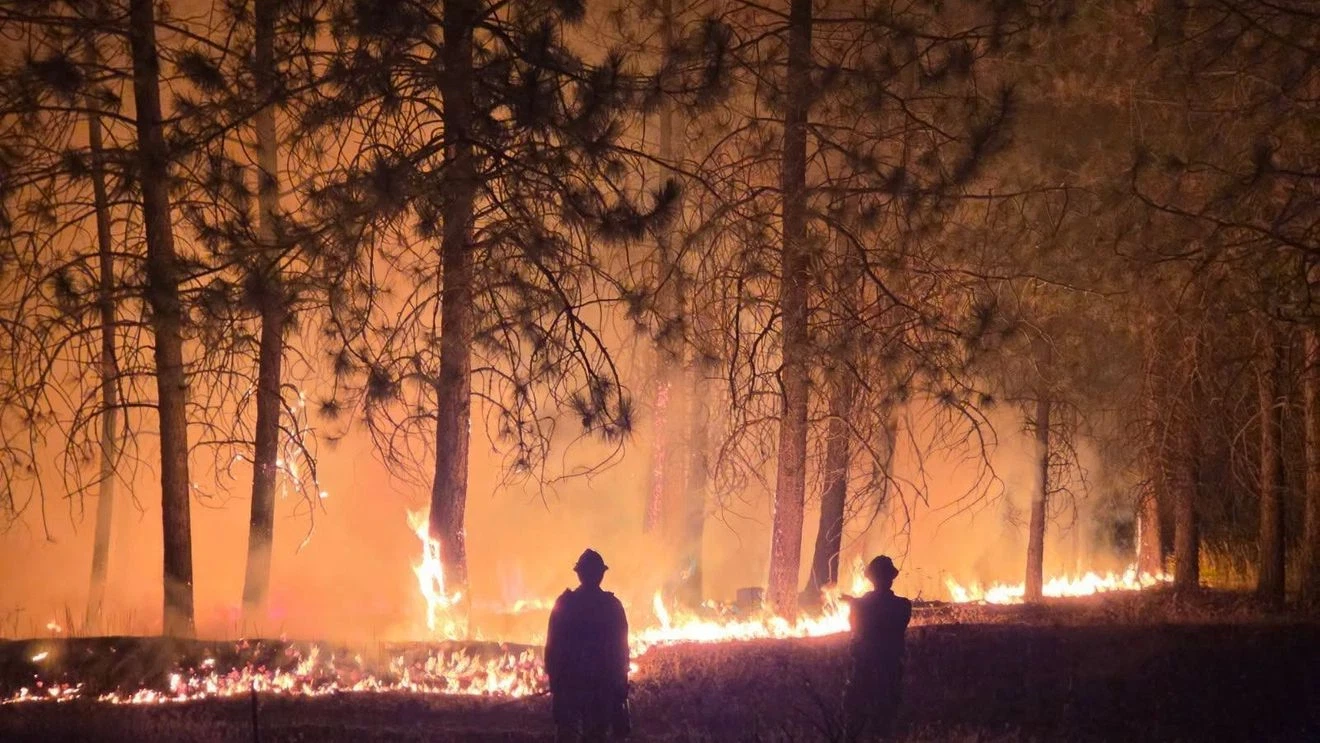
A criminal Investigation has become a central part of the wildfire emergency unfolding around Spokane, Washington, after authorities arrested a local man on suspicion of intentionally starting the Old Trails Fire. The Blaze, the largest of three major wildfires burning near the city, has destroyed hundreds of buildings, displaced tens of thousands of residents and stretched firefighting resources across the region.
The arrest marks a significant development in what has rapidly evolved into one of Washington state’s most destructive wildfire events of the season. While emergency crews continue battling multiple uncontained fires, investigators say the Old Trails Fire is now the subject of an Arson case, adding a law enforcement dimension to an already complex disaster response.
Even as criminal proceedings begin, officials continue to emphasize that firefighting operations remain the immediate priority, with thousands of residents still affected by evacuations and widespread property damage.
Man Charged in Connection With the Old Trails Fire
Authorities identified the suspect as Aaron F. Farinacci, a 37-year-old Spokane resident who was arrested on Monday on suspicion of first-degree arson.
According to the Spokane County Sheriff’s Office, Farinacci was booked in connection with the Old Trails Fire, the largest of three major wildfires burning around Spokane. His bond was set at USD 1 million, and he was scheduled to appear in court on Tuesday.
Officials have not announced charges or causes related to the other two fires, and investigations into those blazes remain ongoing.
How Investigators Linked the Fire to the Suspect
Law enforcement officials credited a vigilant community member with providing the information that ultimately led investigators to the suspect.
Sheriff John Nowels said a witness noticed a nervous-looking man crouched beside a roadside area near dry grass shortly before the fire was reported. Although the individual was initially questioned and released, investigators later revisited the information as the inquiry progressed.
Major crimes detectives subsequently determined that the reported location closely matched the fire’s point of origin. Authorities later identified the individual again and detained him.
According to the sheriff, Farinacci was found carrying matches and a lighter when he was taken into custody.
Nowels praised members of the public for reporting suspicious activity, saying community awareness played an important role in the investigation.
Scale of the Wildfire Emergency
Although the arrest has drawn significant attention, emergency officials stress that the broader wildfire crisis remains far from over.
As of Tuesday morning:
- None of the three major fires had been contained.
- At least 700 buildings had been destroyed.
- Approximately 67,000 people had been ordered to evacuate.
- Roughly 41 square kilometres had burned.
The fires have affected neighborhoods, farms and surrounding communities, leaving widespread destruction across parts of Spokane County.
| Old Trails Fire Emergency Overview | Status |
|---|---|
| Primary criminal investigation | Old Trails Fire |
| Suspect arrested | Aaron F. Farinacci |
| Charge | Suspicion of first-degree arson |
| Buildings destroyed | At least 700 |
| Evacuation orders | Approximately 67,000 people |
| Area burned | About 41 sq km |
| Containment status | None of the three fires contained |
Wildfire Response Continues on Multiple Fronts
More than 1,000 firefighters had been deployed by Monday, including crews from outside Washington state. Officials expected that number to increase significantly in the following days as additional personnel arrived to reinforce local resources.
Fire managers warned that weather conditions could once again become unfavorable. Forecasts indicated stronger winds and temperatures climbing into the 90-degree Fahrenheit range (approximately 32 to 37 degrees Celsius), conditions that can make wildfire suppression more difficult and increase the risk of rapid fire spread.
Benjamin Cossel, a spokesperson for the fire incident management team, said firefighters were preparing for more challenging conditions as weather patterns changed.
How the Old Trails Fire Spread
The Old Trails Fire began on Saturday northwest of downtown Spokane before crossing the Spokane River and moving into residential neighborhoods.
Changing wind patterns initially fueled rapid fire growth before later shifting smoke across western Washington, including the Seattle metropolitan area.
Wildfires can spread quickly under dry conditions, particularly when strong winds carry burning embers ahead of the main fire front. Once embers ignite vegetation or structures, multiple new fire spots can develop simultaneously, making suppression efforts significantly more complex.
Officials have not publicly attributed the spread of the fire to any factor beyond the conditions already described during the Emergency Response.
Residents Return to Devastating Losses
As evacuation orders eased in some locations, residents returned to neighborhoods transformed by fire.
Many discovered homes reduced to ash, with only chimneys or concrete foundations remaining.
Miriam Sim, 76, and her husband Daniel stood where their home had stood since 2005, confronting the reality of rebuilding after decades in the same community.
“There’s nothing to save,” Miriam Sim said while surveying the remains of the property.
Daniel Sim questioned whether rebuilding would be practical at their stage of life, highlighting the deeply personal decisions many affected families now face.
Entire Neighborhoods Show Contrasting Outcomes
The destruction was not uniform.
In several Spokane neighborhoods, burned vehicles, damaged boats and melted household items illustrated the intensity of the flames. Yet across some streets, green lawns and intact homes remained standing.
Residents who were able to do so continued operating hoses and sprinklers around surviving properties while firefighters focused on containing advancing fire lines.
Such contrasts are common during fast-moving wildfires, where wind direction, vegetation, building materials and local conditions can influence which structures survive.
Families Describe Losing Everything
The emotional toll of the fires has become increasingly evident as displaced families assess the damage.
Angela and Wayde Deatherage evacuated Saturday afternoon with their son, taking only a few family photographs and treasured heirloom rings before leaving.
Shortly afterward, security cameras began sending fire alerts to Angela’s phone.
Wayde later returned using back roads and confirmed that their house had already been destroyed. Before leaving the area again, he set up a hose to spray a neighboring property, which ultimately survived.
When the couple returned, they found little remained.
“It’s just ash,” Angela Deatherage said of the home where the family had lived for nearly 22 years.
Her description reflects the experience of many residents who have returned to neighborhoods where decades of memories disappeared within hours.
Another Resident Faces Yet Another Personal Challenge
Karen Faggioli had initially expected firefighters to stop the blaze before it reached her property, recalling previous fires that had eventually been brought under control.
Instead, relatives informed her that her home and three vehicles had been destroyed. A nearby home belonging to her daughter was also lost.
Recovering from breast cancer, Faggioli described herself as emotionally numb, saying she had endured many hardships before and intended to move forward despite the destruction.
Her story illustrates the broader human impact of disasters, where wildfire losses often coincide with other personal challenges facing affected families.
Emergency Declaration Approved
Recognizing the scale of the disaster, Washington state’s congressional delegation requested an expedited emergency declaration from President Donald Trump.
The request was approved, providing additional federal support for the emergency response.
Lawmakers noted that hundreds of residents had lost homes and farms, while many others remained unable to return because firefighters were still extinguishing hotspots and smoldering debris.
Federal emergency declarations can help coordinate resources and support recovery efforts alongside state and local agencies, although the long-term rebuilding process typically extends well beyond the initial emergency response.
Missing Person Reports Largely Resolved
During large-scale evacuations, emergency agencies often receive numerous reports of missing individuals as families become separated or communication networks are disrupted.
Spokane County initially received nearly 300 missing-person reports.
By Monday, authorities said all but 14 had been resolved.
Officials added that those still unaccounted for were believed to be individuals who had not yet re-established contact after evacuating rather than people thought to be trapped or in immediate danger.
This development reduced one of the major uncertainties surrounding the emergency while allowing investigators to focus on remaining cases.
Authorities Warn Against Flying Drones
Emergency officials also urged the public not to operate recreational Drones near wildfire zones.
Drones can interfere with helicopters and fixed-wing aircraft conducting water drops or reconnaissance flights, forcing pilots to suspend aerial firefighting operations for safety reasons.
Authorities stressed that keeping airspace clear helps firefighters respond more effectively during rapidly changing wildfire conditions.
Broader Wildfire Challenges Across the Western United States
The Spokane fires are among dozens of active wildfires affecting the western United States.
Officials said more than 1,000 square kilometres of land has burned across Washington state, which has experienced severe drought conditions and poor snowpack.
These environmental conditions can leave vegetation unusually dry, increasing wildfire risk and making fires more difficult to control once they ignite.
The multiple simultaneous fires have placed significant demands on federal, state and local firefighting resources, requiring assistance from crews deployed across state lines.
Criminal Investigation and Disaster Response Continue Side by Side
The arrest of Aaron F. Farinacci has shifted part of the public focus toward the criminal investigation, but emergency officials continue to emphasize that firefighting operations remain the immediate priority.
Investigators have only linked the arson allegation to the Old Trails Fire. Authorities have not announced causes for the other two major fires burning around Spokane.
The legal proceedings against Farinacci will move through the court system independently of the wildfire response, where firefighters continue working to contain the blazes and protect threatened communities.
What Happens Next?
The immediate outlook depends on several factors, including weather conditions, firefighting progress and continued evacuation efforts.
If forecast winds strengthen as expected, fire crews could face renewed challenges in slowing the spread of the remaining active fires. At the same time, investigators are expected to continue gathering evidence in the arson case connected to the Old Trails Fire.
Longer term, affected communities face the difficult task of recovery, from assessing structural damage and rebuilding homes to restoring essential services. For many families, the disaster represents not only the loss of property but also the loss of years of personal history.
While the criminal case may eventually establish whether the Old Trails Fire was intentionally set, the broader wildfire emergency continues to reshape lives across Spokane as firefighters, emergency responders and residents confront one of the region’s most destructive fire events in recent memory.
For breaking news and live news updates, like us on Facebook or follow us on Twitter and Instagram. Read more on Latest World on thefoxdaily.com.






COMMENTS 0