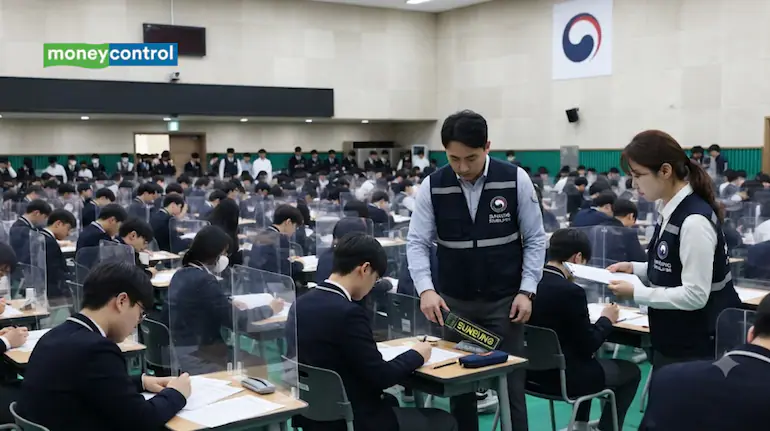
South Korea’s Education Minister Choi Kyo-jin has resigned following a cheating scandal involving concealed electronic devices and Artificial Intelligence (AI), raising serious questions about examination security ahead of the country’s highly competitive university entrance test, known as the Suneung.
President Lee Jae Myung accepted Choi’s resignation on Sunday after the government faced criticism over its preparedness and the emergency measures introduced just days before the annual examination. The controversy began when the top scorer in a national tax accountancy examination admitted to using a hidden camera, a smartphone and AI tools to obtain answers during the test.
The confession triggered concerns that similar technology could be used to cheat in the Suneung, one of the most important examinations in South Korea. Authorities responded with nationwide emergency alerts, stricter inspections and additional restrictions on electronic devices and personal accessories.
Despite the last-minute security measures, the Education Ministry reported that 111 candidates were found carrying unauthorised smart devices during this year’s examination, which was taken by approximately 500,000 students.
Why Did South Korea’s Education Minister Choi Kyo-jin Resign?
Choi’s resignation followed growing criticism over the government’s response to the threat of technology-assisted cheating. The minister acknowledged that the authorities had failed to prepare sufficiently in advance and accepted responsibility for the shortcomings.
In a statement reported by South Korea’s Yonhap News Agency on Sunday, Choi said: “As the minister in charge, I believe I cannot escape criticism that we failed to prepare in advance.”
He added that he was stepping down after the examination had concluded, saying: “Now that the exam has concluded, I feel a deep sense of responsibility and am offering my resignation.”
President Lee Jae Myung accepted the resignation, bringing an end to Choi’s tenure as education minister amid the controversy.
The resignation came after authorities introduced unusual security arrangements shortly before the Suneung. The measures were intended to prevent candidates from using miniature cameras, smartphones and AI applications to obtain answers during the examination.
The episode has also raised broader questions about whether traditional examination security systems are equipped to deal with increasingly sophisticated technology. Devices small enough to remain concealed can potentially capture examination questions and transmit them to external systems capable of generating answers.
What Triggered South Korea’s AI Cheating Scandal?
The controversy intensified after Han Won-seok, who topped South Korea’s national tax accountancy examination in April, admitted to cheating. His exceptionally high score, with just one incorrect answer out of 160 questions, had attracted attention and prompted speculation about how he had achieved the result.
In a video confession, the 34-year-old explained that he had used a concealed microcamera to photograph examination questions. He then sent the images to an AI tool and checked the answers through his smartphone.
“I used a microcamera to photograph the test questions and sent them to an AI, then checked my answers on my smartphone to commit the cheating,” he said.
The admission exposed a method of examination fraud that combines miniature recording equipment, mobile connectivity and AI-powered answer generation. Rather than relying on traditional methods such as notes or assistance from another person inside the examination hall, the candidate allegedly used technology to capture questions and obtain answers externally.
The case became particularly sensitive because Han had achieved the highest score in a national examination. His confession raised concerns about whether other candidates could have used similar methods and whether examination authorities had adequate procedures to detect concealed electronic equipment.
The timing added to the pressure on the Education Ministry. With the Suneung approaching, officials had to respond to the possibility that technology-assisted cheating could undermine confidence in one of the country’s most important academic assessments.
How AI and Hidden Cameras Can Be Used to Cheat in Examinations
The scandal highlighted how AI tools can change the methods available to candidates attempting to cheat in high-stakes examinations. A miniature camera can capture questions without attracting attention, while a smartphone can transmit the images to an AI application for assistance.
AI systems can process photographs of written questions, interpret text and generate possible answers. If a candidate can secretly communicate with an external device, the technology could potentially provide assistance during an examination without requiring another person to enter the examination hall.
The alleged method used in the accountancy examination demonstrated why conventional checks focused only on visible smartphones or written materials may not be sufficient. Small cameras and connected accessories can be difficult to identify through routine inspections.
However, the scandal does not mean that AI itself is responsible for examination fraud. The central issue is the unauthorised use of technology to obtain an unfair advantage. AI can be used legitimately for education, revision and learning, but using it to answer questions during a restricted examination violates the rules governing the test.
South Korea Introduces Emergency Alerts Ahead of Suneung
With only days remaining before the Suneung, South Korean authorities introduced a series of urgent measures to detect concealed electronic devices. The most unusual step involved the use of the country’s national disaster alert system to warn against examination cheating.
On Thursday, three nationwide emergency alerts were issued between 8 am and 3 pm local time. Mobile phones across the country sounded simultaneously, including devices set to silent mode. The alerts also reached tourists using international data roaming services.
Phones that were switched off or placed in airplane mode did not sound the alerts. The exercise marked the first time South Korea had used its national disaster alert system for the purpose of identifying examination cheaters.
The alerts were part of a wider effort to draw attention to unauthorised electronic devices and discourage attempts to use connected equipment during the examination. Their nationwide reach also demonstrated how seriously authorities were treating the potential threat to examination integrity.
Officials introduced additional physical checks at examination centres. Candidates were instructed to cover buttons on their shirts and jackets to prevent the possible concealment of miniature cameras. Authorities also inspected eyewear for hidden recording equipment and increased checks for other electronic devices.
The measures were intended to address concerns that candidates could photograph examination questions using concealed cameras and send the images to AI tools through smartphones or other connected devices.
111 Candidates Found With Unauthorised Smart Devices
Despite the extensive security arrangements, the Education Ministry reported that 111 candidates were found carrying unauthorised smart devices during this year’s Suneung.
The examination was taken by approximately 500,000 students, making the reported number of violations a small proportion of the overall candidate population. Nevertheless, the discovery reinforced the challenges authorities face in preventing electronic devices from entering examination halls.
The ministry’s figures also highlight the scale of the security operation required for an examination conducted nationwide. Officials must ensure that hundreds of thousands of candidates follow the same rules while identifying devices that may be deliberately concealed or disguised as ordinary accessories.
The presence of unauthorised devices does not automatically establish that every candidate found with one used it to cheat. However, examination authorities must determine whether the rules were violated and apply the relevant procedures in individual cases.
Students Worried Ordinary Glasses Could Be Mistaken for Smart Devices
The heightened security checks created anxiety among some students, who feared that ordinary personal accessories could be mistaken for smart technology.
A high school senior told The Korea Times that he was concerned his horn-rimmed spectacles might be mistaken for smart glasses. Another student told Yonhap that he usually wore glasses but decided to use contact lenses for the Suneung to avoid attracting suspicion.
These concerns reflected the uncertainty created by stricter inspections shortly before the examination. While authorities wanted to prevent candidates from using hidden cameras and connected eyewear, students also had to consider whether ordinary accessories could trigger additional scrutiny.
The situation illustrated the difficulty of balancing strict examination security with the need to avoid unnecessary disruption for candidates. Students preparing for the Suneung already face considerable academic pressure, and unexpected changes to examination procedures can add to their anxiety.
Why the Suneung Exam Is So Important in South Korea
The Suneung, officially known as the College Scholastic Ability Test, is one of the most consequential examinations in South Korea’s education system. It plays a major role in determining students’ university admission opportunities and can influence their future career prospects.
The examination can last up to nine hours, placing candidates under intense pressure throughout the day. Performance can have a significant impact on access to prestigious universities, which are widely associated with better employment opportunities and social mobility.
In South Korea’s highly competitive academic environment, students often spend years preparing for the examination. Families, schools and private education institutions devote substantial time and resources to helping candidates achieve strong results.
Because university admissions are closely linked to examination performance, maintaining fairness is essential. If some candidates gain access to answers through concealed electronic devices or AI tools, the credibility of the results could be undermined and students who follow the rules could be disadvantaged.
South Korea Takes Nationwide Measures to Protect Examination Integrity
The importance of the Suneung is reflected in the extensive arrangements made across South Korea each year to ensure that the examination takes place with minimal disruption.
Authorities coordinate transport, public services and other activities around the examination schedule. Aircraft take-offs and landings are rescheduled during the English listening test to reduce noise that could disturb candidates. The opening of the stock market is also delayed as part of the broader arrangements.
These measures demonstrate the national importance attached to the examination. The government treats the Suneung as more than an ordinary academic test because its results can shape students’ educational and professional futures.
The latest cheating scandal has added a new challenge to this system. Traditional arrangements designed to maintain a quiet and orderly examination environment must now be supported by security measures capable of detecting miniature cameras, connected accessories and technology-assisted attempts to obtain answers.
AI Cheating Scandal Raises Questions About Future Exam Security
Choi Kyo-jin’s resignation has turned the controversy into a wider debate about the government’s preparedness for technology-driven examination fraud. The accountancy examination confession exposed how concealed devices and AI applications could be combined to bypass conventional safeguards, forcing authorities to introduce emergency measures ahead of the Suneung.
The discovery of 111 candidates with unauthorised smart devices also shows that enforcing examination rules remains a significant challenge, even with extensive inspections and nationwide alerts.
Going forward, examination authorities will face pressure to develop security procedures that can identify increasingly discreet electronic equipment without creating unnecessary difficulties for genuine candidates. This may require more systematic checks, clearer rules on wearable technology and better preparation before high-stakes examinations begin.
The controversy has also highlighted the need to distinguish between the legitimate educational use of AI and its misuse during restricted tests. As AI tools become more accessible, examination systems will need to adapt their safeguards to protect the fairness and credibility of academic assessments.
For South Korea, the immediate scandal has resulted in the resignation of its education minister and an unprecedented security response around the Suneung. The longer-term challenge will be ensuring that technological advances do not weaken the trust students and universities place in the country’s examination system.
For breaking news and live news updates, like us on Facebook or follow us on Twitter and Instagram. Read more on Latest World on thefoxdaily.com.






COMMENTS 0