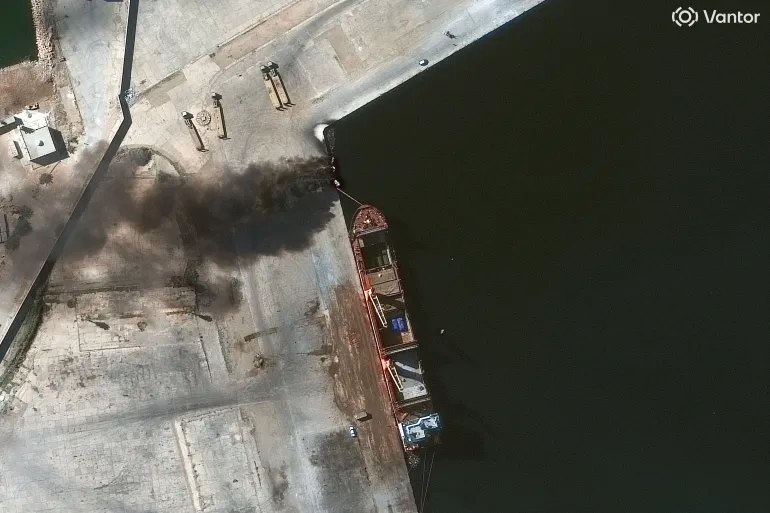
Ukraine has claimed responsibility for a major naval drone operation against Russian vessels near the Libyan port of Benghazi, taking its campaign against Moscow’s military assets far beyond the traditional battlefields of the war. Ukrainian President Volodymyr Zelenskyy said seven Ukrainian-made naval drones were used to attack the Russian corvette Merkury and the transport ship Angara in the Mediterranean Sea.
The operation reportedly took place on Sunday, with Zelenskyy announcing the attack on Monday and describing it as an example of Ukraine’s growing ability to strike Russian military logistics at considerable distances. Ukraine’s Security Service (SBU) said the corvette was sunk, while a Ka-27 helicopter aboard the vessel was also destroyed. The Angara was reportedly hit during the operation.
The attack is significant because it demonstrates how Ukraine is attempting to disrupt Russian military and logistical networks outside the Black Sea. According to the SBU, the targeted vessels were involved in supporting Russian naval operations and transporting military equipment.
However, the extent of the damage has not been independently established. Russia has acknowledged Zelenskyy’s statement but has not publicly confirmed the Ukrainian account. The incident has also triggered diplomatic concerns in Libya, where authorities have described an attack on a vessel inside a national port as a violation of sovereignty and maritime security.
Ukraine Says Seven Naval Drones Targeted Russian Warship Near Benghazi
Zelenskyy said Ukrainian forces deployed seven domestically developed naval drones to strike the Russian corvette Merkury and the transport vessel Angara. The attack reportedly occurred near Benghazi, a major port city in eastern Libya, approximately 1,500 miles from the established front lines of the Russia-Ukraine war.
The Ukrainian president shared footage on X showing unmanned naval vehicles approaching vessels before large explosions and fireballs appeared. He described the operation as an “exemplary Ukrainian operation”, presenting it as evidence that Russian naval assets are vulnerable even far from the principal areas of fighting.
Ukraine’s Security Service provided additional details about how the operation was conducted. According to the SBU, Ukrainian uncrewed boats were transported to a designated location aboard a so-called mother ship before being launched into the water and directed towards their targets.
The agency said the drones reached the vessels despite attempts by Russian forces to destroy them from the air. It also claimed that a Ka-27 multipurpose helicopter stationed aboard the corvette was destroyed in the attack.
The SBU said the operation demonstrated that Russian naval forces and their supply networks could not rely on geographical distance to remain protected from Ukrainian attacks.
Why Were the Merkury and Angara Targeted?
Ukraine has described both vessels as legitimate military targets because of their alleged role in supporting Russia’s military operations. The SBU said the corvette Merkury regularly escorted Russian naval convoys and provided protection to the Angara, which it accused of being used to transport weapons.
The distinction is important because Ukraine’s strategy increasingly focuses on disrupting not only Russian combat forces but also the supply systems that sustain military operations. Transport ships, naval escorts and logistical facilities can all contribute to the movement of equipment and resources required by the armed forces.
According to the Ukrainian account, the Merkury’s role in escorting convoys made it an important part of Russia’s maritime security arrangements. The Angara, meanwhile, was allegedly involved in moving military cargo. Ukraine therefore presented the attack as an operation against vessels supporting Russian military capabilities rather than an indiscriminate strike on commercial shipping.
Ukraine also highlighted the relatively recent commissioning of the Merkury, describing it as one of Russia’s newer naval vessels. The attack, if the Ukrainian account is confirmed, would represent a significant setback for Moscow because of the strategic value of modern naval assets and the resources required to replace them.
Russia Yet to Confirm Ukraine’s Claim That Warship Was Sunk
Moscow has not independently confirmed the sinking of the Merkury. Kremlin spokesperson Dmitry Peskov said on Monday that he was aware of Zelenskyy’s statement but directed questions about the incident to the Russian Defence Ministry.
The Russian Defence Ministry had not issued a detailed public response to the reported attack at the time of the announcement. As a result, the Ukrainian claim that the corvette was sunk and the helicopter destroyed remains unverified independently.
This distinction is important in assessing battlefield announcements. Ukraine and Russia have repeatedly issued competing accounts of attacks, losses and damage during the war. Footage released by one side can provide evidence of an operation, but it does not necessarily establish the full extent of the damage or confirm the final condition of a targeted vessel.
The status of the Angara also requires clarification. Ukraine said the transport ship was hit, but the available announcement did not establish whether it sank, suffered serious damage or remained operational.
Libya Condemns Attack on Vessel at Benghazi Port
The operation has created a diplomatic problem for Libya, a country that has remained politically divided since the 2011 uprising that toppled longtime ruler Moammar Gadhafi.
The eastern Libya-based administration said an explosion occurred aboard a Russian vessel docked at the Benghazi naval base. According to its account, the ship was travelling back towards Russia and had stopped at the port to refuel and take on supplies.
The administration announced that a comprehensive investigation would be conducted in coordination with Russian authorities. It also expressed concern that an attack had taken place inside a Libyan port, describing the incident as a serious violation of national sovereignty, port security and the safety of maritime navigation.
Although the statement did not directly accuse Ukraine, it emphasised that Libya was not a party to the Russia-Ukraine war. The eastern administration’s position reflects concerns that foreign military operations could draw Libyan territory and infrastructure deeper into an international conflict.
The incident is particularly sensitive because eastern Libya has cooperation agreements and maritime facility arrangements with Russia. An attack on a Russian vessel at a port under the eastern administration’s control could therefore complicate its relationship with Moscow.
United Nations Calls for Independent Investigation
The United Nations Support Mission in Libya called for an immediate, independent and transparent investigation into the attack. Its intervention reflects concern about the potential consequences of military operations involving foreign powers inside Libyan territory.
Libya currently has competing political and administrative authorities. A UN-supported government operates from Tripoli in the west, while a rival administration with ties to Russia is based in the east. The country’s division has created an environment in which external powers maintain different relationships with local authorities and armed groups.
The western Libya government also warned against involving Libyan ports and civilian facilities in external conflicts. In its statement, it rejected the idea of turning the country into an arena where international powers settle disputes.
The wording appeared directed at the broader risk of the Russia-Ukraine war spilling into Libyan territory. Although the western administration did not directly assign responsibility for the Benghazi incident, its statement underscored the potential danger to the country’s security and political stability.
Ukraine’s Military Presence in Western Libya Adds Complexity
The situation is further complicated by reports of Ukrainian forces operating in western Libya under an arrangement believed to have the support of Kyiv’s international allies. At the same time, the eastern administration maintains cooperation arrangements with Russia.
This creates an unusual situation in which rival Libyan authorities have different relationships with the two countries involved in the war. Russia has maintained links with eastern Libya, while Ukraine is reported to have established a presence in the west.
The reported naval drone operation near Benghazi could therefore have implications beyond the direct military damage to Russian vessels. It may increase tensions between Libya’s rival administrations and raise questions about how foreign military activity is being conducted around the country’s ports and coastal waters.
For Libya, the central concern is that its divided political landscape could make it vulnerable to becoming an extension of conflicts taking place elsewhere. The UN’s call for an independent investigation is intended to establish the circumstances of the incident and clarify the security implications.
Previous Ukraine-Linked Attack in the Mediterranean
The reported Benghazi operation is not the first incident involving Russian maritime assets in the Mediterranean that has been linked to Ukraine. Libyan officials said Ukrainian forces operating in western Libya struck a Russian tanker near Maltese waters in March in a suspected sea drone attack.
That incident had already raised questions about whether Ukraine was expanding its naval operations into areas far removed from the Black Sea. The latest attack, if confirmed in the form described by Kyiv, would further demonstrate the potential reach of Ukraine’s unmanned maritime capabilities.
Naval drones have become an important part of Ukraine’s strategy against Russia’s larger conventional navy. Uncrewed surface vessels can approach targets without putting a crew directly at risk and can potentially threaten ships in areas where conventional Ukrainian naval forces would face significant disadvantages.
Ukraine has used such systems to challenge Russian naval operations in the Black Sea. Extending these operations into the Mediterranean would represent a wider effort to target Russian maritime logistics and military infrastructure wherever Ukrainian forces can reach them.
Russian Cargo Ship Sparta II Also Hit in Baltic Sea
The Benghazi attack came shortly after another incident involving a Russian-owned cargo ship in the Baltic Sea. The vessel, Sparta II, was struck by drones on Saturday, according to reports, before drifting into Finnish waters.
The Finnish military said the strike was likely carried out by Ukraine. However, Kyiv had not claimed responsibility for the incident, and Ukraine’s Defence Ministry had not immediately responded to a request for comment.
The incident raised concerns about the possibility of the Russia-Ukraine conflict increasingly affecting international shipping routes and waters outside the immediate battlefield. The Baltic Sea is strategically important because it connects several European countries and serves as a major route for commercial and military maritime activity.
Peskov criticised the reported attack on Sparta II, describing it as a dangerous trend involving the expansion of what he called terrorist activity in the Baltic region. Ukraine has not publicly accepted responsibility for the strike.
The two incidents have intensified concerns about the geographic spread of the conflict. While the Benghazi operation was claimed by Ukraine, the circumstances surrounding the Sparta II strike remain less clear.
Ukraine’s Strategy Is Expanding Beyond the Black Sea
Ukraine’s reported attack near Benghazi illustrates how the war is increasingly involving maritime routes and military assets far beyond the main land front. Rather than limiting its operations to territory directly connected to the fighting, Kyiv has sought to strike Russian capabilities that support the country’s military campaign.
Russia’s naval and transport networks are important to the movement of equipment, supplies and other resources. Disrupting these networks could create additional costs for Moscow and force it to devote more resources to protecting vessels and logistical routes.
At the same time, operations in international waters and near foreign ports carry diplomatic and security risks. Even when a target is described as military, an attack in or near another country’s port can create tensions with local authorities and raise concerns about civilian infrastructure and maritime safety.
The Benghazi incident demonstrates this dilemma. Ukraine has presented the operation as a successful strike against Russian military logistics, while Libyan authorities have focused on the alleged violation of their sovereignty and the need for an independent investigation.
Attack Comes Amid Diplomatic Efforts to End the War
The reported escalation in maritime attacks comes amid renewed international diplomatic discussions about ending the war. The incident occurred just days after a three-way summit involving the leaders of Russia, China and the United States.
US President Donald Trump described Russian President Vladimir Putin as his “friend” and said Putin wanted to end the war in Ukraine. However, Zelenskyy expressed doubts about Moscow’s willingness to pursue a genuine peace agreement.
Speaking to NBC News ahead of the Shenzhen summit, the Ukrainian president said he saw no signs that Putin was ready for peace. His comments reflected Kyiv’s continued scepticism about Russia’s intentions despite renewed diplomatic engagement.
The latest naval incidents underline the gap between diplomatic statements and developments on the ground. While international leaders discuss possible ways to end the conflict, both sides continue to pursue military operations designed to weaken the other’s capabilities.
What the Benghazi Attack Means for the Wider Conflict
The reported strike near Benghazi could mark another important stage in Ukraine’s campaign against Russian naval and logistical assets. If the Ukrainian claims are independently confirmed, the destruction of a relatively new Russian corvette and a helicopter would represent a significant operational achievement for Kyiv’s drone forces.
However, the wider consequences may extend beyond the military damage. The incident has brought Libya’s divided political authorities, Russian interests in eastern Libya and reported Ukrainian activity in the west into sharper focus. It has also prompted the United Nations to call for an investigation into an attack involving a vessel inside a Libyan port.
For now, important questions remain unanswered, including the precise extent of the damage to the Merkury and Angara, the circumstances of the attack and the full implications for Libya’s security. Russia’s Defence Ministry has yet to provide a detailed account, while the UN has called for an independent inquiry.
What is clear is that the Russia-Ukraine war is increasingly affecting maritime security beyond the Black Sea. From the Mediterranean near Libya to the Baltic Sea near Finland, incidents involving vessels and unmanned drones are raising the possibility that the conflict’s geographical footprint could continue to widen.
For breaking news and live news updates, like us on Facebook or follow us on Twitter and Instagram. Read more on Latest World on thefoxdaily.com.





COMMENTS 0