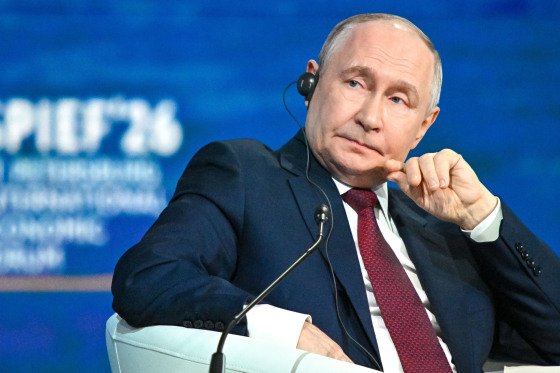
Russian President Vladimir Putin used the St. Petersburg International Economic Forum (SPIEF) to deliver a message that would have seemed improbable just a few years ago: despite years of Conflict, Sanctions, and diplomatic confrontation, Russia remains open to building a new relationship with the United States.
The remarks come at a pivotal moment for Moscow. More than four years after the start of the Russia-Ukraine War, the conflict remains locked in a costly stalemate. Peace negotiations have made little progress, military operations continue on both sides, and fresh Western support for Ukraine signals that the war may persist longer than many initially anticipated.
Against this backdrop, Putin and senior Russian officials are attempting to balance two competing narratives. On one hand, they want to project confidence in Russia’s economic resilience and geopolitical standing. On the other, they must confront the realities of prolonged warfare, sanctions, labor shortages, inflationary pressures, and shifting international priorities.
The result is a complex picture of a country that remains powerful and influential but is increasingly navigating a transformed global environment.
The Ukraine War Has Reached a Strategic Deadlock
One of the most significant developments shaping Russia’s current position is the continued deadlock in Ukraine.
Military analysts have increasingly described the conflict as a war of attrition, where neither side has achieved a decisive breakthrough despite years of fighting.
Russia continues to hold significant territory and maintain military pressure across multiple fronts. Ukraine, meanwhile, remains committed to reclaiming occupied regions while receiving support from Western allies.
The result is a prolonged conflict that imposes substantial costs on both countries.
For Russia, the challenge is not simply military. Long wars place pressure on economies, public finances, labor markets, and political institutions. Even nations with considerable resources eventually face difficult trade-offs when conflicts continue indefinitely.
Why Putin Rejected a Face-to-Face Meeting With Zelenskyy
One of the most closely watched moments of the forum was Putin’s response to calls for direct talks with Ukrainian President Volodymyr Zelenskyy.
The Russian leader dismissed the immediate need for a personal meeting, arguing that technical and diplomatic groundwork must be completed before leaders can meaningfully negotiate.
This position reflects a broader challenge that has hindered peace efforts since the conflict began.
High-level summits often generate headlines, but lasting agreements typically require months of detailed negotiations involving security guarantees, territorial disputes, economic arrangements, prisoner exchanges, and political commitments.
At present, both sides remain far apart on several core issues, making a comprehensive settlement difficult to achieve.
Russia’s Unexpected Message to Washington
Perhaps the most notable aspect of the forum was Russia’s continued emphasis on improving relations with the United States.
Senior officials repeatedly stressed that Moscow remains open to dialogue and cooperation despite years of geopolitical confrontation.
This messaging reflects an important strategic calculation.
Russian policymakers understand that long-term economic growth, investment opportunities, and global stability are easier to achieve in an environment of reduced tensions between major powers.
While disagreements over Ukraine remain profound, the willingness to discuss future engagement suggests that Moscow is attempting to keep diplomatic channels open even amid ongoing conflict.
Whether Washington shares that view remains uncertain.
The Economic Reality Behind Russia’s Public Optimism
Throughout the forum, Putin highlighted positive economic indicators, including low unemployment, technological development, and signs of moderating inflation.
However, beneath the optimistic messaging lies a more nuanced reality.
Russia’s economy has demonstrated resilience in the face of unprecedented sanctions, but resilience does not necessarily mean immunity.
Years of restrictions have altered trade patterns, investment flows, and industrial priorities.
Many businesses have adapted successfully, yet challenges remain significant:
- Restricted access to Western capital markets.
- Reduced foreign investment.
- Labor shortages.
- Higher production costs.
- Technological limitations in certain sectors.
- Ongoing sanctions pressure.
The Russian economy has survived conditions that many observers initially believed would cause far greater disruption, but sustaining long-term growth remains a more difficult challenge.
Sanctions: Effective or Overstated?
One of the most revealing moments at SPIEF came from Russian billionaire Vladimir Yevtushenkov, who openly acknowledged that sanctions have had a meaningful impact.
His comments reflected a growing recognition among business leaders that sanctions have reshaped the economic landscape.
While Russia has successfully redirected portions of its trade toward Asia, the Middle East, and other emerging markets, replacing decades of integration with Western economies is a complex process.
The debate over sanctions often becomes polarized, with critics claiming they have failed and supporters arguing they are highly effective.
The reality lies somewhere in between.
Sanctions have not collapsed Russia’s economy, but they have undoubtedly increased costs, reduced flexibility, and complicated long-term economic planning.
The Iran Factor Is Changing Global Priorities
Another major theme emerging from SPIEF was the impact of the ongoing Iran crisis on international Diplomacy.
Russian officials increasingly believe that developments in the Middle East are competing with Ukraine for attention within Washington’s foreign policy agenda.
This shift matters because geopolitical attention is a finite resource.
When multiple international crises occur simultaneously, governments must prioritize diplomatic efforts, military resources, and political capital.
For Russia, any reduction in international focus on Ukraine could potentially alter the diplomatic landscape surrounding the conflict.
At the same time, instability in the Middle East creates additional uncertainty for global markets and international security.
The Transformation of Russia’s International Partnerships
The composition of attendees at this year’s forum revealed how dramatically Russia’s international relationships have evolved.
Before the Ukraine war, SPIEF regularly attracted major business leaders, investors, and officials from Europe and North America.
Today, delegations from Asia, the Middle East, Africa, and Latin America play a much larger role.
Countries such as china, Saudi Arabia, Iran, India, and others have become increasingly important economic and diplomatic partners.
This transformation reflects a broader trend toward a more multipolar international system in which emerging powers play a larger role in shaping global affairs.
How Russia’s Economy Has Adapted
Despite sanctions and geopolitical tensions, Russia has implemented several strategies to maintain economic stability.
| Challenge | Russia’s Response | Outcome |
|---|---|---|
| Western Sanctions | Trade Diversification | Reduced dependence on Western markets |
| Financial Restrictions | Alternative payment systems | Improved resilience |
| Technology Access | Domestic production initiatives | Mixed results |
| Export Disruptions | New energy customers | Revenue stabilization |
| Labor Shortages | Workforce adjustments | Continuing challenge |
These measures have helped Russia avoid severe economic contraction, though many challenges remain unresolved.
The Human Cost of a Prolonged Conflict
Beyond economic indicators and diplomatic negotiations lies the human reality of war.
Years of fighting have affected millions of people across Russia and Ukraine.
Families have experienced loss, displacement, uncertainty, and economic hardship.
Communities near conflict zones continue to face security risks, while governments devote significant resources to military and reconstruction efforts.
This human dimension often receives less attention during discussions focused on Geopolitics and economics, yet it remains central to understanding the urgency of finding a lasting resolution.
Can Trump Help Break the Deadlock?
Russian officials have repeatedly expressed appreciation for efforts by President Donald Trump to facilitate negotiations.
However, translating diplomatic engagement into concrete progress remains challenging.
Successful peace negotiations typically require both sides to perceive potential benefits from compromise.
At present, neither Moscow nor Kyiv appears convinced that its strategic objectives can only be achieved through concessions.
As long as that calculation persists, diplomatic breakthroughs are likely to remain elusive.
The Rare Earth Opportunity and Economic Reset
One interesting theme discussed at SPIEF involved the potential role of natural resources in improving International Relations.
Russia possesses substantial reserves of rare earth elements and critical minerals that are increasingly important for modern industries, including electric vehicles, renewable energy technologies, electronics, and defense systems.
Some business leaders believe these resources could eventually serve as a foundation for renewed economic cooperation if political conditions improve.
Whether such opportunities materialize depends heavily on future geopolitical developments.
What Happens Next?
The coming months will likely be defined by three interconnected factors.
First, developments on the battlefield will continue influencing diplomatic calculations.
Second, economic conditions inside Russia will shape domestic priorities and policy decisions.
Third, broader geopolitical eventsincluding tensions in the Middle East and relations between major powerswill affect the international environment in which negotiations occur.
While optimism regarding a rapid peace agreement remains limited, both Russia and the United States appear interested in maintaining communication channels.
That alone could prove significant in preventing further deterioration of relations.
Conclusion
The 2026 St. Petersburg International Economic Forum showcased a Russia navigating a period of profound transformation. President Vladimir Putin sought to project confidence in the country’s economic resilience and future prospects while simultaneously signaling openness to a new relationship with the United States.
Yet behind the optimistic rhetoric lies a more complex reality. The war in Ukraine remains unresolved, sanctions continue to impose costs, and shifting global priorities are reshaping international diplomacy. At the same time, Russia has demonstrated a capacity to adapt, develop new partnerships, and maintain influence despite unprecedented external pressure.
The central question now is whether diplomatic engagement can eventually break the deadlock that has defined relations between Russia, Ukraine, and the West for more than four years. Until then, Moscow’s strategy will likely continue balancing military determination, economic adaptation, and cautious outreach to a changing world.
For breaking news and live news updates, like us on Facebook or follow us on Twitter and Instagram. Read more on Latest World on thefoxdaily.com.





COMMENTS 0