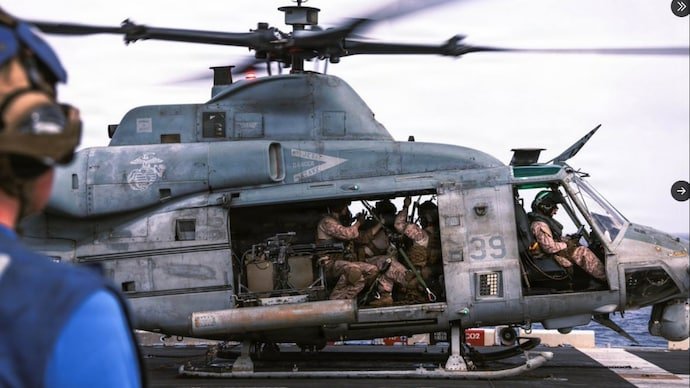
The Middle East has entered another period of heightened uncertainty after the United States launched fresh airstrikes against Iranian military targets while Iran responded with missile activity that extended toward Jordan. The latest escalation follows the reported deaths of US troops in Jordan and has significantly increased concerns that the conflict could expand beyond its current boundaries, drawing more regional powers into direct confrontation.
Beyond the military exchanges, the crisis carries far-reaching implications for global energy markets, maritime security, international diplomacy, and civilian populations across the region. With commercial shipping through the Strait of Hormuz facing unprecedented disruption and diplomatic negotiations under severe strain, analysts warn that every new strike increases the possibility of a broader regional conflict.
What Happened in the Latest US-Iran Escalation?
The United States carried out another round of military strikes targeting facilities linked to Iran’s Islamic Revolutionary Guard Corps (IRGC). According to US military officials, the operation focused on coastal surveillance installations, missile storage facilities, drone infrastructure, air defence systems, and maritime capabilities that could threaten international shipping and regional security.
The strikes came shortly after reports that US service members were killed in Jordan, an incident Washington attributed to Iranian-backed military activity. The latest operation represents a continuation of retaliatory measures intended to weaken Iran’s ability to conduct missile and drone operations while reducing threats against American personnel and allied nations.
Iran, meanwhile, launched missiles toward Jordanian airspace, prompting Jordan’s military to activate air defence systems and intercept several incoming projectiles. Although officials reported no casualties or significant damage, the incident marked another expansion of military activity beyond Iran and its immediate neighbors.
Why Jordan Has Become Increasingly Important
Jordan occupies one of the most strategically significant positions in the Middle East. Sharing borders with Israel, Syria, Iraq, and Saudi Arabia, the country serves as a critical security partner for Western allies while hosting important military facilities used in regional operations.
Missile launches toward Jordan raise concerns for several reasons:
- Jordan hosts key American military installations.
- Its geographic position places it between multiple active conflict zones.
- Any sustained attacks could threaten regional stability.
- Escalation near Jordan increases risks for neighboring Israel.
- Commercial aviation routes across the region may also face additional security challenges.
Because of its role as both a strategic ally and a regional transit hub, any direct military pressure on Jordan has implications extending well beyond its borders.
The Strait of Hormuz Remains the World’s Most Sensitive Energy Chokepoint
One of the most significant aspects of the current crisis is the growing disruption around the Strait of Hormuz.
The narrow waterway connects the Persian Gulf to international shipping routes and serves as one of the world’s most important energy corridors. Before recent hostilities intensified, approximately one-fifth of globally traded crude oil moved through the strait each day, making it essential to international Energy Security.
Any prolonged disruption can affect:
- Global crude oil prices.
- Liquefied natural gas (LNG) exports.
- International shipping costs.
- Marine insurance premiums.
- Supply chains across Asia, Europe, and North America.
| Why the Strait of Hormuz Matters | Global Impact |
|---|---|
| Major oil export route | Influences worldwide fuel prices |
| Critical shipping lane | Affects international trade |
| Strategic naval corridor | Supports military operations |
| Energy supply chain | Impacts electricity and industrial production |
| Global economic stability | Higher transportation and insurance costs |
Understanding the Strategic Objectives Behind the Airstrikes
The latest US operation appears designed to reduce Iran’s ability to coordinate missile launches, operate coastal surveillance systems, and influence maritime traffic in the Persian Gulf. Military analysts note that targeting missile depots, radar installations, and command infrastructure can limit an adversary’s operational flexibility without necessarily requiring a large-scale ground campaign.
At the same time, such strikes carry significant risks. Military facilities are often integrated with broader infrastructure networks, meaning any damage can have secondary effects on nearby civilian services and transportation systems.
Iran’s Response Signals a Broader Regional Strategy
Rather than limiting its response to direct engagement with US forces, Iran has increasingly demonstrated an ability to project military pressure across multiple theaters. Missile launches, drone operations, maritime threats, and support for regional partners have become central elements of its broader deterrence strategy.
This approach allows Tehran to apply pressure across several fronts simultaneously while complicating defensive planning for its opponents.
Regional governments have responded by strengthening air defence readiness, increasing surveillance operations, and coordinating more closely with allied military forces.
Civilian Infrastructure Is Becoming Increasingly Vulnerable
One of the most concerning aspects of the conflict is the repeated impact on infrastructure used by civilian populations.
Recent attacks have reportedly affected facilities including:
- Power infrastructure.
- Water desalination plants.
- Transportation networks.
- Bridges.
- Communication systems.
These facilities provide essential services for millions of people. Damage to energy or water infrastructure can quickly disrupt daily life, healthcare services, emergency response operations, and economic activity.
International humanitarian law generally provides protection for civilian infrastructure unless it is being used for military purposes. Even in such cases, military operations are expected to consider proportionality and minimize harm to civilians.
Regional Air Defence Networks Face Increasing Pressure
Countries across the Gulf have repeatedly activated air defence systems as missile and drone activity has intensified.
Jordan, Kuwait, Bahrain, and Israel all maintain layered defence systems designed to detect, track, and intercept incoming aerial threats. However, modern conflicts increasingly involve combinations of ballistic missiles, cruise missiles, drones, and electronic warfare, making defensive operations substantially more complex.
Large-scale attacks involving multiple weapon types can stretch interceptor inventories and require extensive coordination among military forces.
Shipping Industry Faces Growing Uncertainty
Commercial shipping companies continue to monitor developments closely as security conditions deteriorate.
Reduced maritime traffic through the Strait of Hormuz reflects growing concerns among shipping operators about:
- Missile threats.
- Naval operations.
- Sea mines.
- Drone attacks.
- Insurance costs.
When shipping volumes decline, delays ripple through global supply chains, affecting everything from fuel deliveries to manufactured goods.
Energy Markets Could Feel Long-Term Effects
Energy markets react quickly to uncertainty surrounding major oil-exporting regions. Even temporary disruptions to shipping routes or production facilities can influence international benchmark prices.
Higher crude oil prices often translate into:
- More expensive gasoline and diesel.
- Increased transportation costs.
- Higher manufacturing expenses.
- Rising food prices due to logistics costs.
- Greater inflationary pressure on national economies.
Countries heavily dependent on imported energy are particularly vulnerable to prolonged instability in the Gulf.
The Diplomatic Path Is Becoming Narrower
The latest escalation comes as efforts to establish a longer-term political settlement appear increasingly fragile. Diplomatic agreements intended to reduce hostilities require mutual confidence, verification mechanisms, and sustained communication between all parties involved.
When military operations intensify, political negotiations often become significantly more difficult. Each new exchange can harden positions, reduce trust, and create additional obstacles for future dialogue.
International organizations and regional mediators are therefore likely to continue urging restraint while encouraging renewed diplomatic engagement.
Comparison: Military Objectives of Both Sides
| United States | Iran |
|---|---|
| Protect American personnel and regional allies | Maintain regional deterrence capabilities |
| Reduce missile and drone threats | Preserve strategic influence |
| Secure maritime trade routes | Counter external military pressure |
| Support regional stability | Demonstrate operational resilience |
| Limit escalation while maintaining deterrence | Respond to military actions without appearing weakened |
How the Conflict Could Affect the Global Economy
Although the fighting remains concentrated in the Middle East, its economic consequences extend worldwide.
Businesses dependent on stable shipping routes may experience higher transportation expenses, while investors often respond to geopolitical uncertainty by shifting capital toward safer assets. Tourism, aviation, logistics, and manufacturing sectors may also experience indirect effects if instability continues.
Financial markets typically monitor developments involving major energy-producing regions closely because sustained disruptions can influence inflation, interest rate expectations, and global economic growth.
Military Technology Continues to Shape Modern Warfare
The latest confrontation highlights how precision-guided missiles, drones, satellite surveillance, electronic warfare, and integrated air defence systems are transforming military operations.
Modern conflicts increasingly emphasize long-range precision strikes rather than large conventional offensives. As a result, protecting critical infrastructure and maintaining resilient command networks have become as important as battlefield operations themselves.
Countries around the world are closely studying these developments to refine their own defence strategies and investments.
What Could Happen Next?
Several possible scenarios could emerge in the coming weeks. Military exchanges may continue at a limited level while diplomatic channels remain active, or additional strikes could draw more regional actors into the conflict. Much will depend on whether future attacks target strategic infrastructure, military installations, or civilian population centers.
International efforts to de-escalate tensions are likely to intensify, particularly if shipping disruptions continue to affect global energy markets or if further cross-border missile activity increases risks for neighboring countries.
Conclusion
The latest US airstrikes on Iranian military facilities and Iran’s missile activity toward Jordan mark another dangerous escalation in an already volatile regional crisis. Beyond the immediate military objectives, the confrontation now affects international shipping, global energy security, civilian infrastructure, and regional diplomatic stability.
With the Strait of Hormuz under growing pressure and neighboring countries strengthening air defences, the conflict has evolved into far more than a bilateral dispute. It now represents one of the most significant geopolitical challenges facing the international community, carrying implications for global markets, regional security, and future diplomatic efforts. Whether tensions ease or continue to escalate will depend on military decisions, international mediation, and the willingness of all parties to prevent a broader regional war.
For breaking news and live news updates, like us on Facebook or follow us on Twitter and Instagram. Read more on Latest World on thefoxdaily.com.





COMMENTS 0