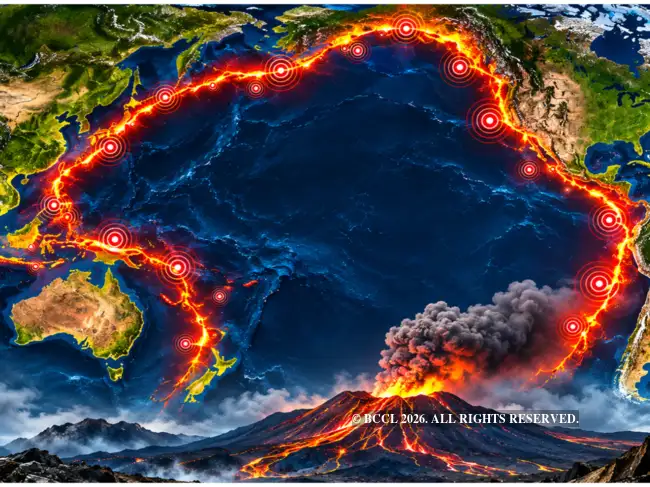
Nearly 200 earthquakes measuring magnitude 4.5 or higher have reportedly occurred across the Pacific Ring of Fire over a seven-day period, drawing attention to seismic activity in one of the world’s most earthquake-prone regions. The reported increase comes as several governments, including those of the United Kingdom, Japan and other European countries, encourage households to maintain emergency supplies and prepare for possible disruptions to essential services.
The developments have raised questions about whether governments are preparing for a major earthquake or tsunami and whether the recent seismic activity signals a larger geological event. However, there is currently no official evidence establishing a direct connection between the emergency-preparedness advisories and the reported earthquake activity.
Earthquakes are a regular occurrence along the Pacific Ring of Fire because of the movement and interaction of tectonic plates. Although the reported number of magnitude 4.5 or stronger earthquakes highlights the region’s continuing seismic activity, it does not establish that a major earthquake is imminent.
What Do the Emergency Preparedness Advisories Say?
Several countries have recently renewed or updated guidance encouraging households to keep essential supplies ready in case of emergencies. The recommendations are designed to help people manage temporary disruptions to electricity, water, communication networks, transport and other everyday services.
The United Kingdom, for example, launched an updated phase of its Be Ready campaign on October 22, 2026. The government is encouraging households to prepare for at least three days without normal access to essential services. Its guidance recommends keeping a small supply of non-perishable food and bottled water and taking practical steps to prepare for emergencies such as severe weather.
Other countries have issued similar recommendations, although the suggested preparation periods vary. Guidance reported across Europe and other regions includes:
- United Kingdom: Households are encouraged to prepare for at least 72 hours of disruption.
- France: Emergency guidance recommends maintaining essential supplies for approximately three days.
- Germany: Preparedness recommendations include supplies that could last up to 10 days.
- Finland: The national preparedness guidance encourages households to maintain supplies for at least 72 hours.
- Norway: Households are encouraged to prepare for approximately one week of emergencies.
- Sweden: Guidance recommends maintaining supplies that can support household needs for around seven days.
- Japan: Authorities are expected to announce an updated preparedness plan on November 2, 2026.
These recommendations cover a range of potential emergencies, including Natural Disasters, severe weather, infrastructure failures and disruptions to essential services. They are not necessarily warnings about a specific earthquake or an imminent natural disaster.
The UK’s updated guidance, for instance, describes preparedness as a way to help households cope when services such as electricity, water, phones and the internet become temporarily unavailable. The government has presented the campaign as part of a broader effort to strengthen national resilience. :chatgpt-content-reference{index=”0″}
Why Are Governments Encouraging Households to Stock Emergency Supplies?
Emergency Preparedness is intended to reduce the difficulties people face when normal services are disrupted. During earthquakes, storms, floods or other emergencies, roads may become inaccessible, electricity supplies may fail and shops or pharmacies may temporarily close.
Keeping essential items at home can help families manage until emergency services and local authorities restore normal conditions. It can also reduce immediate pressure on emergency responders, allowing them to prioritise people who need urgent assistance.
Typical emergency supplies include:
- Drinking water and non-perishable food.
- Essential prescription medicines and a first-aid kit.
- Flashlights, spare batteries and a battery-powered radio.
- Mobile phone charging equipment and backup power supplies.
- Basic hygiene products and sanitation supplies.
- Important documents, emergency contact details and some cash.
- Essential supplies for children, older family members and pets.
The US Geological Survey (USGS) also recommends preparing emergency supplies for earthquakes, including food, water, medicines, flashlights, batteries and first-aid equipment. Its guidance advises households to consider their individual needs and prepare for situations in which access to normal services may be limited. :chatgpt-content-reference{index=”1″}
What Is Happening in the Pacific Ring of Fire?
The Pacific Ring of Fire is a vast, horseshoe-shaped geological zone that surrounds much of the Pacific Ocean. Stretching approximately 40,000 kilometres, it includes parts of Asia, Oceania, North America and South America.
The region includes earthquake-prone countries and territories such as Japan, Indonesia, the Philippines, New Zealand, Papua New Guinea, Alaska and the western coast of the Americas.
It is considered the world’s most seismically and volcanically active region. The Ring of Fire accounts for approximately 90% of recorded global earthquakes and around 75% of the world’s active volcanoes, making it a major area of geological activity.
Its frequent earthquakes are primarily caused by the movement of tectonic plates. Earth’s outer shell is divided into large and small plates that move slowly over the underlying mantle. Where these plates meet, they can collide, move apart or slide past one another.
Why Does the Ring of Fire Experience So Many Earthquakes?
One of the main geological processes responsible for earthquakes around the Pacific is subduction. This occurs when one tectonic plate moves beneath another and descends into the Earth’s mantle.
As the plates interact, friction can cause sections of their boundaries to become locked. Pressure builds as the plates continue moving, and when the accumulated stress is released, the surrounding rocks shift suddenly. This movement produces seismic waves that travel through the Earth and cause ground shaking.
Some earthquakes occur at relatively shallow depths, while others originate much deeper underground. Their effects depend on several factors, including magnitude, depth, distance from populated areas, local ground conditions and the quality of buildings and infrastructure.
The Ring of Fire has experienced some of the most powerful earthquakes in recorded history. Major examples include:
- 1960 Great Chilean Earthquake: A magnitude 9.5 earthquake struck southern Chile and remains the strongest earthquake recorded by modern instruments.
- 2004 Indian Ocean Earthquake: A magnitude 9.1 earthquake near Sumatra triggered a devastating tsunami across the Indian Ocean.
- 2011 Japan Earthquake: A magnitude 9.0 earthquake struck off northeastern Japan, triggering a major tsunami and causing extensive destruction.
These events demonstrate the destructive potential of earthquakes in tectonically active regions. However, their occurrence does not mean that every period of increased seismic activity will lead to another earthquake of similar magnitude.
Nearly 200 Earthquakes in Seven Days: What Does the Number Mean?
The reported figure of nearly 200 earthquakes measuring magnitude 4.5 or higher has attracted attention because it represents a substantial number of seismic events across the Pacific region in a short period.
However, earthquake totals need to be interpreted carefully. The number of earthquakes recorded during a particular week can vary depending on the geographic area included, the magnitude threshold, the monitoring network and the time period used for counting.
Earthquake monitoring agencies record thousands of seismic events worldwide over different periods. Many are too small to be felt by people, while others are detected only through sensitive instruments. A rise in the number of recorded earthquakes does not automatically indicate that a large earthquake is approaching.
Recent activity has included several significant earthquakes around the Pacific. On October 29, a magnitude 6.2 earthquake was recorded near Vanuatu, while other earthquakes were reported around Japan, the Philippines and the wider Pacific region. A magnitude 6.4 earthquake was also recorded southeast of Easter Island during the same reporting period. :chatgpt-content-reference{index=”2″}
Such events demonstrate that the region remains geologically active. Nevertheless, the overall earthquake count alone cannot establish whether tectonic stress is building towards a larger event or whether the activity represents an ordinary pattern of seismicity.
Should You Be Worried About a Major Earthquake?
The reported increase in earthquakes should encourage awareness and preparedness, but it is not, by itself, a reason to panic. There is no reliable scientific method that can currently predict the exact time, location and magnitude of an earthquake.
Scientists can identify active fault systems, study historical earthquake patterns and estimate the likelihood of seismic activity over longer periods. However, these assessments cannot provide a precise warning that a major earthquake will occur within the next few days or weeks.
Similarly, the emergency-preparedness advisories issued by governments should not be interpreted as evidence that officials have detected an impending earthquake. The recommendations are part of wider disaster-readiness programmes covering multiple types of emergencies.
For people living in earthquake-prone countries, the more practical approach is to understand local risks, follow official guidance and prepare for possible disruptions. Households should know how to respond during an earthquake, identify safe places inside their homes and understand evacuation procedures where applicable.
What Should People Do During an Earthquake?
Emergency authorities recommend the Drop, Cover and Hold On procedure for people indoors when an earthquake occurs.
- Drop: Get down on your hands and knees to reduce the risk of being knocked over.
- Cover: Protect your head and neck and take shelter under a sturdy table or desk if available. Stay away from windows and objects that could fall.
- Hold On: Remain under shelter and hold on until the shaking stops.
People should generally avoid running outside while the ground is shaking, as falling debris and damaged structures can create additional risks. Once the shaking stops, they should check for injuries, watch for hazards such as broken glass or damaged electrical wires and follow instructions from local emergency authorities.
Those living in coastal areas should also pay attention to official tsunami warnings after a strong or long-lasting earthquake. If authorities issue an evacuation order, residents should move to higher ground or designated safe areas without waiting for further confirmation from unofficial sources.
The US Centers for Disease Control and Prevention (CDC) recommends preparing an emergency supply kit, practising earthquake drills and securing household items that could fall or cause injuries. Its guidance also advises people to keep important documents and emergency contact information accessible. :chatgpt-content-reference{index=”3″}
Are Emergency Advisories Connected to the Recent Earthquakes?
The timing of the emergency-preparedness announcements and the reported earthquake activity has led to speculation about a possible connection. However, no official statement has established that governments issued their household preparedness recommendations because of the recent seismic events in the Pacific Ring of Fire.
Several of the advisories are part of broader national and regional initiatives designed to prepare households for emergencies. The UK’s Be Ready campaign, for example, focuses on disruptions caused by severe weather and other incidents that can affect electricity, water, communications and essential services.
Japan and other countries also face recurring risks from earthquakes, storms, floods and other natural hazards. Their preparedness recommendations reflect the need to maintain household resilience in regions where such events can disrupt daily life.
It is therefore important to distinguish between routine disaster-preparedness guidance and an official warning about a specific geological threat. A recommendation to maintain emergency supplies does not mean that authorities expect a major earthquake to strike imminently.
What Happens Next?
Seismic monitoring agencies will continue tracking earthquakes across the Pacific Ring of Fire, while national authorities will maintain their disaster-preparedness programmes. Any significant earthquake or potential tsunami threat will be assessed through monitoring networks and communicated through official warning systems.
The reported number of magnitude 4.5 or stronger earthquakes over seven days highlights the continuing geological activity of the Pacific region. But earthquake frequency alone cannot predict the timing of a future major event.
For households, the most useful response is practical preparation rather than speculation. Keeping essential supplies, knowing emergency procedures and following verified instructions from local authorities can reduce risks when natural disasters occur.
The key takeaway: Nearly 200 reported earthquakes do not establish that a major earthquake or tsunami is imminent. Governments’ emergency-supply advisories are broader preparedness measures, and there is currently no confirmed link between those recommendations and the recent seismic activity.
For breaking news and live news updates, like us on Facebook or follow us on Twitter and Instagram. Read more on Latest World on thefoxdaily.com.


COMMENTS 0