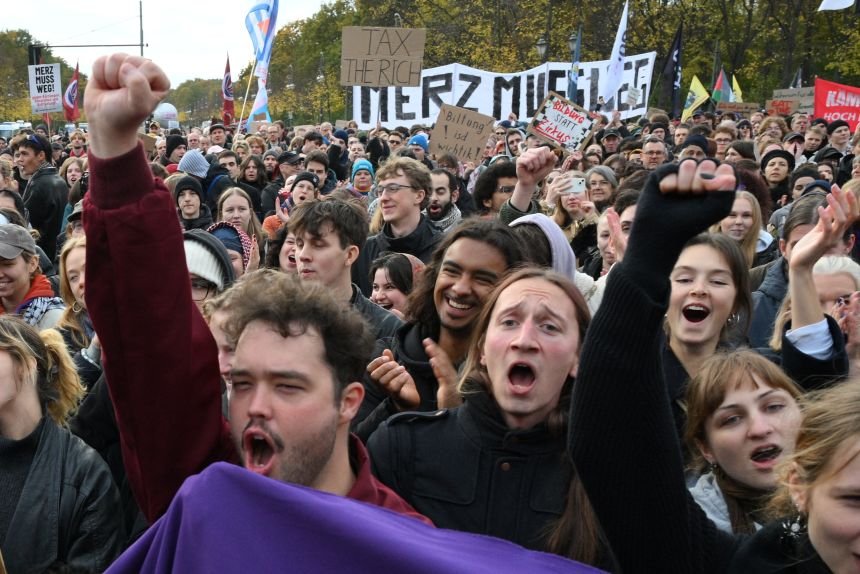
Cost-of-living protests that began in France spread to Germany on Saturday, October 31, as thousands of young people joined demonstrations across major German cities over rising living expenses, underfunded schools, environmental concerns and the possible return of compulsory military service. At the same time, hundreds of thousands of people took to the streets across France for a third consecutive weekend of protests.
The demonstrations highlighted growing frustration among younger generations over economic pressures, public services and decisions affecting their future. While Germany’s new youth-led movement, known as Gen Z regelt, organised rallies in cities including Berlin, Frankfurt, Cologne and Munich, France witnessed another nationwide mobilisation involving students, trade unions and the Yellow Vests movement.
French authorities estimated that 320,000 people participated in Saturday’s demonstrations, including approximately 70,000 in Paris. Although the overall turnout was lower than during the previous two weekends, police maintained a large security presence amid concerns about further clashes and looting.
Germany’s Gen Z Movement Takes to the Streets
The German demonstrations were organised by Gen Z regelt, a youth-led campaign whose name translates roughly as “Gen Z takes charge”. Organisers planned protests in 34 cities, seeking to draw attention to the financial and social pressures facing younger people.
The movement’s demands include lower living costs, better-funded schools and universities, improvements to public services, environmental action and opposition to the potential reintroduction of mandatory military service.
Organisers said young people wanted a greater say in decisions affecting their lives rather than watching political leaders make choices without adequately considering their concerns.
On its website, the movement described itself as a group of young people unwilling to remain passive while decisions about their future are made without their participation. It also called for peaceful demonstrations and instructed participants to keep their faces visible, even when wearing Halloween costumes.
Halloween was deliberately chosen as the date for the nationwide mobilisation to increase visibility and encourage participation. The organisers had expected more than 160,000 people to take part, although police figures in several major cities indicated that actual turnout was below those expectations.
Police Deploy Water Cannons and Riot Units in German Cities
While demonstrations in Berlin largely remained peaceful, police encountered confrontations in other German cities. Authorities deployed additional officers nationwide, and security measures were particularly visible in Cologne and Hamburg.
In Cologne, police used water cannons after some demonstrators reportedly set off fireworks during a march in the city centre. Authorities later cancelled the moving procession because of masked participants and the use of smoke bombs, allowing the gathering to continue as a stationary rally.
Police said their actions were directed at individuals involved in violence rather than peaceful demonstrators. The authorities stressed that the intention was to prevent disturbances while allowing people to exercise their right to protest.
Hamburg also witnessed incidents involving burning barricades and attacks on emergency personnel. Riot police intervened after officers and emergency workers reportedly faced fireworks and construction materials thrown by individuals in the crowd.
German authorities had warned before the demonstrations that extremist groups could attempt to exploit the youth-led movement. The possibility of violence also prompted additional security preparations in several cities.
Berlin Businesses Prepare for Possible Unrest
Security concerns were visible in Berlin even before the demonstrations began. Several luxury shops along the city’s Kurfürstendamm shopping boulevard boarded up their windows as a precaution against possible vandalism and looting.
Extra police officers were deployed across the country, reflecting concerns that the unrest witnessed during recent demonstrations in France could influence events in Germany.
However, organisers rejected the suggestion that violence should define their campaign. They argued that attention should remain on their demands concerning education, public services, living costs and military conscription.
The movement’s broad range of supporters has also raised questions about its leadership and political character. Germany’s national school student umbrella organisation, the BSK, distanced itself from Gen Z regelt while maintaining that young people’s concerns were legitimate. It announced plans for a separate day of protest on November 20.
Why Young Germans Are Protesting
The German protests reflect concerns about the economic and social pressures facing younger generations in Europe’s largest economy.
Rising living costs have made housing and everyday expenses difficult for many young people. Students have also raised concerns about deteriorating university facilities, underfunded educational institutions and reductions in public spending.
Another major issue is the debate over compulsory military service. The possibility of bringing back mandatory service has generated opposition among young people who do not want the government to impose additional obligations on their generation.
Environmental concerns and the perception that younger citizens have limited influence over political decisions have added to the movement’s demands.
The demonstrations are taking place as Germany faces economic challenges, pressure on pension systems and a shrinking working-age population. These wider issues have intensified debates about public spending, social services and how the costs of economic changes should be distributed between generations.
France Sees 320,000 Protesters in Third Weekend of Demonstrations
France experienced another major day of demonstrations on October 31, with the Interior Ministry estimating that 320,000 people participated nationwide. Around 70,000 demonstrators were reported in Paris.
The latest mobilisation was described as the third major weekend of protests, following demonstrations on October 17 and October 24. Saturday’s turnout was considerably lower than the previous gatherings:
- October 17: Approximately 550,000 people demonstrated across France.
- October 24: Around 410,000 people participated in the second major weekend of protests.
- October 31: The Interior Ministry estimated nationwide participation at 320,000.
The figures indicate a decline in participation over the three weekends, although the latest demonstrations still attracted hundreds of thousands of people.
Authorities reported 296 detentions nationwide by 6 p.m. local time. The government had deployed approximately 70,000 police officers and gendarmes to manage demonstrations and prevent a repeat of the serious unrest witnessed earlier in October.
French Authorities Restrict March Routes Amid Security Fears
French Interior Minister Laurent Nuñez warned of a very high risk of public disorder ahead of the Halloween weekend. Authorities decided that demonstrations would be permitted only outside city centres in an effort to protect businesses, public infrastructure and heavily populated areas.
In Paris, organisers had initially planned a march between Nation and Bastille. However, authorities prohibited the proposed route and redirected the demonstration to begin at Porte de Bagnolet on the eastern edge of the capital.
The restrictions followed serious incidents during previous protests, when businesses were attacked, shops were looted and police officers were injured.
Although Saturday’s gatherings were largely peaceful during much of the day, confrontations occurred towards the end of demonstrations in several cities. Police used tear gas in Lyon and Toulouse, while tensions were also reported in Marseille and other locations.
The Interior Ministry said groups described as radical elements had attempted to enter city centres with the intention of causing damage and engaging in looting. Authorities said police interventions prevented several of these attempts.
Violence and Arrests Continue to Concern French Officials
Despite the largely peaceful nature of many demonstrations, violence has remained a major concern for French authorities. The Interior Ministry reported that at least 1,193 police officers had been injured since the beginning of the protest movement, according to figures available on October 29.
Police in Rennes said the main march there had proceeded calmly along its authorised route. However, several hundred individuals reportedly began attacking officers after the demonstration ended, throwing projectiles and setting fires.
In other cities, including Bordeaux, Toulouse, Lille, Nantes, Marseille and Lyon, authorities reported attempts by groups to move towards central areas and cause disruption.
Jordan Bardella, leader of France’s far-right National Rally party, condemned attacks involving incendiary devices against law enforcement officers. He called for severe punishment for those responsible.
The government has faced pressure to restore public order while allowing peaceful protesters to express their concerns. The challenge has become more complicated as the movement has expanded beyond its original student-led demands.
Halloween Adds Another Challenge for French Police
Halloween created additional security concerns because some protesters planned to wear costumes and masks during demonstrations. Interior Minister Nuñez warned about separate calls for gatherings beginning at 8 p.m. local time, which authorities attributed to radical far-left groups and radicalised Yellow Vests.
Some messages circulating on social media used Halloween imagery alongside calls for “revolution” and “insurrection”. Nuñez described these messages as incitements to serious public disorder and warned that the gatherings would be prohibited.
The word “purge” also circulated across social media platforms in the days before Halloween. The term references the dystopian film franchise in which all crimes become legal for 12 hours each year.
Paris police responded with a public warning that Halloween costumes would not exempt people from existing laws. Authorities reminded residents that concealing one’s face in public could result in a €150 fine. Carrying a weapon, including a fake weapon in circumstances covered by the law, could lead to a prison sentence of up to three years and a fine of €45,000.
Organisers of the demonstrations had instructed participants to keep their faces visible, indicating an effort to distance the movement from individuals seeking to use costumes or masks to conceal their identities.
How France’s Student Protests Turned Into a Wider Movement
The French protests began in late September, initially led by high school students demanding improvements to deteriorating school buildings, teacher shortages and inadequate educational resources.
Students also raised concerns about the university admissions system, which they argued created difficulties for disadvantaged applicants. Demonstrations over educational conditions gradually expanded as other groups joined the movement.
The Yellow Vests movement became one of the prominent groups participating in the protests. Originally formed in response to rising fuel prices and the cost of living, the movement has previously organised large demonstrations against economic policies and perceived inequalities.
Trade unions, students, climate activists and people concerned about living expenses have since brought different demands into the broader mobilisation.
This expansion has made the protests more difficult to characterise as a single-issue movement. While education remains important, economic inequality, public spending, housing and the cost of everyday necessities have become central themes.
October 17 Unrest Still Shapes the Government’s Response
The first major weekend of demonstrations on October 17 was marked by widespread violence and looting in several French cities. According to figures cited by the Interior Ministry, more than 550,000 people participated in the protests that day.
More than 3,000 shops were reportedly attacked or looted, with some businesses suffering extensive damage. Authorities also reported more than 2,700 arrests following the unrest.
The scale of the destruction has continued to influence the government’s approach to subsequent demonstrations. Police deployments, restrictions on march routes and warnings against masked gatherings have all been part of efforts to prevent further incidents.
President Emmanuel Macron described the violence and injuries involving students and police officers as a “collective failure”. Speaking to YouTuber Hugo Travers, he said that students had not begun their protests expecting to experience such serious consequences, while police officers had also not joined the force expecting to face such violent situations.
His remarks reflected the wider concern over how demonstrations driven by demands for better public services and economic conditions have repeatedly turned violent.
November 5 Strike Could Bring Another Wave of Protests
Saturday’s demonstrations in France came ahead of a nationwide strike and mobilisation scheduled for November 5. The action has been called by an inter-union coalition protesting against rising living costs.
Students and some unions are expected to participate, potentially bringing together different sections of the protest movement once again.
The planned mobilisation could become another major test for the French government as it attempts to respond to economic grievances while preventing further violence and disruption.
The authorities will also be watching whether the student movement, Yellow Vests and trade unions maintain a common focus or continue pursuing separate demands.
What the Protests Mean for Europe
The demonstrations in Germany and France reflect a wider wave of youth-led activism across Europe. Although each country’s movement has its own political and economic context, several concerns are shared: rising living costs, pressure on education systems, public spending decisions and uncertainty about future opportunities.
In Germany, Gen Z regelt has brought younger protesters together around education, economic pressures and opposition to compulsory military service. In France, the demonstrations have expanded into a broader movement involving students, unions and Yellow Vests.
The response from authorities has also highlighted the difficulty of balancing the right to peaceful assembly with public safety. While most participants have demonstrated peacefully, violent incidents in some cities have prompted stronger policing and restrictions.
The declining turnout in France over the three weekends may indicate a change in the scale of mobilisation, but the planned November 5 strike suggests that public dissatisfaction has not disappeared. Meanwhile, Germany’s youth movement has demonstrated that similar concerns are finding an audience beyond French borders.
For European governments, the challenge extends beyond managing demonstrations. Addressing the underlying concerns about affordability, education, employment prospects and public services will be central to determining whether the protests lose momentum or develop into a longer-running movement.
Sources: Reuters, Associated Press and CNN. :chatgpt-content-reference{index=”0″}
For breaking news and live news updates, like us on Facebook or follow us on Twitter and Instagram. Read more on Latest World on thefoxdaily.com.





COMMENTS 0