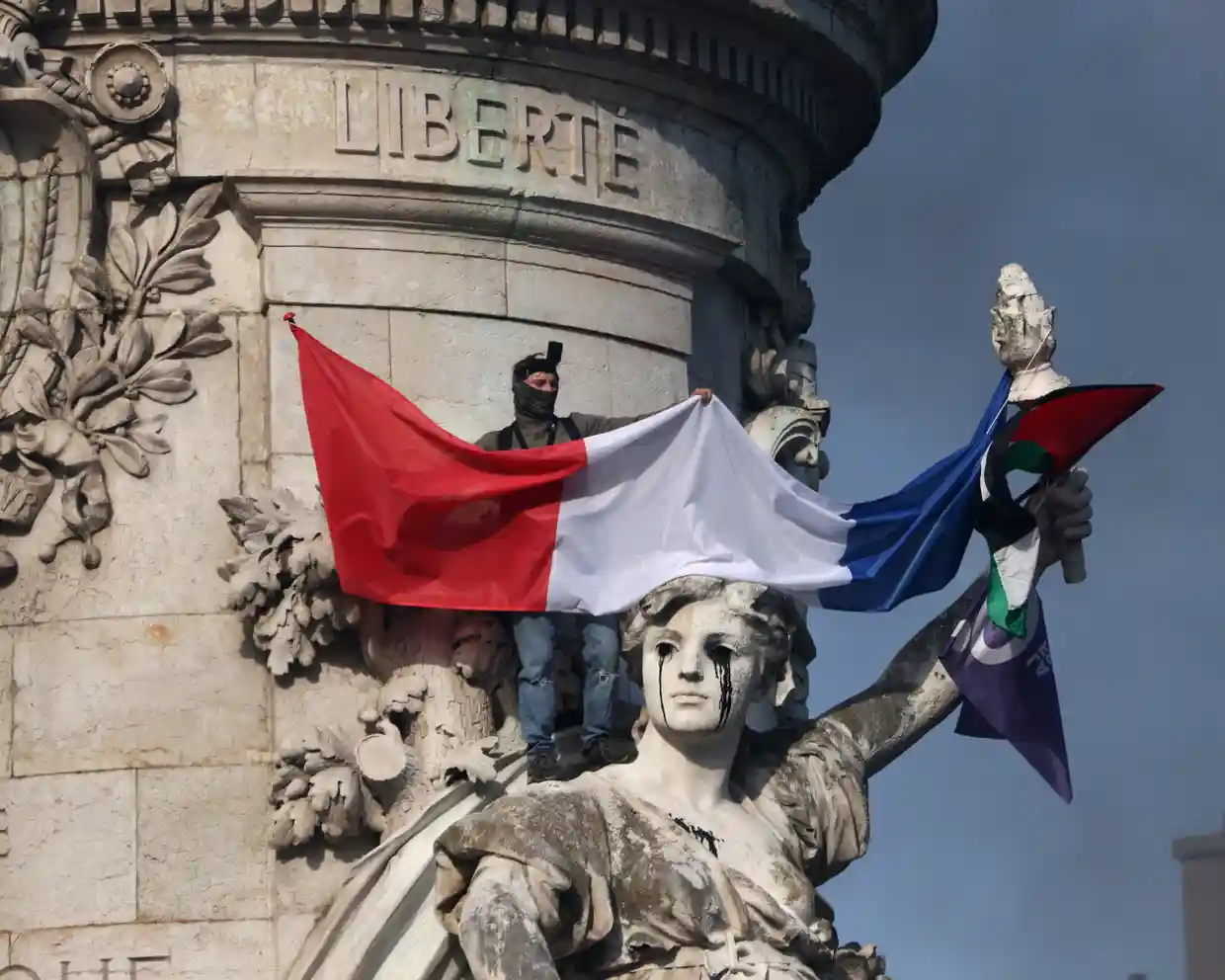
More than 400 people were arrested across France after nationwide demonstrations over school conditions, the rising cost of living, public spending and police violence escalated into clashes between protesters and law enforcement. Police fired tear gas in Paris, while demonstrators briefly forced their way into Marseille’s town hall as unrest spread beyond the main marches.
France’s Interior Minister Laurent Nuñez said late on Saturday that most of those arrested were adults who were not directly involved in the high school Protests. He accused opportunistic offenders of exploiting the demonstrations to commit acts of vandalism and looting, while insisting that the government was not planning to declare a state of emergency.
The demonstrations brought together students, teachers, workers, pensioners and other groups frustrated by economic pressures and deteriorating public services. What began with complaints about teacher absences and inadequate school facilities in the northern suburbs of Paris developed into a broader movement against inequality, rising prices and what protesters see as insufficient government support.
Clashes Erupt in Paris as Police Fire Tear Gas
Some of the most serious confrontations took place around Place de la République in central Paris, where a peaceful march deteriorated into violence. Police fired tear gas at masked, black-clad individuals who threw fireworks and paving stones, while some participants attacked businesses and looted shops.
Witnesses reported that bins were set on fire, glass recycling containers were overturned and bottles were collected for use as projectiles. A lorry was also set ablaze, with flames spreading to a nearby building. The disturbances forced residents in surrounding streets to shut their windows and doors as thick clouds of tear gas rose above the buildings.
Along Boulevard Magenta, a major route north of Place de la République that passes through a largely working-class area, dozens of shops were reportedly broken into and looted. A bank was attacked, and a sports shop was among the businesses targeted.
The violence unfolded alongside demonstrations over the cost of living, education and policing. The presence of people engaged in vandalism complicated efforts to distinguish peaceful demonstrators from those involved in confrontations with the police.
Protesters Briefly Enter Marseille Town Hall
In Marseille, protesters stormed the town hall after using security barriers removed from the street to ram its entrance. Some demonstrators briefly entered the municipal building before police intervened and removed them.
Inside, one protester reportedly spray-painted an anarchist symbol on a wall. The incident added to the disruption in France’s second-largest city, where rubbish bins were also set alight during the demonstrations.
Authorities reported protest activity across the country, including street marches, spontaneous gatherings and blockades. The scale of the mobilisation reflected how grievances initially associated with high school students had attracted support from people facing different economic and social pressures.
France’s Interior Minister Blames Violence on Opportunistic Offenders
Interior Minister Laurent Nuñez said more than 400 people had been arrested by late Saturday, with most being adults rather than high school protesters. He argued that the official demonstrations had been exploited by individuals seeking opportunities to loot and cause damage.
Nuñez described those involved as opportunistic offenders and said the authorities would pursue them firmly. He also condemned the violence but ruled out plans to declare a state of emergency.
French authorities said 140 protest actions involving 32,800 people had been recorded outside Paris by midday. Officials attributed the unrest in part to what they described as the ultra-left, a characterisation that reflects the government’s assessment of some elements involved in the disturbances rather than an established description of every participant.
The government faced the challenge of maintaining public order while protecting the right to peaceful assembly. The presence of large crowds, spontaneous gatherings and road blockades increased the demands on police forces deployed across multiple cities.
Why Are People Protesting Across France?
The protests emerged from complaints about conditions in schools in the poor northern suburbs of Paris. Students and supporters raised concerns about absent teachers, deteriorating school buildings and inadequate learning environments.
Those grievances subsequently broadened into a nationwide campaign addressing the cost of living, inequality, declining public services and concerns about government spending. Organisers and supporters called for teachers, students, labourers, pensioners and farmers to join the demonstrations, seeking to turn a school-focused movement into a wider expression of economic and social frustration.
The demonstrations also revived themes associated with the gilets jaunes, or Yellow Vests, movement, which emerged in 2018 in opposition to perceived social injustice and economic pressures. Protesters wearing high-visibility vests blocked streets, recalling the tactics used during earlier unrest under President Emmanuel Macron.
The movement’s renewed visibility suggested that dissatisfaction with household costs and public services remained a significant issue in French public life. However, the participation of different groups did not necessarily mean that all protesters shared the same demands or political objectives.
Rising Prices and Pressure on Public Services Fuel Anger
The cost of living was a central theme of Saturday’s demonstrations. Protesters complained about the prices of everyday goods and fuel, while labour groups called for higher wages and pensions and stronger protection for public services.
The CGT, one of France’s largest labour unions, backed the mobilisation and demanded better pay, improved pensions, lower prices and public services capable of meeting people’s needs. Its support gave the demonstrations a broader labour dimension beyond the original school-related grievances.
An October survey of 2,000 people found that about 45% of French respondents were worried about rising living costs and inflation. The finding offered an indication of the wider concern surrounding household finances, although it did not establish that everyone worried about prices supported the protests.
For many demonstrators, the complaints were interconnected. Higher household expenses can intensify frustration when people also perceive schools and other public services as underfunded or unable to meet basic needs. The demonstrations brought these concerns together in a movement that extended beyond any single policy demand.
Protester Describes Anger Over Fuel Prices and School Conditions
A 19-year-old demonstrator in Paris, identified as Lola, said the protests were driven by the pressure of living costs, expensive fuel and concerns about how student demonstrators had been treated by police.
“We are fighting because the cost of living is too harsh, because the price of fuel is too high,” she said, adding that students were seeking more teachers and decent learning conditions.
Her comments reflected the combination of economic and education-related concerns that helped expand the demonstrations. The participation of young people also brought renewed attention to allegations of excessive police force during recent school protests.
At the same time, violence on the fringes of the marches created a separate public-order issue, with authorities arguing that some individuals had used the demonstrations as cover for criminal activity.
Police Presence Increased Across Central Paris
Police maintained a substantial presence in central Paris, particularly around major landmarks and politically sensitive locations. The Avenue des Champs-Élysées and the Arc de Triomphe were excluded from the routes of the two official demonstrations, while authorities banned some other proposed gatherings in central areas.
Many Métro stations were also closed at the police’s request, including stations near the Champs-Élysées and around the presidential palace, parliament and government offices. The restrictions were intended to manage movement and reduce the risk of unrest near key public institutions.
Authorities had warned of possible violence before the demonstrations. President Emmanuel Macron appealed for calm on Friday, emphasising both the constitutional right to protest and the obligation to respect people and property.
Macron said he had consistently defended the right to express dissent but condemned the prospect of people attending demonstrations solely to cause damage and disorder. His comments highlighted the government’s position that peaceful protest must be protected while violence and destruction should not be tolerated.
Police Violence Allegations Add to Tensions
Allegations of police violence have been another major source of anger during the recent protests. The police watchdog was investigating at least two dozen allegations of excessive force, according to the supplied report.
Some teenagers had suffered serious injuries that protesters attributed to police crowd-control weapons. The reported injuries intensified criticism of law enforcement tactics and raised questions about how officers should respond to demonstrations involving young people.
Nuñez had suspended the use of a particular type of police stun grenade against young demonstrators after a 15-year-old lost a hand. However, he said the weapon could be used during Saturday’s demonstrations.
The French prime minister also said that more than 900 police officers had been injured during the wider period of unrest. That figure underscored the risks faced by law enforcement personnel, while the ongoing investigations into alleged police misconduct remained important to assessing individual incidents.
The competing accounts of police conduct and protester violence have made public confidence a central issue. Investigations into alleged abuses, alongside efforts to identify people responsible for attacks and looting, are likely to remain important to the authorities’ response.
Political Parties Seek to Influence the Protest Movement
The demonstrations have also become a point of political competition, with parties on the far left and far right seeking to position themselves around the unrest. The political divide has included contrasting emphasis on protesters’ grievances and the need to support police officers confronting violence.
Jean-Luc Mélenchon, leader of the left-wing France Unbowed party, marched in a demonstration earlier in the week and expressed support for student protesters. His involvement reflected efforts by parts of the left to connect the movement with broader concerns about inequality and public services.
On the right, political voices backed the police and emphasised public order. These competing positions risked drawing the demonstrations further into France’s already fragmented political debate, even though participants did not necessarily share the same political affiliations.
Macron was entering the final stretch of his presidency, with the country facing a polarised electorate and a fragmented political landscape. The protests added another source of pressure on the government as it dealt with economic dissatisfaction, public-service concerns and questions about policing.
Yellow Vests Legacy Returns to the Streets
Calls circulated on social media to revive the Yellow Vests movement, which began in 2018 and became a prominent expression of anger over economic inequality and the cost of living. The use of high-visibility vests and street blockades during the latest demonstrations echoed that earlier mobilisation.
The comparison is significant because the Yellow Vests protests showed how complaints about specific economic measures could develop into a wider challenge involving public trust, purchasing power and perceptions of political representation.
The current demonstrations began with school-related grievances but expanded to include workers, pensioners and other groups. Whether the coalition can sustain its momentum will depend in part on whether participants maintain common demands despite their different priorities.
The government’s response will also shape the movement’s future. Managing demonstrations without undermining the right to peaceful assembly, addressing legitimate complaints about public services and investigating allegations of police violence are separate but connected challenges.
What Happens Next in France’s Protests?
Nuñez said hundreds of protest actions and more than 80 marches were expected nationwide, including spontaneous gatherings, street demonstrations and blockades. The scale and dispersed nature of the mobilisation posed continuing challenges for police and local authorities.
More arrests were expected as authorities assessed incidents reported across the country. The immediate priorities included restoring order in affected areas, investigating vandalism and looting, and establishing accountability for alleged misconduct by both protesters and police officers.
Beyond the immediate security response, the demonstrations have highlighted unresolved concerns about living costs, education and public services. The participation of labour unions and groups beyond the student movement suggests that the grievances extend into wider debates over economic security and the state’s responsibilities.
The coming days will show whether the protests remain a series of local actions or develop into a sustained national movement. For the French government, the challenge is to respond to public concerns while protecting peaceful dissent and preventing further violence.
For breaking news and live news updates, like us on Facebook or follow us on Twitter and Instagram. Read more on Latest World on thefoxdaily.com.



COMMENTS 0