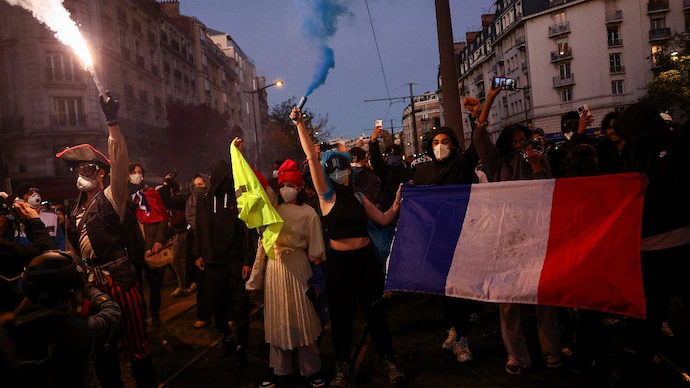
About 3.2 lakh people took to the streets across France on Saturday, October 31, protesting against the rising Cost of Living, pressure on public services and deteriorating conditions in schools and universities. Although the nationwide turnout was lower than during the previous two weekends, the demonstrations highlighted continuing public anger as the government faces mounting economic and political pressure.
The French Interior Ministry estimated that around 70,000 people joined the main demonstration in Paris. The march took place along an alternative route on the eastern edge of the capital after authorities secured a court ruling preventing protesters from marching between the central squares of Nation and Bastille.
Student groups criticised the restrictions and announced plans to blockade high schools and universities next week. Their warning signals that the movement, which began with student demonstrations in September, could continue to disrupt educational institutions and public life ahead of another nationwide protest scheduled for November 5.
France Protest Turnout Falls From Previous Weekends
Saturday’s demonstrations attracted an estimated 320,000 people nationwide, according to government figures. This represented a decline compared with the previous two weekends, when authorities recorded more than 500,000 participants on October 17 and approximately 410,000 on October 24.
Despite the lower turnout, protests were organised in around 150 locations across the country. Demonstrators included students, trade union members, Yellow Vest activists and people concerned about inflation, fuel prices, household expenses and the condition of public services.
Most demonstrations remained peaceful during the afternoon. However, police fired tear gas in Lyon and Toulouse, while tensions were reported towards the end of the march in Marseille. Authorities had deployed additional security personnel to prevent a repeat of the violence and looting witnessed on October 17, when shops, businesses and public buildings were damaged.
The difference in turnout does not necessarily indicate that the underlying grievances have disappeared. Organisers have continued to demand action on living costs and public services, while student representatives have threatened further demonstrations and blockades.
Paris March Shifted Away From City Centre After Court Ruling
The main Paris demonstration was held under tighter restrictions after France’s top administrative court upheld a ban on the proposed march between Place de la Nation and Place de la Bastille. Unions had challenged the decision, but the court rejected their appeal on Saturday.
Authorities instead approved a route along boulevards on the eastern edge of Paris. The stated aim was to reduce the possibility of unrest near government buildings, major tourist locations and central shopping districts.
The decision reflected heightened security concerns following the damage caused during earlier demonstrations. Police and local authorities were particularly concerned about violence, vandalism and looting in busy commercial areas.
Student protesters objected to the decision to keep the march away from central Paris. They argued that the restrictions limited their ability to demonstrate in prominent public spaces and announced plans for further action at educational institutions.
Students Threaten Blockades From November 3
Student organisations have warned that the protests will move beyond street demonstrations next week. Sabrine Kharbach, spokesperson for the Union étudiante union, said students planned to blockade universities and high schools on Tuesday, November 3, and repeat the action on Thursday before joining the next demonstration called by workers and trade unions.
“Starting this Tuesday, we will blockade our universities and high schools, and we will do so again on Thursday before joining the demonstration on November 5 called by workers and trade unions,” Kharbach said.
The planned blockades could put additional pressure on educational institutions already at the centre of the movement. Students have raised concerns about overcrowded classrooms, deteriorating school facilities and what they describe as an unfair university admissions system.
The student movement began in September, with young demonstrators demanding improvements in education and greater resources for schools and universities. The involvement of trade unions and Yellow Vest protesters subsequently widened the campaign, bringing economic concerns and demands over public services into the demonstrations.
Authorities Increase Security During Halloween Protests
Saturday’s demonstrations coincided with Halloween, prompting authorities to issue additional warnings about face coverings. Interior Minister Laurent Nunez said existing laws allowed police to prohibit masks when there was a threat to public order.
Officials were concerned that some individuals could use masks to conceal their identities while engaging in vandalism or violence. The warning came amid increased security preparations following the disturbances recorded during earlier protests.
Police were deployed in significant numbers across the country to monitor demonstrations and prevent clashes. The US Embassy also advised travellers to avoid protest locations and large gatherings while demonstrations were taking place.
Although the majority of participants demonstrated peacefully, incidents in Lyon, Toulouse and Marseille showed that tensions remained a concern for law enforcement agencies.
Students, Trade Unions and Yellow Vest Protesters Unite
The movement initially emerged from student demonstrations in September, with young people protesting against deteriorating school conditions, overcrowded classrooms, teacher shortages and concerns about university admissions. It has since developed into a broader campaign involving trade unions, Yellow Vest protesters and groups campaigning over the cost of living.
Participants have raised several interconnected issues, including rising fuel prices, inflation, household expenses, education funding and the quality of public services. The demonstrations have also become a platform for criticism of President Emmanuel Macron’s government and its handling of the country’s economic difficulties.
During the Paris march, protester Jerome Rodriguez criticised the government’s economic management, arguing that ordinary families were struggling with everyday expenses while public finances remained under pressure.
Political figures have also joined the demonstrations. Far-left leader Jean-Luc Mélenchon marched at the head of the Paris gathering, while Marine Le Pen and her National Rally party remain prominent in the political debate ahead of France’s next presidential election, scheduled for April 2027.
The movement has also attracted younger participants who say that inadequate resources in schools and universities threaten their future. Aaron Berthier de Grandry, a 15-year-old student who planned to attend his third consecutive weekend of protests, said young people had been told they represented France’s future but were concerned about the resources available to them.
The government’s announcements on education reforms and measures to ease fuel costs have so far failed to end the demonstrations. Student organisations and unions are continuing to call for further action, including the November 5 mobilisation.
France’s Economic Problems Add to Public Discontent
The protests are taking place as France faces growing pressure over public finances, weak economic performance and the cost of government borrowing. Public debt reached approximately 119% of gross domestic product at the end of June 2026, according to figures published by France’s national statistics institute. The debt burden is therefore approaching 120% of annual economic output.
Credit ratings agency Fitch revised its outlook on French sovereign debt from stable to negative on October 30, while maintaining the country’s A+ rating. The agency cited weaker economic growth, higher borrowing costs, a widening budget deficit and political fragmentation as factors complicating efforts to stabilise public finances. Reuters reporting on Fitch’s decision highlighted the financial challenges facing the government. :chatgpt-content-reference{index=”0″}
Economic data released on Friday also showed that France’s economy contracted by 0.1% in the third quarter of 2026. The unexpected decline added to concerns about the country’s economic outlook at a time when the government is trying to reduce its deficit and control public spending. :chatgpt-content-reference{index=”1″}
These financial pressures have complicated the government’s efforts to prepare its 2027 budget. Higher borrowing costs mean that financing public debt is becoming more expensive, while spending reductions and tax decisions are politically difficult amid widespread public dissatisfaction.
Retailers Count More Than €1 Billion in Protest-Related Losses
The earlier rounds of unrest have also caused significant damage to businesses and commercial areas. France’s Chamber of Commerce estimates that retailers have suffered losses exceeding €1 billion. Broader estimates could put the financial impact at roughly twice that amount when uninsured damage and lost revenue are included.
Several shops along major Paris shopping streets have remained boarded up or protected by security grilles following earlier incidents of looting and vandalism. Luxury retailers, including outlets belonging to Hermès, Louis Vuitton and Burberry, were among the businesses targeted during previous unrest.
The damage has affected businesses not only through direct theft and destruction but also through temporary closures, security expenses and reduced customer activity. The continuing presence of protective boards and metal grilles in commercial districts illustrates the impact of the earlier disturbances on local retailers. :chatgpt-content-reference{index=”2″}
France’s Proposed Law Could Make Rioters Pay Up to €10,000
In response to the damage caused during recent demonstrations, the government is advancing legislation designed to make people involved in violent gatherings financially responsible for the destruction caused. The proposal would allow liability of up to €10,000 per person in certain circumstances, including situations where individuals knowingly remain part of a group involved in violence or property damage.
The French Senate adopted the bill on October 28, with 229 votes in favour and 105 against. The legislation still requires approval by the National Assembly before it can become law. It also includes provisions intended to make it easier for victims to receive compensation for damage caused during violent gatherings. :chatgpt-content-reference{index=”3″}
The proposal has drawn criticism from human rights organisations, lawyers and trade union representatives. They argue that the provisions could expose peaceful demonstrators to financial liability for damage committed by other people, potentially discouraging citizens from exercising their right to protest.
Amnesty International has warned that the measure could undermine freedom of peaceful assembly. The government, however, argues that those responsible for damage should bear the financial consequences rather than leaving victims and taxpayers to cover the costs. :chatgpt-content-reference{index=”4″}
The debate over the legislation adds another dimension to the current unrest. While authorities are seeking to prevent further vandalism and compensate affected businesses, critics are concerned about how collective responsibility could affect people who attend demonstrations peacefully.
Protests Spread Beyond France
The demonstrations have also become part of a wider wave of youth-led protests across Europe. In Germany, gatherings were planned in more than 30 cities on Saturday, with young people raising concerns about education, housing and living costs.
Protest movements in other European countries have reflected some of the same concerns, particularly among younger people facing pressure from rising expenses and dissatisfaction with public services. The developments suggest that the issues driving the French demonstrations are not limited to one country’s political or economic circumstances. :chatgpt-content-reference{index=”5″}
What Happens Next in France?
The next major test for the protest movement is expected on November 3, when student organisations plan to begin blockades at schools and universities. Further action is scheduled for November 5, when students intend to join workers and trade unions in another demonstration.
The government will face the challenge of addressing public concerns over education, fuel prices and living costs while managing a difficult budget situation. Authorities are also expected to maintain a strong security presence as demonstrations continue, particularly after the looting and damage recorded during earlier weekends.
Although the October 31 turnout was lower than the previous two weekends, the planned student blockades indicate that the movement has not ended. Whether the next demonstrations attract larger crowds or lead to further disruption will depend on participation, negotiations with authorities and the government’s response to the protesters’ demands.
For now, France faces two connected challenges: widespread public dissatisfaction over living conditions and a difficult economic situation that is limiting the government’s room for manoeuvre. The November 5 demonstration could provide another indication of whether the protest movement is losing momentum or preparing for a longer campaign.
For breaking news and live news updates, like us on Facebook or follow us on Twitter and Instagram. Read more on Latest World on thefoxdaily.com.






COMMENTS 0