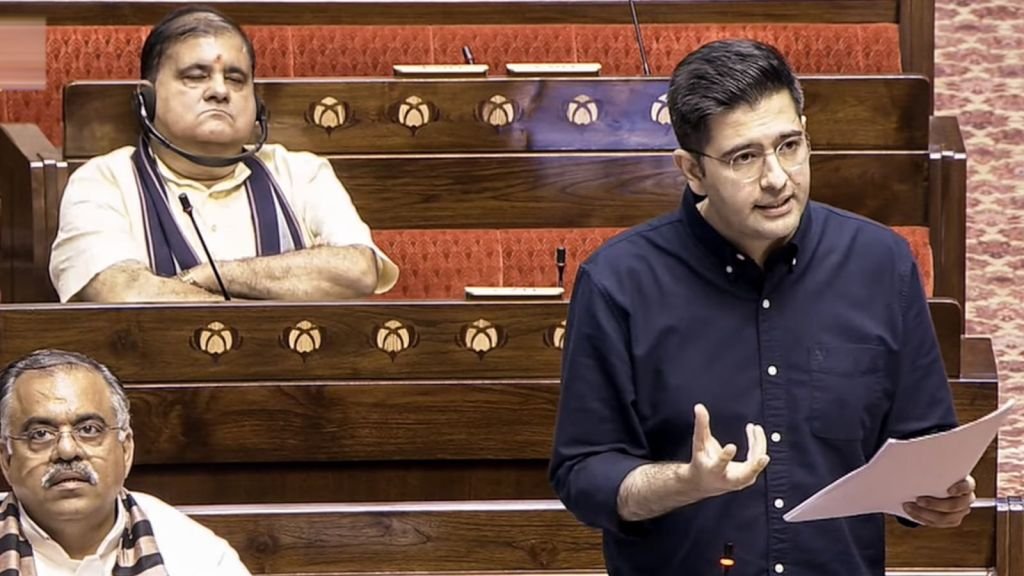
After weeks of criticism over his silence on nationwide student protests against examination paper leaks, BJP Rajya Sabha MP Raghav Chadha has finally addressed the issue in Parliament. During a debate on the Public Examinations (Prevention of Unfair Means) Amendment Bill, 2026, Chadha said he had consciously chosen not to make public statements until legislation addressing the problem was introduced.
The remarks mark Chadha’s first detailed response since widespread protests erupted over alleged irregularities in several competitive examinations, including recruitment and entrance tests. His speech also reflected the shift in his political role after moving from the Opposition to the ruling National Democratic Alliance (NDA), where he said his responsibility had changed from raising questions to delivering solutions.
Why Raghav Chadha Stayed Silent on Student Protests
I spoke for every young Indian who believes that honest effort deserves an honest opportunity.
With the passage of the Public Examinations Amendment Bill, 2026, India’s first ever Anti Paper Leak framework comes into effect.
Students spoke.
The Government listened.
Action… pic.twitter.com/2ri8BF3pVg— Raghav Chadha (@raghav_chadha) July 30, 2026
Addressing the Rajya Sabha, Chadha said many supporters had questioned why he had not spoken publicly about the examination controversies despite previously being vocal on issues affecting students.
Explaining his position, he said his approach had changed after joining the treasury benches.
“When I was in the Opposition, questions were my weapon. Today, sitting on the treasury benches, finding solutions is my responsibility. I wanted an outcome, not a headline.”
According to Chadha, he made a personal commitment to speak only when Parliament considered legislation aimed at tackling the issue rather than merely debating it.
Shift from Opposition Politics to Governance
Chadha acknowledged that his responsibilities had evolved significantly after joining the BJP approximately three months ago.
He said that while opposition leaders primarily highlight issues and demand accountability, members of the ruling alliance are expected to implement reforms.
He emphasized that his silence should not be interpreted as indifference toward students but as a decision to focus on legislative outcomes instead of media appearances.
What Is the Public Examinations Amendment Bill, 2026?
The legislation passed by Parliament strengthens India‘s legal framework against examination-related fraud and unfair practices.
The amended law seeks to curb organized Paper Leak networks through stricter penalties and enhanced enforcement mechanisms.
The Bill aims to strengthen action against:
- Question paper leaks.
- Cheating syndicates.
- Impersonation during examinations.
- Organized examination fraud.
- Digital manipulation of examination systems.
The Rajya Sabha passed the Bill through a voice vote following a walkout by several Opposition parties.
Why Paper Leaks Have Become a National Concern
Competitive examinations play a crucial role in admissions to educational institutions and recruitment for government jobs across India. Alleged paper leaks can undermine public confidence in these examinations by raising questions about fairness and transparency.
Over recent years, several entrance tests and recruitment examinations conducted by different agencies and state governments have faced allegations of irregularities, prompting protests by students demanding stronger safeguards.
Student groups have consistently called for:
- Greater transparency in examinations.
- Swift investigations into paper leaks.
- Strict punishment for organized cheating networks.
- Better digital security for examination systems.
- Timely conduct of re-examinations where necessary.
Chadha Says Government Chose Reform Over Politics
During his speech, Chadha argued that the government responded to students’ concerns by introducing systemic reforms instead of treating the protests as political criticism.
“Their voices matter. Their voices were heard, and systemic changes have been brought in.”
He described the legislation as evidence that the government had acted on public concerns through institutional reforms.
Paper Leaks Are a National Problem, Not a Party Issue
One of the central themes of Chadha’s address was that examination fraud cannot be blamed on any single political party or state government.
He described paper leaks as an organized crime that has affected multiple states governed by different political parties.
According to him, solving the problem requires coordinated action rather than political point-scoring.
Chadha Criticises Opposition Parties
The BJP MP also targeted both the Aam Aadmi Party (AAP) and the Congress during his speech.
Referring to reported examination controversies in Punjab and other states, he argued that similar incidents had occurred under governments led by different political parties.
He questioned why some incidents receive national attention while others are viewed as local issues.
“If a national Exam Paper Leak is a national crisis, then a paper leak in any state cannot be treated differently. There is no difference between students.”
Message on Student Protests
Chadha urged political leaders to avoid turning student demonstrations into political campaigns.
He argued that student movements should remain focused on securing fair examinations rather than becoming platforms for political rivalry.
In one of the more widely discussed lines from his speech, he remarked that some political leaders encourage students to confront authorities while remaining safely away from the protests themselves.
His comments highlighted the broader debate over the role political parties should play during student-led movements.
How India Is Strengthening Examination Security
The passage of the amended legislation reflects a broader effort to improve the integrity of public examinations.
Measures increasingly discussed in examination reforms include:
- Enhanced cybersecurity protocols.
- Encrypted digital question paper transmission.
- Biometric verification of candidates.
- Real-time monitoring of examination centres.
- Stronger coordination between investigating agencies.
- Harsher penalties for organized examination fraud.
Experts generally agree that technology, institutional accountability, and swift investigations are all essential for reducing examination-related malpractice.
Timeline of Recent Developments
| Event | Development |
|---|---|
| Student protests | Nationwide demonstrations raised concerns over examination paper leaks. |
| Public debate | Calls increased for stricter anti-cheating legislation and reforms. |
| Parliament debate | Rajya Sabha discussed the Public Examinations Amendment Bill. |
| Bill passed | The amended anti-paper leak legislation received parliamentary approval. |
Why Examination Integrity Matters
Public examinations influence educational admissions, government recruitment, and career opportunities for millions of students every year.
Maintaining confidence in these examinations is important because it helps ensure:
- Equal opportunity for candidates.
- Merit-based selection.
- Transparency in recruitment.
- Public trust in educational institutions.
- Reduced influence of organized cheating networks.
Any compromise in examination integrity can affect not only individual students but also the credibility of public institutions.
Future Outlook
With Parliament approving stricter anti-paper leak legislation, attention will now shift toward implementation. The effectiveness of the new legal framework will depend on timely investigations, stronger enforcement, improved examination security, and coordination between central and state authorities.
Student organizations are also expected to closely monitor how the law is enforced and whether it succeeds in preventing future examination irregularities.
Conclusion
Raghav Chadha’s parliamentary speech marked his first detailed response to nationwide student protests over examination paper leaks since joining the BJP. Framing his silence as a deliberate choice, he argued that governance requires delivering solutions rather than making repeated public statements. By supporting the Public Examinations (Prevention of Unfair Means) Amendment Bill, 2026, Chadha positioned the legislation as a step toward strengthening examination integrity across the country.
While political parties continue to debate responsibility for past paper leak incidents, the long-term success of the new framework will ultimately depend on effective implementation, transparent investigations, and restoring public confidence in India’s competitive examination system.
For breaking news and live news updates, like us on Facebook or follow us on Twitter and Instagram. Read more on Latest India on thefoxdaily.com.





COMMENTS 0