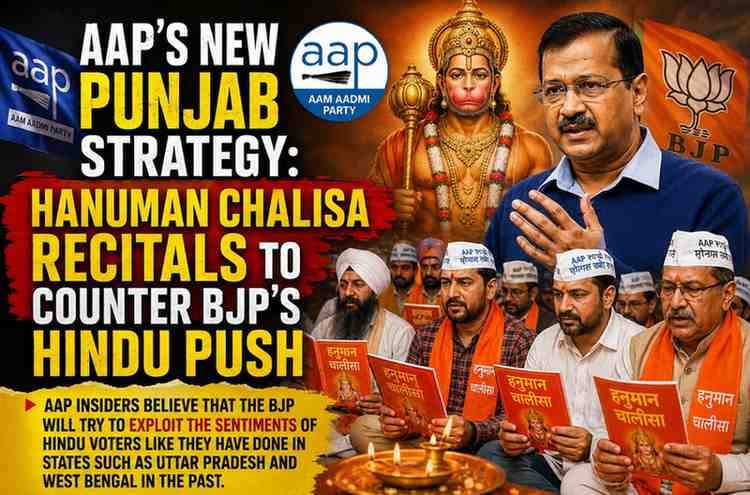
As political activity intensifies ahead of the next Punjab Assembly elections, the Aam Aadmi Party (AAP) is recalibrating its electoral strategy with a renewed focus on religious outreach. The party, which currently governs Punjab, is planning a series of Hanuman Chalisa recitals, Sunderkand Path programmes and devotional events across dozens of constituencies where Hindu voters play a decisive electoral role.
The move reflects a broader effort to strengthen grassroots engagement while countering the Bharatiya Janata Party’s (BJP) attempts to expand its support base in the border state. According to party insiders, the campaign is designed not only to connect with Hindu voters but also to reinforce AAP’s organizational network before the elections.
Unlike several other states where political competition is shaped by religious polarization, Punjab presents a distinct electoral landscape. Here, caste dynamics, regional issues, governance, agriculture, employment and Sikh-Hindu social harmony remain central to electoral politics. Consequently, AAP appears to be adopting a strategy that combines religious outreach with governance messaging rather than relying solely on identity politics.
Why AAP Is Launching a Religious Outreach Campaign
The immediate trigger for the campaign came after senior AAP leaders Arvind Kejriwal and Manish Sisodia participated in a public Sunderkand Path in Delhi. Party leaders described the event as both a spiritual gathering and an opportunity to connect with Hindu voters.
According to sources within the party, similar programmes are now being planned across Punjab over several weeks.
The campaign is expected to include:
- Mass Hanuman Chalisa recitals.
- Sunderkand Path gatherings.
- Local devotional meetings.
- Community interaction programmes.
- Signature campaigns at polling booths.
- Volunteer outreach initiatives.
Party organizers believe these events will strengthen local engagement while increasing visibility in constituencies where electoral contests are expected to be closely fought.
The Electoral Mathematics Behind the Strategy
Punjab’s demographic composition differs significantly from many northern Indian states.
Sikhs constitute the largest share of the electorate, while Hindus form the second-largest voting bloc. Although the state has generally avoided the scale of religious polarization witnessed elsewhere, Hindu voters remain electorally significant in several urban and semi-urban constituencies.
Political observers note that approximately three dozen Assembly seats have substantial Hindu populations capable of influencing electoral outcomes.
For AAP, retaining these constituencies is considered important for securing another term in office.
Focus on Hindu-Majority Assembly Segments
According to party sources, the campaign will primarily target constituencies where Hindu voters represent a significant proportion of the electorate.
Organizers reportedly plan to reach thousands of polling booths through coordinated grassroots programmes involving local volunteers and party workers.
Beyond religious events, the exercise is also expected to strengthen booth-level management ahead of the elections.
Election strategists generally consider booth organization one of the most important factors in modern political campaigns because it directly affects voter outreach, mobilization and polling-day coordination.
Testing AAP’s Organizational Machinery
While the devotional programmes are expected to receive public attention, the campaign also serves another purpose internally.
AAP has recently reorganized its booth-level structure in Punjab. The upcoming outreach drive will effectively test whether communication channels between state leaders, district units and booth-level volunteers function efficiently.
Party leaders are expected to monitor:
- Volunteer participation.
- Booth-level coordination.
- Public attendance.
- Campaign logistics.
- Local leadership effectiveness.
- Voter engagement.
Strong organizational performance during these events could provide valuable momentum before formal election campaigning begins.
How BJP’s Expanding Presence Shapes AAP’s Strategy
Although Punjab has historically been dominated by regional parties such as the Shiromani Akali Dal (SAD), the congress and, more recently, AAP, the BJP has steadily attempted to expand its independent political footprint following the end of its long-standing alliance with the Akali Dal.
The BJP has increasingly focused on urban constituencies, traders, professionals and sections of Hindu voters.
AAP leaders believe the BJP could attempt to consolidate Hindu votes by emphasizing cultural and religious themes, similar to strategies adopted in several other states.
The planned devotional campaign is therefore being viewed as both a political response and an outreach exercise.
Punjab’s Political Landscape Is Different
Despite the increased emphasis on religious events, Punjab’s electoral dynamics remain distinct from many other parts of India.
The state has traditionally witnessed relatively peaceful coexistence between Sikh and Hindu communities.
Major election issues often include:
- Agricultural policies.
- Drug abuse prevention.
- Employment generation.
- Industrial development.
- Border Security.
- Water sharing.
- Education and healthcare.
- Fiscal management.
As a result, analysts believe governance performance is likely to remain one of the decisive factors during the election campaign.
Will Religious Outreach Affect Sikh Voters?
One question raised by political observers is whether increased emphasis on Hindu-focused programmes could influence Sikh voters.
AAP leaders have dismissed such concerns, arguing that devotional events should not be viewed through the lens of religious competition.
The party maintains that Punjab’s social fabric has historically been based on mutual respect among communities and that spiritual gatherings are common across different religious traditions.
Chief Minister Bhagwant Mann is expected to remain the party’s principal political face in Punjab, with governance continuing to form the core of AAP’s campaign narrative.
| Political Factor | Expected Impact |
|---|---|
| Hanuman Chalisa campaigns | Grassroots engagement with Hindu voters |
| Sunderkand Path events | Community outreach and public interaction |
| Booth-level mobilisation | Strengthening election organization |
| Urban constituencies | Higher focus due to competitive contests |
| Bhagwant Mann’s leadership | Central governance face of the campaign |
Religion and Electoral Politics in Punjab
Religion has always played an important cultural role in Punjab, but electoral outcomes have generally been influenced by a broader combination of governance, regional identity and socio-economic issues.
Political parties frequently participate in religious events and community gatherings, particularly during election seasons.
However, voters often evaluate governments based on factors such as infrastructure, public services, employment opportunities, agricultural support and law and order alongside cultural outreach.
This means symbolic programmes alone are unlikely to determine electoral success without corresponding governance performance.
What the Campaign Means for the 2027 Punjab Election
The upcoming outreach campaign signals that AAP is preparing for an increasingly competitive electoral battle.
Besides the BJP, the party will also face challenges from the Congress and the Shiromani Akali Dal, both of which continue to retain influence across different regions of the state.
The election is expected to revolve around multiple issues, including economic development, Youth Employment, agriculture, industrial Investment, border security and public welfare.
Religious outreach may help political parties connect with specific communities, but voters are also expected to closely examine each party’s governance record and future Policy agenda.
Broader Implications for Indian Politics
The strategy illustrates how political parties across India are increasingly blending organizational strengthening with cultural outreach.
Rather than treating religious programmes solely as symbolic events, parties are using them to build volunteer networks, improve local engagement and enhance voter communication.
This reflects a broader evolution in election campaigning, where community participation, digital outreach and booth-level management work alongside traditional political messaging.
Future Outlook
AAP’s proposed Hanuman Chalisa and Sunderkand outreach campaign represents more than a series of devotional events—it is part of a broader electoral strategy aimed at reinforcing the party’s organizational structure while expanding engagement with key voter groups before the Punjab Assembly elections.
Whether the initiative succeeds will depend not only on public participation but also on how effectively the party balances cultural outreach with governance, development and local issues that continue to shape Punjab’s political landscape.
As election preparations gather pace, competition among the AAP, BJP, Congress and Shiromani Akali Dal is expected to intensify, making Punjab one of India’s most closely watched political battlegrounds in the coming months.
For breaking news and live news updates, like us on Facebook or follow us on Twitter and Instagram. Read more on Latest India on thefoxdaily.com.






COMMENTS 0