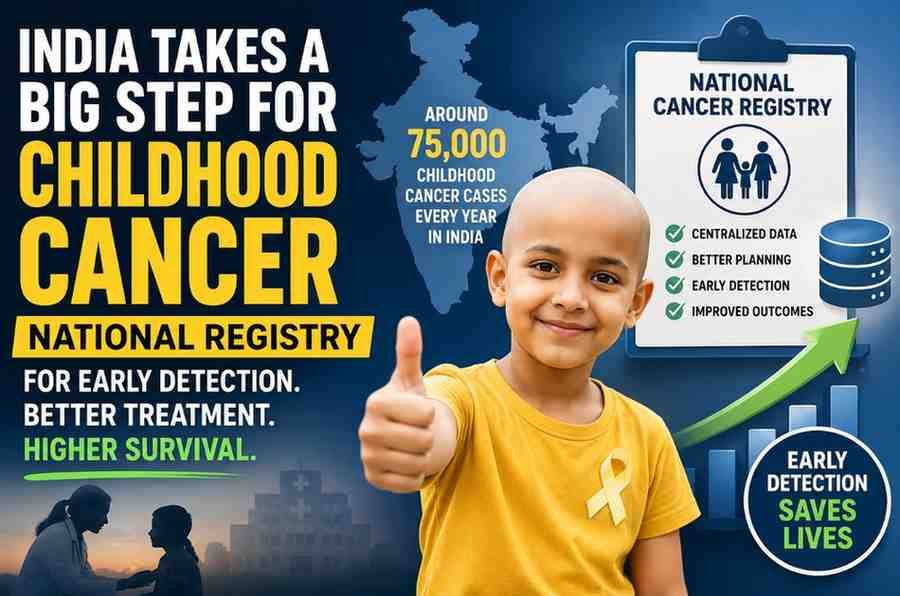
Who is affected? Thousands of children across India and their families navigating complex cancer care. What’s happening? The government is planning a nationwide childhood cancer registry. When? Amid rising case numbers and growing healthcare pressure. Where? Across India, particularly in underserved regions. Why does it matter? Because without reliable data, effective treatment strategies and Policy decisions remain incomplete. How will it help? By creating a structured system to track cases, improve early diagnosis, and optimize care delivery.
The Growing Burden of Childhood Cancer in India
Childhood cancer is no longer a rare or isolated Health issue in India. With an estimated 75,000 new cases annually, the country carries one of the highest global burdens. Unlike adult cancers, which are often linked to lifestyle or environmental factors, childhood cancers are more complex, often arising from genetic or developmental causes.
One of the biggest challenges is that many cases are either missed or diagnosed far too late. It’s not because doctors lack the knowledge it’s because the system doesn’t always support early detection. Limited awareness, uneven access to healthcare, and scattered data make it harder to catch the disease in time.
In many regions, especially rural and semi-urban areas, families may not recognize early symptoms such as persistent fever, unusual swelling, or unexplained fatigue. By the time medical help is sought, the disease may have already progressed to an advanced stage.
Why India Needs a Childhood Cancer Registry
A childhood cancer registry is essentially a centralized database that collects detailed information about cancer cases in children. This includes diagnosis, treatment patterns, outcomes, and geographic distribution.
Right now, India relies on scattered hospital-based registries and regional data, which creates gaps in understanding the true scale of the problem. A national registry aims to fix this by bringing consistency and completeness.
Key Benefits of a National Registry
- Accurate Data Collection: Helps identify how many children are affected and where.
- Better Policy Planning: Enables targeted healthcare investments and infrastructure development.
- Improved Survival Rates: Early detection strategies can be refined using real data.
- Research Advancement: Provides a foundation for scientific studies and clinical trials.
- Equity in Healthcare: Highlights underserved regions that need urgent attention.
What’s Missing Today: The Data Gap Problem
One of the biggest challenges in tackling childhood cancer in India is the lack of comprehensive, real-time data. Without it, policymakers are essentially working with incomplete information.
For example, certain regions may appear to have lower cancer rates—not because fewer children are affected, but because cases are not being reported or diagnosed. This creates a false sense of security and delays critical interventions.
Additionally, treatment outcomes vary widely across the country. Some urban centers report survival rates comparable to developed nations, while others struggle with basic treatment access. A unified registry can bridge this gap by making disparities visible and actionable.
How a Registry Can Transform Early Detection
Early diagnosis is one of the most powerful tools in improving childhood cancer outcomes. When detected early, many pediatric cancers are highly treatable.
A national registry can support early detection in several ways:
- Pattern Recognition: Identifying common early symptoms across regions
- Awareness Campaigns: Targeting high-risk areas with education programs
- Screening Strategies: Developing region-specific diagnostic approaches
This shift from reactive to proactive healthcare could significantly reduce mortality rates.
Real-World Impact: What This Means for Families
Behind every statistic is a family navigating emotional, financial, and logistical challenges. Childhood cancer treatment is not just a medical journey it’s a life altering experience.
A well implemented registry can:
- Reduce diagnostic delays
- Improve access to specialized care centers
- Lower treatment costs through better planning
- Provide clearer treatment pathways
In simple terms, it can turn confusion into clarity for thousands of families.
India vs Global Standards: Where Do We Stand?
| Factor | India (Current Scenario) | Developed Countries |
|---|---|---|
| Data Availability | Fragmented and incomplete | Centralized and comprehensive |
| Early Detection | Often delayed | Highly structured screening systems |
| Survival Rates | Variable across regions | Consistently higher |
| Healthcare Access | Uneven distribution | More uniform access |
This comparison highlights a crucial point: data driven healthcare systems consistently outperform fragmented ones. India’s move toward a national registry is a step in that direction.
The Bigger Picture: Why This Decision Matters Now
This initiative is not just about data it’s about timing. India is at a critical juncture where healthcare demand is rising rapidly, and systems need to evolve just as quickly.
Several factors make this moment particularly important:
- Increasing awareness of pediatric health issues
- Advancements in medical technology
- Growing policy focus on preventive healthcare
- Rising public demand for better healthcare infrastructure
Delaying such a registry could mean continuing with inefficiencies that cost lives. Acting now creates an opportunity to build a future ready healthcare system.
A Unique Insight: Data as a Lifesaving Tool, Not Just a Statistic
Most discussions around healthcare focus on hospitals, doctors, and medicines. But one of the most powerful tools is often overlooked: data.
A childhood cancer registry is not just a database—it’s a decision making engine. It can reveal hidden patterns, predict future trends, and guide life saving interventions.
Think of it this way: without data, healthcare is reactive. With data, it becomes predictive and preventive.
What Could Come Next?
If implemented effectively, the registry could open doors to several future developments:
- AI-driven diagnosis tools using collected data patterns
- Personalized treatment plans based on national trends
- Stronger public-private partnerships in cancer care
- Global research collaborations placing India at the forefront of pediatric oncology
This is not just a healthcare upgrade it’s a transformation.
Conclusion: A Small Step in Policy, A Giant Leap for Pediatric Care
The proposed childhood cancer registry represents more than just administrative reform. It signals a shift toward data-driven, patient centric healthcare in India.
By addressing gaps in diagnosis, treatment, and policy planning, it has the potential to save thousands of young lives each year. While challenges in implementation are inevitable, the long-term benefits far outweigh the hurdles.
The real success of this initiative will not be measured in databases created, but in lives saved, families supported, and futures restored.
For breaking news and live news updates, like us on Facebook or follow us on Twitter and Instagram. Read more on Latest Health on thefoxdaily.com.






COMMENTS 0