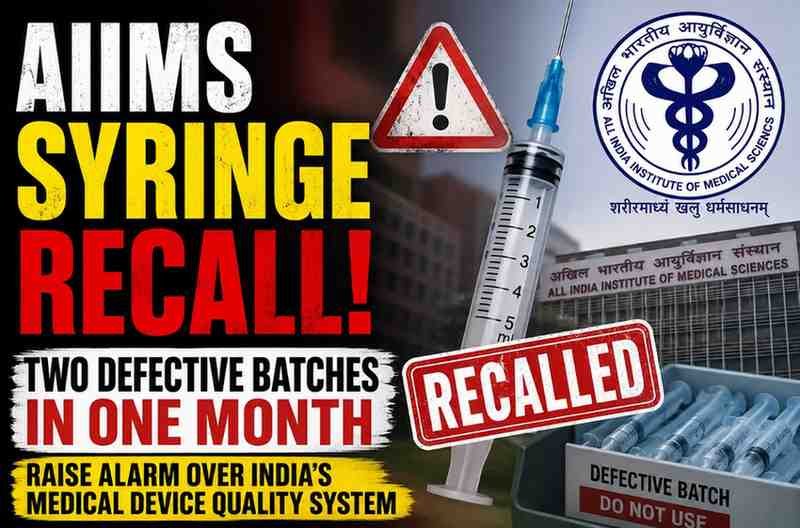
A syringe is not a complex device. It has no circuit board, no algorithm, no moving parts beyond a plunger and a needle. It is, in theory, one of the simplest products a medical supply chain is asked to deliver. Which is why the news that the All India Institute of Medical Sciences (AIIMS) in New Delhi ranked sixth best hospital in the world by Brand Finance in 2026 was forced to issue recall notices for two separate batches of disposable 10 ml syringes with needles, from two different manufacturers, within a span of three weeks, is far more alarming than its modest framing suggests.
The story broke quietly. In a letter addressed to Union Health Minister J.P. Nadda, Rajya Sabha Member of Parliament Haris Beeran elected from Kerala representing the Indian Union Muslim League flagged the back-to-back recalls and formally sought a thorough probe. The letter pointed to an uncomfortable truth: two separate quality failures in the same product category, procured from different vendors, at the country’s premier public hospital, within a single calendar month, cannot be dismissed as coincidence or bad luck. It looks, instead, like a structural problem wearing a product-failure disguise.
The implications are significant. AIIMS Delhi serves millions of patients every year from across India and the world. It is the reference institution for India’s public health system the standard against which other hospitals are measured, and the institution to which patients who have exhausted options elsewhere turn as a last resort. If the quality of consumable medical devices at AIIMS is uncertain, the question of what is reaching smaller, less scrutinised public hospitals across the country becomes genuinely disturbing.
What Happened: The Timeline of a Double Recall
The facts, as established by MP Haris Beeran’s letter to the Health Minister, are straightforward. Over the course of approximately one month in mid-2026, AIIMS New Delhi issued two separate recall notices for batches of disposable 10 ml syringes with needles. The two recalled batches were sourced from different manufacturers, which is a detail that matters enormously and deserves emphasis.
A single recall from a single manufacturer can plausibly be attributed to a manufacturer-specific lapse a batch contamination, a packaging failure, a quality control breakdown at one facility. It is unfortunate, but it is contained. The corrective action is identifiable: investigate the manufacturer, suspend the batch, and strengthen incoming quality checks at the procurement end.
Two recalls from two different manufacturers for the same product, within three weeks, at the same institution, tells a different story. It suggests that the quality control problem is not localised to one supplier. It may indicate systemic weaknesses in the procurement and incoming inspection process at the hospital itself. It may point to a broader failure in the regulatory environment governing medical device manufacturing in India. It may reflect a price-driven procurement framework that incentivises the selection of the lowest-cost supplier over the most reliably quality-controlled one. Possibly all of the above.
MP Beeran’s letter to Health Minister Nadda did not merely report the facts it demanded accountability. The probe sought is not a routine audit request. It is a political signal that the double recall has created enough concern at the parliamentary level to require a formal ministerial response.
Why a Syringe Failure at a Hospital Like AIIMS Is Never a Minor Story
Syringes are so ubiquitous in clinical settings that their failure modes are often underestimated. At a hospital the size of AIIMS which handles hundreds of thousands of patient interactions annually, operates over a thousand beds, runs dozens of operation theatres, and manages intensive care units serving some of India’s most critically ill patients the syringe is not a peripheral supply item. It is a front-line clinical tool used in virtually every procedure, from a simple blood draw to complex intravenous drug delivery in an ICU.
Quality failures in syringes are not abstract. Depending on the nature of the defect, they can result in:
- Sterility breaches: A compromised sterile barrier damaged packaging, inadequate sealing, or manufacturing contamination can introduce bacteria or particulate matter directly into a patient’s bloodstream, with potentially fatal consequences in immunocompromised or critically ill patients.
- Mechanical failures: Plunger defects, barrel cracks, or needle attachment failures can result in inaccurate dosing, medication spillage, or needle-stick injuries to clinical staff each carrying its own cascade of clinical and occupational health risks.
- Particulate contamination: Injecting particulate matter into a patient is a known cause of embolism, vascular damage, and inflammatory reactions. Between 2012 and March 2026, approximately 305 out of nearly 5,578 sterile injectable device recalls logged in the FDA’s database were specifically attributed to the presence of foreign matter a significant proportion of the total.
- Compromised drug delivery: In critical care contexts, where the precision of a drug dose can be the difference between clinical effect and overdose or under-treatment, a syringe that delivers unpredictably is a direct patient safety risk.
None of these outcomes require imagination. They are documented in pharmacovigilance literature, patient safety reports, and recall databases globally. The question of why a batch of syringes was recalled is rarely answered publicly at the institutional level in India’s public health system — and that opacity is itself part of the problem.
India’s Medical Device Recall System: Functional in Theory, Fractured in Practice
To understand why two syringe batch recalls at AIIMS in a single month carries significance beyond the immediate incident, it is essential to understand the state of India’s medical device quality and recall infrastructure which, experts have long argued, is structurally inadequate for a country of India’s size, complexity, and healthcare ambition.
The Central Drugs Standard Control Organisation (CDSCO) is India’s national regulatory authority for drugs and medical devices. Under the Medical Devices Rules 2017, all manufacturers of notified medical devices — a category that includes syringes are required to be registered and must meet specified quality standards. CDSCO is responsible for post-market surveillance, quality testing, and coordinating recall actions when defects are identified.
In practice, the system has well-documented gaps. A major legal analysis published in early 2026 on India’s medical device recall framework identified the following structural weaknesses:
- No binding mandatory recall law for medical devices: Unlike the United States, where the FDA has statutory authority to mandate recalls under defined circumstances, India’s framework relies heavily on voluntary compliance by manufacturers. A manufacturer-initiated voluntary recall depends on the manufacturer’s own willingness to act and the speed and completeness with which they do so is not uniformly enforced.
- Fragmented state-level oversight: India’s federal structure means that drug and device regulation operates simultaneously at central and state levels. A problematic batch identified and recalled in one state may continue to circulate in others unless the CDSCO issues a national alert and the coordination mechanisms for ensuring this are inconsistent.
- Limited post-market surveillance capacity: Tracking a product from manufacturer through distributor to hospital, identifying quality failures in real time, and executing a recall across a supply chain that covers 1.4 billion people spread across 28 states and eight union territories requires surveillance infrastructure that India’s regulatory system is still building.
- Procurement processes that can deprioritise quality: Public hospital procurement in India including at premier institutions operates under frameworks such as the Government e-Marketplace (GeM) in which cost remains a dominant selection criterion. The lowest-price competitive bidding model, when applied to medical consumables without sufficiently rigorous quality pre-qualification, creates incentive structures that do not always favour the most quality-reliable supplier.
Against this backdrop, the AIIMS syringe recall is not an anomaly. It is a data point consistent with a pattern. CDSCO data released in 2026 showed that 1,879 drug and device samples were declared Not of Standard Quality (NSQ) during 2025 more than double the 877 reported in 2024. Regulatory officials attributed much of this increase to improved surveillance and greater state-level participation in reporting, rather than an actual deterioration in product quality. But the scale is striking regardless of its interpretation.
| Indicator | Data / Finding | Significance |
|---|---|---|
| AIIMS syringe recalls in one month (2026) | 2 separate batches, 2 different manufacturers, within 3 weeks | Rules out single-manufacturer defect; points to systemic issue |
| NSQ drug/device samples in India, 2025 | 1,879 more than double 2024’s 877 | Reflects either rising quality failures or improved detection — both warrant action |
| NSQ samples from State regulators, 2025 | 1,163 of 1,879 (62%) up from 339 (39%) in 2024 | Improved state-level surveillance catching failures previously missed |
| Global sterile injectable recalls for particulates, 2012–2026 | ~305 of 5,578 total FDA sterile injectable recalls | Foreign matter contamination is a documented, ongoing global risk in this category |
| US medical device recall events, 2024 | 1,059 four-year high; Class I recalls at 15-year high | Quality failures in medical devices are rising globally, not just in India |
| India’s mandatory recall law for medical devices | No binding statutory recall obligation for manufacturers | Creates structural accountability gap; relies on voluntary compliance |
| CDSCO’s 2026 digital regulatory overhaul (DDRS) | Bids invited April 2026 for unified digital drug/device regulatory system | System-level reform underway but implementation timeline unclear |
The Procurement Problem: When the Lowest Bidder Reaches the Patient First
India’s public hospital procurement system is built on principles of fiscal accountability, transparency, and cost-efficiency — all legitimate and important goals for institutions that serve millions of patients on public funds. The Government e-Marketplace and comparable centralised procurement platforms have made procurement processes more auditable and reduced opportunities for corruption. These are genuine advances.
But there is a tension at the heart of cost-driven procurement for medical consumables that the AIIMS syringe recall brings into sharp focus. When price is the dominant selection criterion in a competitive bidding process for a product like a disposable syringe, the market systematically favours the manufacturer who can produce at the lowest cost per unit. In a well-regulated market with credible quality enforcement, this is fine the floor of acceptable quality is maintained by regulation, and competition on price occurs above that floor.
In a regulatory environment where pre-qualification is inconsistent, incoming inspection at hospitals is variable, and post-market surveillance has known gaps, the lowest-cost supplier is often the supplier who has cut costs at the expense of quality controls that are expensive to maintain. The result is a procurement logic that creates patient safety risk as an externality of fiscal discipline.
This is not a new observation in Indian healthcare policy. What the AIIMS double recall does is give it institutional specificity. This is not a small district hospital with limited procurement expertise and no quality infrastructure. This is AIIMS — with the resources, the technical capacity, and the institutional standing to demand quality from its suppliers and enforce those demands. If quality failures are reaching AIIMS patients, the question of what is reaching patients elsewhere becomes urgent and unanswerable without a formal investigation.
Haris Beeran’s Letter and Why Parliamentary Scrutiny Matters Here
MP Haris Beeran’s decision to write directly to Health Minister JP Nadda rather than routing the concern through a committee or a routine parliamentary question reflects the seriousness with which the double recall is being received at the political level. It is a formal demand for ministerial attention to what might otherwise be treated as a routine administrative matter handled quietly between AIIMS procurement, the implicated manufacturers, and CDSCO’s medical devices division.
Parliamentary pressure is one of the few mechanisms in India’s public health accountability architecture capable of generating a response with genuine consequences. AIIMS operates under the direct administrative oversight of the Ministry of Health and Family Welfare. When a sitting MP writes formally to the Health Minister about a patient safety concern at an institution under that Ministry’s direct purview, the institutional dynamics for inaction shift significantly.
What the probe, if it is conducted seriously, should examine:
- The precise nature of the quality defects identified in both recalled batches were they sterility failures, mechanical defects, particulate contamination, or packaging breaches?
- How far the defective syringes were distributed before the recalls were issued and whether any patients received care using products from the affected batches before the recall notices were acted on.
- The procurement pathway for both manufacturers how they were selected, what quality pre-qualification criteria they satisfied, and whether the incoming inspection process at AIIMS identified any concerns before the batches were cleared for use.
- Whether the manufacturers involved have been previously flagged for quality issues by CDSCO, state drug regulators, or any other institution.
- What systemic changes are needed in AIIMS procurement protocols and in the national regulatory framework for medical device quality assurance to prevent recurrence.
India’s Medical Device Ambition and Its Quality Gap
India’s medical device sector is one of the fastest-growing in the world, valued at approximately $12 billion and expanding at double-digit annual rates. India is also one of the world’s largest manufacturers of syringes and other disposable medical consumables — with companies like Hindustan Syringes and Medical Devices Ltd. holding WHO prequalification status for multiple syringe products and supplying immunisation programmes globally. The sector’s ambition is to become a global hub for medical device manufacturing, and genuine progress has been made toward that goal.
The quality challenge, however, is real and ongoing. The Indian medical device regulatory framework which brought medical devices formally under regulatory oversight through the Medical Devices Rules 2017 is still maturing. Pre-market quality requirements are improving. Post-market surveillance is expanding. The CDSCO’s forthcoming Digital Drugs Regulatory System (DDRS), for which bids were invited in April 2026, promises to unify and digitise the fragmented regulatory landscape.
But the gap between regulatory aspiration and clinical reality is still measurable in NSQ reports, in recall notices, and now in a letter from a Member of Parliament to the Health Minister about syringes at AIIMS. That gap is not an argument against the medical device sector’s growth ambitions India’s manufacturing capabilities are real and significant. It is an argument for ensuring that the regulatory infrastructure grows at the same speed as the sector it governs.
There is, notably, a global dimension to this concern. US FDA data from 2024 shows medical device recalls at a four-year high, with Class I recalls the most serious classification, indicating reasonable probability of serious patient injury or death — at their highest level in fifteen years. Device quality failures are a global challenge, not an India-specific one. What India-specific context adds is the regulatory framework dimension: the absence of a binding mandatory recall law for medical devices, the fragmented state-federal oversight structure, and the procurement practices that may inadvertently select for cost over quality.
The Visibility Problem: What We Do Not Know Is More Worrying Than What We Do
One of the most significant and least discussed dimensions of the AIIMS syringe recall story is not the recall itself. It is the fact that the recall became public at all. AIIMS has the institutional standing and the patient volume to identify quality failures in its supply chain that smaller hospitals cannot detect. A district hospital with limited incoming inspection capacity, under-resourced procurement processes, and no MP writing letters to ministers on its behalf, may receive and use defective medical consumables without ever generating a public alert.
This is the iceberg problem in medical device quality. The visible failures the recalls that make it into news, the NSQ alerts published on the CDSCO portal, the letter from an MP to a Minister represent the portion of the quality problem that the surveillance system has managed to catch. The larger, invisible portion is what the system has not caught: the defective products that reached patients before being identified, the quality failures in institutions without the resources to detect them, and the absence of a mandatory reporting infrastructure that would make the full scale of the problem visible.
India’s CDSCO acknowledged as much, implicitly, when officials explained that the doubling of NSQ reports between 2024 and 2025 reflected improved surveillance rather than worsening quality. If that explanation is correct and it is plausible then improved surveillance is surfacing problems that previously existed but went undetected. That is, in one sense, the system working as it should. In another sense, it is a recognition that the pre-2024 surveillance baseline was capturing only a fraction of the actual quality failure rate.
Conclusion: Two Syringe Batches and a Systemic Question That Cannot Be Quietly Recalled
The AIIMS syringe recall story is, on its surface, a specific institutional event: two batches, one hospital, one month, one MP’s letter. But surface framing is rarely where the significance of a story lives, and this one is no exception.
What the double recall at India’s most prestigious public hospital actually represents is a window into a set of systemic pressures — on procurement quality, on regulatory enforcement, on post-market surveillance, and on the institutional accountability mechanisms that are supposed to ensure that a patient receiving care at a public hospital in India is not endangered by the most basic tool a nurse picks up to administer their medication.
The probe that MP Haris Beeran has demanded from Health Minister JP Nadda should be conducted seriously, transparently, and with findings made public. It should examine not just the two defective batches but the procurement pathway, the regulatory oversight, and the institutional processes that allowed two separate quality failures in the same product to reach AIIMS within a month of each other. And it should ask and answer the harder question that the visible recall only partially illuminates: if this is what India’s best-resourced public hospital is experiencing, what is reaching the patients who do not have AIIMS’s systems, standing, or scrutiny to protect them?
A syringe is a simple device. The system that is supposed to ensure it works safely is not simple at all. And two recall notices in three weeks is the clearest possible evidence that the system has room and responsibility to do better.
For breaking news and live news updates, like us on Facebook or follow us on Twitter and Instagram. Read more on Latest Health on thefoxdaily.com.






COMMENTS 0