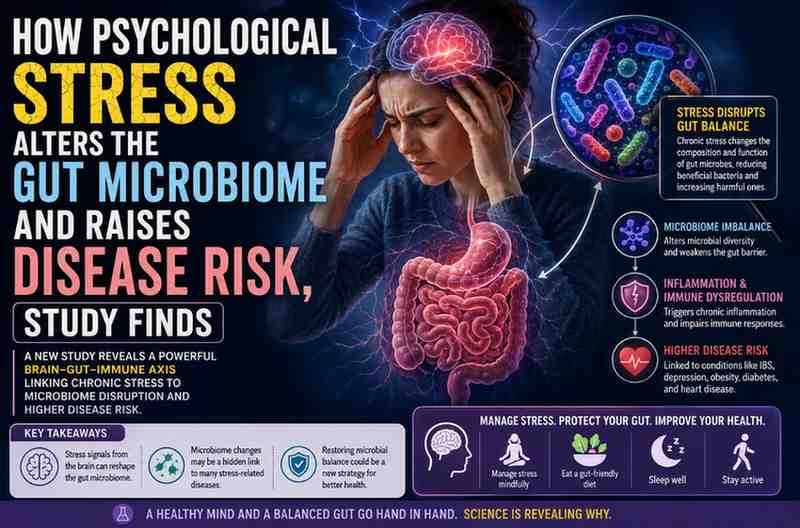
For decades, doctors have told anxious patientsthat stress is “bad for the gut” without being able to say exactlywhy. A new study published in Cell Stem Cell inJuly 2026 finally draws a mechanistic line connecting the dots: chronicpsychological stress dampens activity in two specific brain regions, which inturn disrupts the gut microbiome, drains a beneficial metabolite calledspermidine, and pushes the body’s blood-forming stem cells into a state thatresembles premature aging. The result, according to researchers led by MengZhao and Linjia Jiang at Sun Yat-sen University in Guangzhou, China, is abiological pathway that could help explain why chronically stressed people facehigher long-term risk of conditions like heart disease, diabetes, and weakenedimmunity.
The research was conducted in mice, using fourdistinct models of psychological stress, and the findings were released thisweek, drawing attention from clinicians and microbiome researchers who havelong suspected a two-way conversation between the brain and the gut but lackeda clear mechanism linking it to bone marrow function. This article breaks downwhat the study actually found, why the brain-gut-bone marrow axis matters morethan prior stress research, and what it means for anyone trying to protect theirlong-term health from the wear and tear of chronic stress.
Background: Why Scientists Have Long Suspected aStress-Gut-Immunity Link
The idea that stress affects digestion is not new.Anyone who has felt their stomach knot up before a job interview hasexperienced the gut-brain axis firsthand. What has been harder to prove iswhether everyday psychological stress the kind that builds up over months oryears rather than a single frightening event can reach all the way into thebone marrow, where the body manufactures blood and immune cells.
Earlier research had already established twothings. First, chronic stress activates the sympathetic nervous system,releasing stress hormones that bind to adrenergic receptors on immune cells inthe bone marrow, nudging the system toward inflammation. Second, gut bacteriaare known to produce metabolites that circulate throughout the body andinfluence organs far from the intestines, including the brain and the marrow.What remained unclear was the wiring: which parts of the brain initiate thiscascade, and how exactly do signals travel from a stressed mind to a stem cellburied in bone.
Key Developments: Mapping the Brain-Gut-MarrowCircuit
To answer that question, the Sun Yat-sen Universityteam exposed mice to four different stress paradigms, an approach thatstrengthens the study’s conclusions because it rules out the possibility thatthe results were a quirk of one particular stress test. Across all four models,two brain regions consistently showed reduced activity under chronicstress:
- The medial prefrontal cortex(mPFC), which integrates emotional regulation with cognitivedecision-making.
- The periaqueductal gray(PAG), a midbrain structure best known for modulating pain butalso involved in autonomic responses.
When the researchers artificially suppressed justthese two regions in otherwise unstressed mice, they reproduced many of thesame blood and bone marrow abnormalities seen in the chronically stressedanimals. That is a striking result: it suggests the brain doesn’t need afull-blown stress response to damage the blood system. Quieting just tworegions was enough to trigger a cascade that included loss of hematopoieticstem cells (the cells responsible for generating all blood and immune cells)and a drop in lymphocyte production, which are the white blood cells central toadaptive immunity.
The downstream effects on the gut were just asspecific. Stressed mice lost populations of Lactobacillusreuteri, a bacterial species widely recognized for helpingmaintain a balanced gut ecosystem, and showed reduced levels ofspermidine, a naturally occurring polyaminecompound that the body and gut bacteria both produce.
“Our research shows how stress-responsivebrain regions regulate the balance of the intestinal microbiota, whichultimately affects the function of hematopoietic stem cells,” said MengZhao, the study’s senior author. Lead author Linjia Jiang added that thediscovery of just two brain regions driving so much of the effect wasunexpected, and that changes in gut bacteria and spermidine appeared to be thecrucial messengers carrying the signal from brain to bone marrow.
Why Spermidine Is the Real Star of ThisStudy
The source article treats spermidine as a passingdetail, but it deserves far more attention, because it is arguably the mostactionable piece of this entire puzzle. Spermidine is a polyamine found inevery living cell, and it is best known for triggering autophagy the processby which cells clear out damaged components and recycle them, something like abuilt-in cellular housekeeping service. As people age, spermidine levels in thebody naturally decline, and lower spermidine has independently been associatedwith higher rates of cardiovascular disease and reduced lifespan in populationstudies.
Separately from this new stress research,spermidine has already been shown in other studies to help maintain the gut’sprotective barrier, encourage the growth of beneficial bacteria, calm chronicgut inflammation, and support metabolic health in animal models of obesity. Putthose findings alongside the new Cell Stem Cell study, and a more completestory emerges: chronic stress appears to suppress the very gut bacteria andmetabolites that would otherwise be protecting the blood-forming stem cells frompremature aging. In other words, stress does not just feel bad, it may beactively switching off one of the body’s own anti-aging systems.
| Factor Affected by Chronic Stress | What Happens | Downstream Consequence |
|---|---|---|
| Medial prefrontal cortex & periaqueductalgray activity | Activity is suppressed | Triggers signals that disrupt gut and marrowfunction |
| Lactobacillus reuteri population | Declines significantly | Gut microbial balance weakens |
| Spermidine levels | Drop | Reduced cellular clean-up (autophagy), weaker gutand immune resilience |
| Hematopoietic stem cells | Show aging-like decline | Reduced capacity to regenerate blood and immunecells |
| Lymphocyte production | Falls | Weaker adaptive immune response overtime |
Deep Analysis: Why This Matters More Than PreviousStress Research
Most public health messaging about stress focuseson mental health outcomes — anxiety, depression, burnout — and cardiovasculareffects through blood pressure and hormones like cortisol and adrenaline. Thisstudy adds a third, largely overlooked pathway: stress reprogramming the immunesystem’s manufacturing plant through the gut. That distinction matters for afew reasons.
First, it offers a biological explanation forsomething clinicians have observed anecdotally for years: people underprolonged stress seem to get sick more often, heal more slowly, and sometimesdevelop metabolic conditions that seem disproportionate to their diet orexercise habits. If chronic stress is quietly aging the bone marrow’s stem cellpool, that could help explain part of this pattern, independent of lifestylefactors people usually get blamed for.
Second, the study reframes the gut microbiome notjust as a digestive organ but as a messenger service between the brain and theimmune system. This positions Gut Health interventions — probiotics, fermentedfoods, fiber, and potentially spermidine-rich foods such as aged cheese,mushrooms, soybeans, and wheat germ — as tools that might matter for stressresilience in a way that goes beyond digestion or mood.
Third, and perhaps most importantly for the fieldof aging research, this work adds hematopoietic stem cell decline to thegrowing list of processes that can be triggered psychologically rather thanpurely through chronological time, injury, or toxin exposure. That reinforces abroader shift happening across biology: aging is increasingly understood lessas a fixed clock and more as a set of switchable, at least partly reversible,biological programs.
A Useful Comparison: Stress and Cortisol vs.Stress and the Microbiome
It’s worth contrasting this new mechanism with thestress pathway most people already know: the cortisol and adrenaline response.That pathway is fast, acting within seconds to minutes, and is mostlyreversible once the stressor passes. The brain-gut-marrow pathway described inthis new research appears to work on a much slower timescale, more like adrip-feed of damage that accumulates over weeks or months of sustained stress,and it targets the stem cell reserves that the body relies on for decades ofblood and immune regeneration. That is a meaningfully different threat:hormonal stress responses spike and fade, but a depleted stem cell pool doesnot simply refill overnight.
Real-World Impact: What This Could Mean forPatients and Public Health
It is important to be precise about what this studydoes and does not show. The research was conducted entirely in mice, and theauthors themselves acknowledge that whether the same neural circuits andmicrobial changes occur in humans remains an open question. No human clinicaltrial has yet confirmed this exact brain-gut-marrow pathway.
That said, the implications, if the findingstranslate to humans, are significant. They would suggest that stress managementinterventions such as therapy, meditation, exercise, and sleep hygiene are notjust mental health tools but potential ways to protect long-term immune andblood health. It would also suggest gut-focused interventions, from targetedprobiotics to spermidine-supportive diets, might one day be studied as acomplementary approach for people under chronic occupational or caregiving stress,rather than only being marketed as general wellness products.
For clinicians, this research offers a rationalefor taking patient-reported chronic stress more seriously as a risk factoralongside more traditional markers like blood pressure, cholesterol, and bloodsugar, particularly for patients who report high stress but do not yet showconventional warning signs.
Prediction: Where This Research Is Likely HeadedNext
Based on the trajectory of similar discoveries ingut-brain-immune research over the past decade, it is reasonable to expect thenext phase of this work to move in three directions. Researchers will likelyattempt to confirm whether reduced activity in equivalent human brain regionscorrelates with gut and blood markers in people reporting chronic stress,probably through neuroimaging studies paired with microbiome and bloodsampling. Second, expect trials testing whether restoring Lactobacillus reuterior spermidine levels, through diet, supplementation, or engineered probiotics,can blunt the hematopoietic effects of stress in animal models before any humantesting begins. Third, this discovery is likely to accelerate interest in”psychobiotics,” a term already used in early research for probioticstrains selected specifically for their effects on mood and stress physiology,since this study gives that field a much clearer mechanistic target:hematopoietic stem cell aging, not just anxiety symptoms.
Conclusion: A New Reason to Take Chronic StressSeriously
This study does not tell people anything theyhaven’t already sensed intuitively, that prolonged stress takes a physicaltoll. What it adds is a plausible, testable mechanism: specific brain regionsquieting down under chronic stress, gut bacteria and a key metabolite decliningas a result, and blood-forming stem cells aging faster because of it. Theresearch authors themselves frame the finding carefully, noting that managingpsychological stress may help preserve immune function and support healthy aging,while also being upfront that translating this from mice to people, anddeveloping any therapies around it, will take years of further study.
Still, the framework matters. It gives researchersa concrete target — the medial prefrontal cortex, the periaqueductal gray, gutLactobacillus populations, and spermidine levels — rather than a vague sensethat “stress is bad for you.” For anyone managing high stress today,the practical takeaway is not to wait for a pill or a probiotic breakthrough,but to treat stress reduction, sleep, and gut-supportive nutrition asinvestments in long-term immune and metabolic health, not just short-termcomfort.
For breaking news and live news updates, like us on Facebook or follow us on Twitter and Instagram. Read more on Latest Health on thefoxdaily.com.






COMMENTS 0