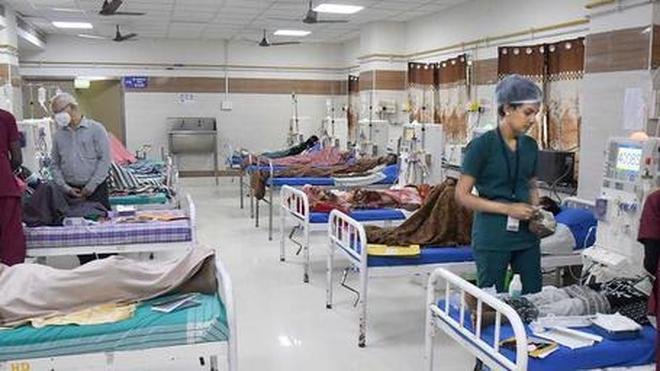
vacancies in central health institutions
Search intent: Informational — readers want to understand the scale of vacancies, why they matter, how AIIMS is affected, and what the numbers mean for India’s healthcare system.
Related keywords: AIIMS faculty vacancies, healthcare staff shortage in India, central government hospitals vacancies, medical faculty shortage, AIIMS recruitment, public healthcare staffing, doctor vacancies in India, healthcare infrastructure India
India has invested heavily in expanding its public healthcare infrastructure, but a hospital building can only deliver its full promise when enough doctors, nurses, technicians, administrators and other healthcare professionals are available to operate it. The latest government data bring that basic reality sharply into focus: more than 23,000 posts are vacant across 28 central health institutions.
The figures, furnished by Union Minister of State for Health and Family Welfare Anupriya Patel, show that the staffing challenge extends beyond a single category of workers or one institution. Among the 18 AIIMS institutions covered in the data, 4,850 faculty posts have been sanctioned for 2026-27, while 1,645 remain vacant. That represents roughly 34% of the sanctioned faculty strength.
At first glance, the headline number is the obvious story. But the more important question is what sits behind it. Vacancies in a major government hospital are not simply empty boxes on an administrative chart. They can affect outpatient services, inpatient care, specialist availability, teaching, research, postgraduate training and the ability of institutions to use newly created infrastructure effectively.
There is another detail that deserves closer attention: the data also indicate a decline in sanctioned posts at some institutions. That makes the issue more complicated than simply asking how quickly existing vacancies can be filled. If sanctioned strength changes over time, policymakers and the public need to distinguish between genuine recruitment gaps and changes in the staffing structure itself.
What do the latest vacancy figures actually show?
The government data cover 28 central health institutions and point to more than 23,000 vacant positions. Within the AIIMS group, the numbers are particularly significant because faculty members perform two jobs simultaneously: they provide specialist healthcare and train the next generation of medical professionals.
| Indicator | Reported figure | Why it matters |
|---|---|---|
| Central health institutions covered | 28 | Shows that the staffing issue extends across a broad group of institutions |
| AIIMS institutions covered | 18 | Represents a major part of India’s premier public medical network |
| Sanctioned AIIMS faculty posts in 2026-27 | 4,850 | Indicates the planned faculty capacity |
| Vacant AIIMS faculty posts | 1,645 | Shows a substantial gap between sanctioned and filled positions |
| Approximate AIIMS faculty vacancy rate | 34% | Roughly one in three sanctioned faculty positions is vacant |
| Total vacancies across 28 institutions | Over 23,000 | Highlights the wider workforce challenge beyond AIIMS faculty |
The AIIMS figure is particularly striking because faculty shortages have a multiplier effect. A vacant administrative position may slow a process; a vacant clinical faculty position can simultaneously affect patient care, teaching and academic supervision.
Why AIIMS faculty vacancies matter beyond hospitals
AIIMS institutions are not conventional hospitals alone. They combine healthcare delivery with medical education, specialist training and research. That means staffing levels influence several parts of the health system at once.
Consider a department that has fewer faculty members than its sanctioned strength. Existing doctors may have to divide their time between patient care, teaching, academic responsibilities, research work and institutional administration. The result does not automatically mean poor care, but prolonged understaffing can place additional pressure on the workforce.
The teaching dimension is equally important. Medical students and postgraduate residents need access to experienced faculty for clinical teaching, supervision and assessment. As India expands medical education capacity, the availability of qualified teachers becomes an important part of determining whether expansion is sustainable.
This is why the AIIMS vacancy figure should not be viewed simply as a recruitment statistic. It is also a measure of how effectively the country can convert investment in medical infrastructure into actual healthcare and educational capacity.
The bigger issue: infrastructure without enough people
India’s healthcare expansion has increasingly involved new institutions, upgraded hospitals and greater public investment. But healthcare capacity has two essential components: physical infrastructure and human resources.
A modern hospital needs operating theatres, intensive-care facilities, diagnostic equipment, laboratories and beds. It also needs people who can use those facilities safely and efficiently.
This creates a simple but frequently overlooked equation: healthcare infrastructure is only productive when workforce capacity grows alongside it.
A newly constructed facility may look like a major addition to healthcare capacity on paper. Yet if recruitment does not keep pace, some of that potential may remain underused. The problem can become particularly important in specialised services where qualified professionals are harder to recruit.
The current vacancy data therefore raise a broader policy question: should healthcare expansion be measured primarily by the number of institutions and facilities created, or by how much functioning capacity those institutions can actually deliver?
Why are healthcare vacancies difficult to fill?
There is no single explanation for vacancies across a large and diverse network of central institutions. Recruitment in healthcare is different from filling an ordinary administrative position because many jobs require specialised qualifications, professional registration, experience and, in the case of senior academic roles, a combination of clinical and teaching expertise.
Recruitment processes can also take time. A vacancy may move through advertisement, application screening, eligibility checks, interviews, selection and appointment before a candidate actually joins.
For highly specialised departments, the challenge can be even greater because the pool of eligible candidates is smaller.
Location and professional preferences can also influence recruitment. Experienced specialists may have opportunities across government hospitals, private institutions, medical colleges and research organisations. A central institution must therefore compete not only on salary but also on working conditions, academic opportunities, career progression, research support and professional environment.
Another important distinction is between a vacancy existing on paper and an institution being unable to provide a service. A vacancy rate is an important warning indicator, but it should be interpreted alongside workload, department-level staffing, patient volumes and the availability of alternative personnel.
The overlooked detail: sanctioned posts are changing too
One of the most significant details in the latest data is not the headline vacancy number but the reported decline in sanctioned posts at some institutions.
This matters because vacancy percentages are calculated against sanctioned strength. If the number of sanctioned positions changes, the apparent size of the staffing gap can change as well.
For example, imagine an institution with 100 sanctioned posts and 20 vacancies. Its vacancy rate is 20%. If the sanctioned strength later changes to 80 while the number of employees remains unchanged, the vacancy picture would look very different. Conversely, increasing sanctioned strength without corresponding recruitment can make the vacancy rate rise.
That is why policymakers should publish three figures together whenever possible: sanctioned posts, filled posts and vacant posts. Tracking only one of these numbers can produce an incomplete picture.
The long-term question should therefore not simply be, “How many vacancies were filled?” It should be, “Is the sanctioned workforce adequate for the institution’s present and planned workload?”
A 34% faculty vacancy rate is more than an HR problem
With 1,645 vacancies out of 4,850 sanctioned AIIMS faculty positions, the reported gap is approximately 34%. Put differently, around one out of every three sanctioned faculty positions is vacant.
That proportion deserves attention because faculty members are central to the academic model of medical institutions. They are responsible for clinical supervision, teaching and other institutional responsibilities in addition to patient care.
However, it would be misleading to conclude that every AIIMS is experiencing exactly the same problem. A national aggregate can conceal substantial differences between institutions, departments and specialties.
A more useful next step would be to examine vacancy rates institution by institution and department by department. A hospital with a relatively low overall vacancy rate could still face a serious shortage in a critical specialty. Likewise, a high overall vacancy percentage may have a different operational effect depending on where the vacancies are concentrated.
What does this mean for patients?
For patients, the most visible consequences of staffing shortages can include longer waits, fewer appointment slots, pressure on specialist services and increased workload for available healthcare workers. The exact effect varies by institution and department, so the vacancy figures alone cannot establish a direct cause for any particular patient’s experience.
Still, the workforce question matters because public hospitals often serve patients who depend on affordable specialist treatment. When specialist capacity is stretched, demand does not disappear. It may shift to other public hospitals, private facilities or facilities farther from a patient’s home.
That creates a wider system effect. One understaffed institution can contribute to pressure elsewhere, particularly when it is a referral centre handling complex cases.
The hidden impact on medical education
The staffing shortage may be even more consequential when viewed through the education pipeline.
India needs a continuing supply of trained doctors and specialists. Medical colleges and teaching hospitals cannot function effectively as educational institutions without sufficient faculty supervision.
This creates a circular challenge. The country needs more trained specialists to strengthen healthcare institutions, but strong medical education itself depends on adequate faculty. If teaching positions remain vacant for extended periods, the capacity to train future professionals can come under pressure.
The issue is therefore not only about today’s hospital workforce. It is also about tomorrow’s workforce.
Why filling every vacancy immediately is not the whole solution
It may be tempting to treat the 23,000-plus vacancies as a simple recruitment target. But a sustainable solution requires more than issuing advertisements.
First, recruitment systems need to be predictable and timely. Repeated delays can make institutions less attractive to candidates who have multiple career options.
Second, workforce planning needs to be linked to actual service demand. Sanctioned positions should reflect patient load, specialty requirements, teaching responsibilities and institutional expansion.
Third, retention deserves as much attention as recruitment. Hiring professionals only to see experienced staff leave after a short period does not solve the underlying capacity problem.
Fourth, institutions need appropriate support systems. Doctors and faculty cannot compensate indefinitely for shortages in nursing, technical, administrative or other essential categories. Healthcare is a team activity, and workforce planning should reflect that reality.
What policymakers should track next
The most useful measure of progress will not be a single annual vacancy headline. A stronger monitoring framework would track several indicators together.
- Vacancy rates by institution and specialty.
- Time taken from advertisement to appointment.
- Number of sanctioned positions added or removed each year.
- Retention and attrition of doctors and faculty.
- Patient workload relative to available clinical staff.
- Impact of staffing levels on teaching and postgraduate training.
- Use of hospital infrastructure relative to its planned capacity.
Such reporting would give citizens a clearer picture of whether the healthcare system is genuinely gaining capacity or simply moving vacancies between categories.
Comparison: building hospitals versus staffing hospitals
The distinction can be understood through a simple comparison. Building a hospital creates potential capacity. Staffing it creates operational capacity.
| Healthcare investment | What it creates | What is needed to make it effective |
|---|---|---|
| New hospital building | Physical infrastructure | Doctors, nurses, technicians and support staff |
| Advanced medical equipment | Diagnostic or treatment capability | Trained professionals and maintenance support |
| New medical college capacity | Additional educational potential | Qualified faculty and clinical teaching facilities |
| Expanded specialist services | Greater treatment capacity | Specialists, allied staff and adequate patient-support systems |
This is the central insight behind the vacancy figures: human resources are not a secondary component of healthcare infrastructure; they are part of the infrastructure itself.
What could happen if the trend continues?
If vacancies remain elevated for long periods while healthcare demand and institutional responsibilities grow, the pressure on existing staff is likely to become an increasingly important policy concern.
On the other hand, a sustained recruitment drive combined with better retention and smarter workforce planning could turn vacant posts into real gains in service capacity. The impact would be particularly meaningful if recruitment focuses on departments and locations where shortages have the greatest operational consequences.
The more important prediction, therefore, is not that vacancies will automatically worsen or disappear. It is that the quality of India’s healthcare expansion will increasingly depend on how successfully policymakers connect infrastructure planning with workforce planning.
The road ahead for India’s public healthcare system
The figure of more than 23,000 vacant posts across 28 central health institutions is significant, but it should be read as a starting point for deeper analysis rather than a standalone verdict on the health system.
The AIIMS numbers make the challenge especially visible. With 4,850 sanctioned faculty positions and 1,645 vacancies in the 2026-27 figures, the reported gap is approximately 34%. That is large enough to warrant close attention because faculty shortages can influence healthcare delivery and medical education at the same time.
Yet the changing number of sanctioned posts adds another layer to the story. Policymakers, researchers and citizens need consistent year-on-year data showing not only vacancies but also sanctioned strength, filled positions, recruitment timelines and workload.
India’s healthcare ambitions are expanding. More institutions, more medical education and greater access to specialised care can strengthen the system substantially. But those ambitions will ultimately be judged not by how many buildings stand on a campus, but by how many patients can be treated, how many students can be trained and how reliably services can be delivered.
Conclusion: The real healthcare capacity test is the workforce
The latest data on vacancies in central health institutions expose a challenge that is easy to overlook when healthcare expansion is measured mainly through new infrastructure. More than 23,000 vacant posts across 28 central institutions represent a substantial workforce gap, while the 1,645 vacant AIIMS faculty positions highlight the particular importance of staffing in teaching hospitals.
The next phase should move beyond simply counting vacancies. India needs transparent workforce planning that connects sanctioned posts with actual patient demand, medical education requirements and the long-term ability to recruit and retain skilled professionals.
The key lesson is straightforward: a healthcare system becomes stronger not merely when more institutions are built, but when those institutions are fully staffed, properly supported and able to function at the capacity for which they were designed.
If recruitment, retention and workforce planning improve alongside infrastructure investment, today’s vacancy figures can become a roadmap for strengthening India’s public health system rather than merely a measure of its staffing gaps.
Four key takeaways
- More than 23,000 posts are reported vacant across 28 central health institutions.
- Among 18 AIIMS institutions, 1,645 of 4,850 sanctioned faculty posts are vacant in 2026-27.
- The AIIMS faculty vacancy rate is approximately 34%, making the staffing gap a significant institutional issue.
- Changes in sanctioned posts mean vacancy figures must be assessed alongside workforce planning, workload and recruitment trends.
Frequently Asked Questions
How many posts are vacant in central health institutions?
More than 23,000 posts are reported vacant across 28 central health institutions, according to the government data cited in the report.
How many AIIMS faculty posts are vacant?
The data show 1,645 vacant faculty positions among 4,850 sanctioned faculty posts across 18 AIIMS institutions for 2026-27.
What is the AIIMS faculty vacancy rate?
The reported figures translate into an approximate vacancy rate of 34%, meaning roughly one-third of the sanctioned AIIMS faculty positions are vacant.
Why are AIIMS faculty vacancies important?
AIIMS institutions combine patient care with medical education and research. Faculty shortages can therefore affect clinical services as well as teaching and academic supervision.
Does a vacancy always mean a hospital cannot provide a service?
No. A vacancy statistic shows the difference between sanctioned and filled positions, but its operational impact depends on factors such as department, workload, specialty and the availability of other staff.
Why are sanctioned posts important when analysing vacancies?
Vacancy rates depend on sanctioned strength. If the number of sanctioned positions changes, the apparent vacancy rate can also change. Therefore, sanctioned, filled and vacant posts should be examined together.
What is the biggest challenge beyond filling vacant posts?
The larger challenge is sustainable workforce planning. Healthcare institutions need timely recruitment, competitive retention conditions and staffing levels that match patient care, teaching and research responsibilities.
What should be monitored to measure improvement?
Future assessments should track institution-wise and specialty-wise vacancies, recruitment timelines, sanctioned strength, staff retention, workload and the relationship between staffing and actual healthcare capacity.
For breaking news and live news updates, like us on Facebook or follow us on Twitter and Instagram. Read more on Latest Health on thefoxdaily.com.

COMMENTS 0