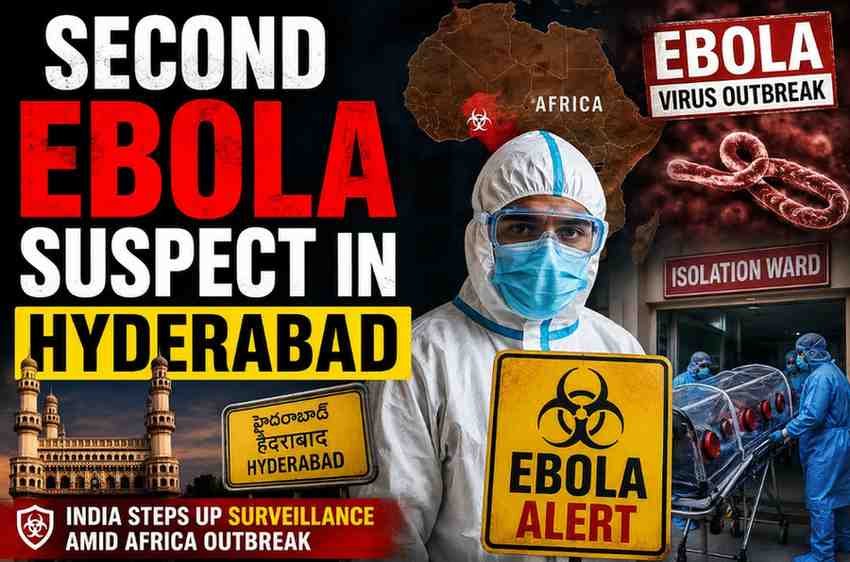
In what is fast becoming a critical test of India‘s public health preparedness, a second Sudanese national has been isolated at Gandhi Hospital in hyderabad after developing a fever, with samples dispatched to the National Institute of Virology (NIV) in Pune for Ebola testing. The development occurring within days of the first such isolation has placed Telangana’s healthcare system squarely under the spotlight as a rare and aggressive strain of the Ebola virus continues to surge across Central Africa, triggering a global health emergency that the World Health Organization has classified as a Public Health Emergency of International Concern (PHEIC).
The patient is a Sudanese student in his twenties, pursuing higher education at a private university in Hyderabad. He was flagged during routine thermal screening at Rajiv Gandhi International Airport (RGIA) after recording a body temperature of 100 degrees Fahrenheit. Given his travel history from Sudan a country under heightened health surveillance health authorities referred him to Gandhi Hospital, the state’s designated nodal centre for Ebola preparedness. A contact of the student has also been isolated and is currently undergoing screening at the same facility.
Crucially, as of the latest update, the student has not exhibited hallmark Ebola symptoms such as vomiting, diarrhoea, or unexplained bleeding a distinction that health officials and anxious members of the public should not overlook.
To understand the second case in full context, one must revisit the first. A 35-year-old Sudanese national arrived in Hyderabad in the early hours of June 4, 2026, on a flight from Ethiopia. Thermal screening at RGIA flagged him for fever, and his travel history which included Uganda and South Sudan raised immediate red flags given those countries’ proximity to the current Ebola outbreak zone. He had travelled to Hyderabad not for any alarming purpose, but for a planned knee surgery.
His samples were also sent to NIV Pune. On June 5, Telangana Health Minister Damodar Raja Narasimha confirmed that the first patient had tested negative for Ebola welcome news, and a demonstration that India’s screening protocols are functioning as intended.
The second patient, a young student, was referred to Gandhi Hospital on the evening of June 5 from a private healthcare facility. His test results are expected within two days. According to Dr. Vamshee Krishna, nodal officer for the isolation ward at Gandhi Hospital, if results are negative, the student will likely be advised home isolation with continued monitoring. A positive result would trigger immediate treatment and full containment protocols.
Gandhi Hospital: Hyderabad’s Ebola Shield
Gandhi Hospital has been designated as Telangana’s nodal centre for Ebola preparedness a role it has been quietly building capacity for in recent weeks. The Telangana government has established a dedicated isolation facility at the hospital comprising 10 fully equipped, isolated rooms, each with an attached bathroom a critical feature in containing any potentially infectious patient.
The hospital’s response structure is methodical: symptomatic travellers from high-risk nations are admitted to the isolation ward; samples are collected and sent to NIV Pune (the only ICMR-designated laboratory in India authorised to test for Ebola); and contacts are either isolated at the hospital or advised home quarantine depending on their own symptom status.
Meanwhile, Rajiv Gandhi International Airport had already issued a public advisory prior to these two cases stating it was implementing enhanced health preparedness measures in accordance with directives from the Directorate General of Civil Aviation (DGCA) and the Ministry of Health and Family Welfare (MoHFW). Under these measures, passengers arriving from or transiting through affected regions, including Uganda, the Democratic Republic of Congo (DRC), and neighbouring high-risk areas, may be required to complete a Self-Declaration Form (SDF) before deboarding.
The Outbreak Behind the Alarm: 2026 Central Africa Ebola Epidemic
To fully appreciate why two Sudanese students in Hyderabad have triggered national-level health alerts, one must understand the severity of what is unfolding in Central Africa.
On May 15, 2026, the Ministry of Health of the Democratic Republic of the Congo (DRC) confirmed an outbreak of Ebola in Ituri Province in northeastern DRC the country’s 17th Ebola outbreak, arriving just five months after the previous one was declared over. But this outbreak carries a particularly dangerous characteristic: it is caused by the Bundibugyo ebolavirus (BDBV), a rare strain that last caused a significant outbreak in Uganda in 2007.
The Bundibugyo strain complicates the response in a critical way: existing approved Ebola treatments and vaccines including the widely stockpiled Ervebo were developed specifically against the Zaire ebolavirus, the strain responsible for the catastrophic West Africa epidemic of 2014–16. Their efficacy against Bundibugyo is limited or unproven, meaning the 2026 outbreak is, in many respects, a battle being fought without the right weapons.
As of June 5, 2026, the DRC Ministry of Health reported a total of 381 confirmed cases, including 64 confirmed related deaths, with 233 individuals hospitalised in isolation. The outbreak has spread across 17 health zones in Ituri Province, with additional cases confirmed in North Kivu and South Kivu. Imported cases have also been confirmed in Uganda’s capital Kampala, with at least 19 confirmed Ugandan cases and 2 deaths as of early June.
The WHO and Africa CDC have jointly announced a $518 million response plan to run from June through November 2026, underscoring how serious this outbreak has become at the international level.
| Parameter | 2026 Bundibugyo Outbreak (DRC/Uganda) | 2014–16 West Africa Outbreak (Zaire strain) |
|---|---|---|
| Strain | Bundibugyo ebolavirus (BDBV) | Zaire ebolavirus (EBOV) |
| WHO Classification | PHEIC (declared May 16, 2026) | PHEIC (declared August 8, 2014) |
| Countries primarily affected | DRC, Uganda | Guinea, Liberia, Sierra Leone |
| Confirmed cases (as of early June 2026) | 381+ (DRC), 19 (Uganda) | ~28,600 at peak |
| Approved vaccine available? | No (Ervebo targets Zaire strain) | Yes (Ervebo approved in 2019) |
| Key complication | Conflict zones, cross-border movement, no targeted vaccine | Weak health systems, delayed response |
| India cases confirmed? | No (two under investigation in Hyderabad) | No |
Why Sudan and Why Hyderabad? The Travel Corridor That No One Is Talking About
A question that deserves more analysis than it has received in standard news coverage is this: why are Sudanese nationals specifically triggering alerts in Hyderabad, and not nationals from DRC or Uganda the epicentres of the outbreak?
The answer lies in the geography of conflict and connectivity. Sudan shares a long, porous southern border with South Sudan, which in turn borders Uganda and is economically tied to DRC’s eastern provinces. Movement between these regions especially among students, traders, and medical travellers is common, informal, and not always well-documented in passport stamps or travel declarations. The Sudanese nationals flagged in Hyderabad both had travel histories that involved Uganda and South Sudan, regions within direct exposure range of the Bundibugyo outbreak zone.
Hyderabad, for its part, has grown into a significant destination for international students and medical travellers from Africa and the Middle East. The city’s mix of private universities, affordable medical care, and international air connectivity makes it a natural hub and precisely the kind of city where a traveller from a high-risk region might land without appearing on any country-level radar until thermal screening catches a fever.
This is not a failure of the system. It is, in fact, the system working exactly as it should. The challenge is sustaining that vigilance over weeks and months, not just during the initial alarm phase.
What Is Ebola and Why a Fever Alone Matters
For readers who may be encountering Ebola in the news for the first time, a brief grounding is important — especially because widespread misunderstanding of how Ebola spreads contributes to both panic and negligence.
Ebola is a severe, often fatal viral haemorrhagic fever that affects humans and other primates. Early symptoms are deceptively ordinary: sudden onset of fever, intense weakness, muscle pain, and headache. These can easily be mistaken for malaria, typhoid, or influenza which is precisely what makes early-stage detection so difficult. The disease progresses to vomiting, diarrhoea, rash, and in severe cases, internal and external bleeding as the virus attacks the immune system and blood-clotting mechanisms simultaneously.
Critically, Ebola is not airborne. The virus is transmitted through direct contact with the blood, secretions, organs, or other bodily fluids of infected individuals, and through contaminated surfaces and materials such as bedding or clothing. It can also be transmitted to humans from infected wild animals particularly fruit bats, which are considered a natural reservoir of the virus.
This means that a person sitting next to a traveller on a flight is not at meaningful risk. A healthcare worker who handles blood or bodily fluids without full protective equipment is. Understanding this distinction is fundamental to calibrated, evidence-based public response and to preventing the kind of hysteria that damaged communities during the 2014 West Africa outbreak.
India’s Preparedness: Encouraging, But With Caveats
The response in Hyderabad has, so far, followed the correct protocol: airport screening, rapid referral to the designated nodal hospital, isolation, sample collection, and dispatch to NIV Pune. The first case returned negative. The second is under investigation.
However, several systemic realities warrant honest examination.
India has only one ICMR-authorised laboratory the National Institute of Virology in Pune capable of testing for Ebola. This creates a geographic and logistical bottleneck. Samples from Hyderabad must travel approximately 560 kilometres to Pune for testing, adding time to a situation where speed is everything. Any expansion of testing capacity to regional laboratories at minimum to government medical college labs in metros would significantly strengthen India’s response architecture.
Second, while Gandhi Hospital’s 10-bed isolation facility is a meaningful step, national-level Ebola preparedness cannot rest on a single hospital in a single city. Mumbai, Delhi, Chennai, and Kolkata all major international entry points must have equivalent or greater dedicated capacity, and those systems need to be stress-tested before they are needed, not during an active scare.
Third, India has a large population of African students studying across its universities a social reality that demands cultural sensitivity alongside health vigilance. The way health authorities communicate about these cases matters enormously. Language that inadvertently associates African nationals with disease risk can cause real social harm and, perversely, discourage the very community-level reporting and self-declaration that keeps outbreak chains short.
What Happens Next: A Calibrated Outlook
The probability of the Hyderabad cases turning Ebola-positive remains low, based on available evidence. Neither patient has exhibited the haemorrhagic hallmarks of advanced Ebola infection a reassuring clinical indicator. The first patient has already been cleared. The second student’s samples are in transit, with results expected within two days of sample collection.
That said, the broader situation demands sustained alertness. The 2026 Bundibugyo outbreak is still escalating. As of the first week of June, the DRC reported 18 new confirmed cases and two new deaths in a single 24-hour period. The virus has now been detected in Kampala a major regional hub with significant air connectivity to Indian cities. The mathematical probability of an infected traveller arriving at an Indian airport increases with each passing week of active international spread.
India’s most effective tool in this scenario is not fear it is protocol. Consistent thermal screening, well-briefed airport health officials, empowered nodal hospitals, and a public that knows the difference between Ebola’s actual transmission risks and the fearful myths that surround it.
The two Sudanese students at Gandhi Hospital are not a crisis. They are a test run. And by most accounts, Hyderabad is passing it.
Conclusion: Vigilance Without Panic, Preparedness Without Prejudice
The isolation of a second Sudanese national at Gandhi Hospital is a headline that demands context, not alarm. Hyderabad’s health system has responded correctly flagging, isolating, testing — and the infrastructure of India’s Ebola response, while not without gaps, is functioning. Against the backdrop of a genuinely severe outbreak in Central Africa caused by a rare and treatment-resistant Bundibugyo strain, this level of vigilance is not only justified but essential.
In the weeks ahead, India must use this moment to accelerate what it has already started: expanding testing capacity beyond NIV Pune, conducting regional drills, and investing in health communication that is as effective as its clinical protocols. The 2026 Ebola outbreak is a PHEIC a phrase the WHO does not deploy lightly. India’s response, beginning with a student in a Hyderabad isolation ward, must be worthy of that designation.
Test results are expected within days. The world is watching what comes next.</p
For breaking news and live news updates, like us on Facebook or follow us on Twitter and Instagram. Read more on Latest Health on thefoxdaily.com.






COMMENTS 0