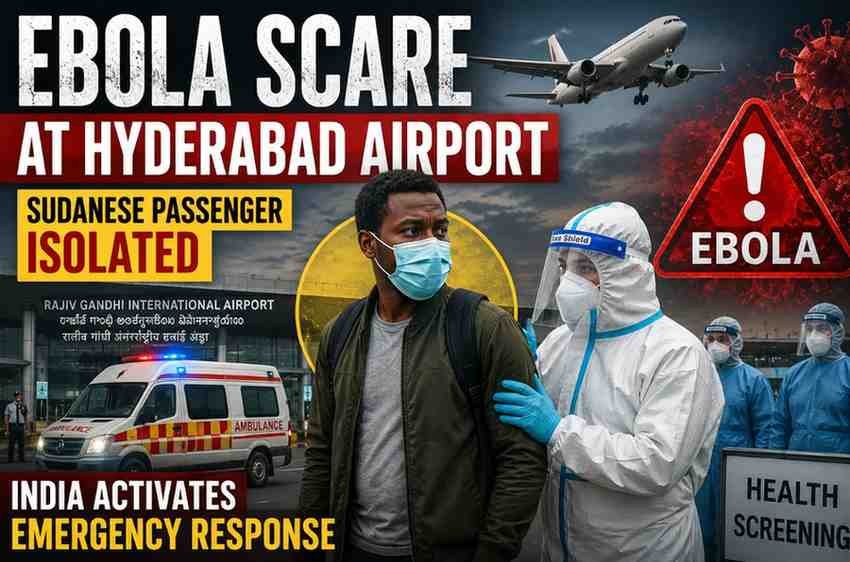
<p>On the morning of Thursday, June 4, 2026, a Sudanese national who had just landed at Hyderabad’s Rajiv Gandhi International Airport (RGIA) became the focal point of one of India’s most closely watched public Health responses in recent memory. Detected with a fever of around <strong>100°F (37.8°C)</strong> during routine thermal screening, the male passenger aged above 35 was swiftly isolated and transferred via a dedicated ambulance to Gandhi Hospital in Secunderabad, the state’s officially designated Ebola nodal centre. His blood samples have been dispatched to two of India’s most advanced diagnostic facilities: the Centre for Cellular and Molecular Biology (CCMB) in Hyderabad and the ICMR-National Institute of Virology (NIV) in Pune. As of the filing of this article, results are still awaited and India holds its breath.</p>
This is not merely a story about one traveller with a mild fever. It is a stress test of India’s entire Ebola preparedness architecture and a window into how close the world already is to a possible international spread of a disease that has killed roughly 40–90% of those it infects in past outbreaks.
The Sudanese national had not come to India on vacation. He had arrived specifically for a scheduled knee surgery at a private hospital in Hyderabad a reminder of the country’s growing stature as a destination for medical tourism from Africa and the Middle East. What made his case immediately concerning was not just the fever, but his travel history: he had recently passed through South Sudan and Uganda, two of the three countries currently under active international Ebola surveillance.
Dr. Vamsi Krishna, the Nodal Officer for Ebola Preparedness at Gandhi Hospital, was unambiguous in his communication to the public. The referral was made purely as a precaution. The patient was not presenting classic Ebola symptoms no haemorrhaging, no muscle pain, no vomiting and his fever had already subsided by the time he reached the hospital. “The patient is not reporting any complaints,” Dr. Krishna stated. It is not a confirmed case. It will only be classified as an Ebola case after laboratory testing confirms the presence of the virus.
But in the world of infectious disease containment, waiting for confirmation is exactly the right thing to do and doing it proactively is what separates a contained scare from a catastrophic outbreak.
The Larger Crisis: What Is Happening in Africa Right Now
To understand why India is treating a low-grade fever in a foreign traveller with this level of seriousness, you need to understand the scale of what is unfolding thousands of miles away.
The 2026 Ebola outbreak driven primarily by the Bundibugyo strain of the Ebola virus has been raging across Central Africa with alarming momentum. The Democratic Republic of the Congo (DRC) has borne the heaviest burden, reporting 363 confirmed cases and 62 confirmed deaths as of June 2, 2026. Uganda has recorded 15 confirmed cases and at least one confirmed death, along with one probable case and one probable death.
In mid-May 2026, the World Health Organization (WHO) took the significant step of declaring the outbreak a Public Health Emergency of International Concern (PHEIC) the highest alarm level in the global health system, a designation reserved for infectious events that risk crossing borders and require coordinated international action. The last time this designation was used for Ebola was during the catastrophic 2014–2016 West African outbreak that killed more than 11,000 people.
The Bundibugyo strain, first identified in Uganda in 2007, carries a case fatality rate historically estimated between 30% and 50% lower than the Zaire strain’s notorious kill rate but still among the deadliest pathogens circulating in the human population today.
India’s Response: From Advisory to Action
India did not wake up to this threat on June 4. The government’s response has been building steadily for weeks and the Hyderabad case is both a product of that preparedness and a test of its effectiveness.
The timeline of India’s escalating response tells a coherent story:
| Date | Action Taken |
|---|---|
| May 17, 2026 | WHO declares Ebola outbreak a Public Health Emergency of International Concern (PHEIC) |
| May 22, 2026 | DGCA issues emergency operating procedures requiring airlines from Uganda and DRC to collect Self-Declaration Forms (SDFs) from all passengers |
| Late May 2026 | Ministry of Health and Family Welfare issues comprehensive travel advisory; Union Health Minister chairs high-level preparedness review |
| June 2, 2026 | Indian Air Force C-17 Globemaster III airlifts 2.5 tonnes of medical aid from New Delhi to Uganda |
| June 4, 2026 | Sudanese national with fever and Africa travel history isolated at Hyderabad airport; transferred to Gandhi Hospital for testing |
India’s airport surveillance mechanism the Airport Health Organisation (AHO) had already set up dedicated Ebola screening counters at Rajiv Gandhi International Airport to examine all arriving international passengers for symptoms. The system worked exactly as designed on June 4: thermal sensors flagged the passenger’s elevated temperature, health officials cross-referenced his travel history against affected countries, and the protocol was activated within minutes.
Crucially, India’s response pushed accountability upstream. Under the new DGCA framework, airlines themselves including Air India, IndiGo, Emirates, Qatar Airways, Ethiopian Airlines, and Kenya Airways are required to conduct onboard health screenings, make in-flight Ebola announcements, and isolate symptomatic travellers before they even land on Indian soil.
Gandhi Hospital: The Epicentre of Telangana’s Ebola Response
Not every hospital in India is equipped to handle a suspected Ebola case. Gandhi Hospital in Secunderabad has been formally designated as the Ebola nodal centre for Telangana a title that comes with dedicated isolation wards, specialised medical teams on standby, and stringent infection prevention protocols that mirror international biosafety standards.
The facility’s role in this incident reflects a broader national strategy. India has designated specific hospitals in key states as nodal centres for haemorrhagic fever management, ensuring that the chain of response from airport detection to isolation to laboratory testing flows without delay or confusion. The CCMB and ICMR-NIV are equipped with biosafety level (BSL)-4 capable infrastructure for precisely this kind of high-consequence pathogen testing.
Health Minister Damodar Rajanarasimha revealed this week that 58 travellers from Ebola-affected countries had arrived in Hyderabad in recent weeks. None had shown symptoms. All were placed under Category-I surveillance and mandatory 21-day home isolation as a precautionary measure. The Sudanese national is the first to trigger a hospital-level response.
Why This Case Is Different from a Typical Fever Scare
India sees millions of international passengers every month. Fevers at airports are detected routinely from dengue to typhoid to ordinary seasonal flu. What elevates this particular case is the intersection of three simultaneous risk factors that no health official could responsibly ignore:
- Active travel history: The passenger had recently been in South Sudan and Uganda both under active WHO Ebola surveillance at the time of travel.
- Timing: His arrival came days after India airlifted emergency medical supplies to Uganda and amid a WHO-declared global health emergency.
- Strain specificity: The current outbreak involves the Bundibugyo ebolavirus, which spreads through direct contact with bodily fluids of infected individuals making airport-level detection the single most important line of defence against imported cases.
Compare this to India’s experience in 2022, when a traveller arriving in Bengaluru was isolated and tested for Ebola after developing mild symptoms only for results to come back negative. That incident, though ultimately a false alarm, validated the very infrastructure that is now handling the Hyderabad case. Each drill real or precautionary strengthens the system’s muscle memory.
The Medical Tourism Dimension: A Hidden Risk Vector
Here is an angle that most coverage of this incident has entirely overlooked: the patient did not come to India as a tourist or a business traveller. He came for knee surgery at a private Hyderabad hospital. This matters enormously.
India receives hundreds of thousands of medical tourists annually, with a significant proportion arriving from African nations particularly East Africa and the Horn of Africa where healthcare infrastructure is limited and India’s combination of quality care and affordability is a powerful draw. Sudan, South Sudan, Uganda, and the DRC are all countries from which Indian medical tourism actively attracts patients.
This creates a structurally underappreciated exposure pathway. Unlike business or leisure travellers who may avoid affected regions during an outbreak, patients travelling for non-emergency surgical procedures often have no choice but to travel regardless of regional disease conditions. Their travel is planned weeks or months in advance. They may transit through high-risk zones. And they arrive, by definition, in a compromised health state making clinical differentiation between travel-related illness and surgical post-operative fever genuinely difficult.
Indian health authorities would do well to establish a specific protocol for medical tourists from Ebola-affected regions including mandatory pre-travel PCR testing at origin, coordination with the private hospitals receiving these patients, and expedited screening channels at airports that flag medical visa holders from high-risk countries.
How India Compares to Global Ebola Response Standards
India’s response to the 2026 outbreak compares favourably to global benchmarks with some notable gaps. The United States, responding to the same outbreak, has gone further by placing entry restrictions on non-US passport holders who have been in Uganda, DRC, or South Sudan within the previous 21 days, and by rerouting all affected air passengers to four designated airports with CDC screening capacity.
India has not imposed travel bans a deliberate policy choice that balances public health risk against diplomatic, economic, and humanitarian considerations. Given India’s deep and growing ties with African nations and its active role in the African Union’s Ebola response a blanket travel ban would carry significant geopolitical costs. Instead, India has chosen the path of aggressive surveillance with open borders: a bet that robust airport detection and hospital isolation can substitute for entry restrictions.
That bet is being tested right now in a Secunderabad isolation ward.
What Happens Next: The 21-Day Window
The Ebola virus has an incubation period of 2 to 21 days. This is the scientific basis for the 21-day isolation protocols used worldwide. A person infected with Ebola may show no symptoms for up to three weeks appearing perfectly healthy while carrying the virus. Once symptoms appear, the virus can spread rapidly through contact with bodily fluids.
For the Sudanese national currently at Gandhi Hospital, the next steps follow a clear protocol. Blood samples will be analysed at CCMB and ICMR-NIV Pune for the presence of Ebola viral RNA using RT-PCR testing. If results are negative, the patient will be discharged from isolation and may once his fever fully resolves proceed with the knee surgery that brought him to Hyderabad in the first place. If results are positive, India will have recorded its first ever confirmed imported Ebola case, triggering a full-scale national response that will involve contact tracing of every passenger on his incoming flight, quarantine of exposed medical staff, and immediate WHO notification.
Based on available information the absence of classic Ebola symptoms, the fact that the fever has already subsided, and the patient’s own report of feeling well a negative result is the considerably more likely outcome. But the system’s job is not to assume. Its job is to verify.
Conclusion: A System Working as It Should For Now
The isolation of a feverish Sudanese traveller at Hyderabad airport on June 4, 2026, is, in one sense, entirely unremarkable. It is the healthcare system functioning exactly as it was designed to function. A thermal scanner caught an anomaly. An alert official checked travel history. A protocol was activated. A patient is safe and being monitored. Results are awaited.
In another sense, this single incident crystallises every tension at the heart of global health security in 2026: the collision of open borders and deadly pathogens; the challenge of differentiating an innocent fever from a catastrophic virus; the unique vulnerability of medical tourism corridors; and the pressure on developing nations to match the surveillance infrastructure of wealthy countries without the same resource base.
India has, to its credit, built something real here. The airport health organisation, the nodal hospital network, the CCMB and NIV testing infrastructure, the DGCA airline protocols these are not paper systems. They are functioning institutions that caught a risk in real time on June 4.
The real question is not whether India can handle one suspected case in Hyderabad. It is whether this infrastructure currently stretched across dozens of international airports, processing hundreds of flights from Africa weekly can sustain its vigilance as the 2026 outbreak continues to evolve. With the DRC’s case count above 363, Uganda recording new transmissions, and a WHO-declared global emergency in full force, the Hyderabad airport incident is unlikely to be the last time India’s Ebola readiness is put to the test.
For now, the isolation ward at Gandhi Hospital holds the answer the country is waiting for.
For breaking news and live news updates, like us on Facebook or follow us on Twitter and Instagram. Read more on Latest Health on thefoxdaily.com.






COMMENTS 0