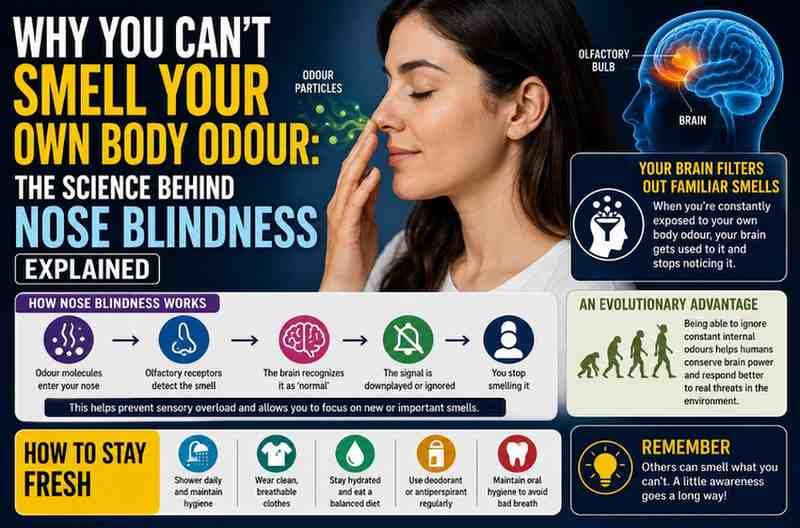
Have you ever wondered why someone else notices a smell that you cannot detect at all? Perhaps you’ve walked into a room and immediately noticed a strong fragrance, only for it to seemingly disappear minutes later. Or maybe you’ve been surprised when someone hinted that your breath wasn’t fresh despite you sensing nothing unusual. The explanation lies in a fascinating biological process known as nose blindness, also called olfactory adaptation.
Nose blindness is not a disease or a flaw in your sense of smell. Instead, it is one of your brain’s smartest energy-saving mechanisms. Your nervous system constantly filters familiar information so that it can focus on new and potentially important changes in your environment. While this process helps humans survive by prioritizing unexpected smells like smoke, gas leaks, or spoiled food, it also explains why people often fail to notice their own body odour, perfume, or even the smell inside their homes.
This natural phenomenon affects virtually everyone regardless of age or gender. Understanding why it happens can help improve personal hygiene, oral Health, workplace etiquette, and even household cleanliness. More importantly, knowing how to work around nose blindness ensures that familiar smells don’t become an unnoticed problem.
What Is Nose Blindness?
Nose blindness refers to the temporary inability to notice an odour after continuous exposure to it. Scientists call this olfactory adaptation. Once your nose detects a scent repeatedly, the brain gradually reduces its response because it assumes the smell no longer provides important information.
Rather than continuously processing the same smell, your brain shifts attention toward detecting new odours that may signal danger, food, or environmental changes.
This is why:
- You stop noticing your own perfume after a few minutes.
- Your home’s unique smell disappears to you but is obvious to visitors.
- You rarely notice your own body odour.
- People often fail to detect their own bad breath.
Far from being a weakness, this filtering system helps prevent sensory overload throughout the day.
How Your Sense of Smell Actually Works
Your sense of smell begins inside the nasal cavity, where millions of specialized receptor cells detect airborne chemical molecules.
The process follows several steps:
- Odour molecules enter through the nose.
- They bind to olfactory receptors.
- Signals travel to the olfactory bulb.
- The brain identifies and interprets the smell.
- Repeated exposure causes the brain to reduce attention to that scent.
The remarkable aspect is that the receptors may continue functioning normally while the brain intentionally ignores the information because it has become familiar.
Why You Cannot Smell Your Own Body Odour
Body odour develops gradually throughout the day. Because your brain is exposed continuously, it slowly classifies the scent as “background information.”
This gradual exposure is the key reason why people often underestimate their own body smell while others notice it immediately.
Unlike a stranger who experiences your scent for the first time, your brain has been filtering those odour signals for hours.
The same principle applies to:
- Sweat after exercise
- Clothing that has absorbed odours
- Shoes
- Hair products
- Perfume or deodorant
- Household smells
Since these scents remain relatively constant, your brain treats them as non-essential information.
Why Bad Breath Often Goes Undetected
Bad breath, medically called halitosis, provides one of the clearest examples of nose blindness.
Because your mouth is located directly below your nose, your brain experiences your breath continuously. Over time, it essentially tunes out the smell.
Unfortunately, this means other people may notice unpleasant breath long before you do.
Common causes include:
- Poor oral hygiene
- Bacteria on the tongue
- Dry mouth
- Gum disease
- Smoking
- Certain foods like garlic and onions
- Medical conditions affecting the mouth or digestive system
Since self-assessment is unreliable, regular dental hygiene and routine dental checkups become especially important.
Does Everyone Experience Nose Blindness?
Yes. Nose blindness is considered a normal biological response rather than a medical condition.
However, the intensity varies based on several factors:
- Age
- Overall nasal health
- Strength of the odour
- Duration of exposure
- Individual sensitivity to smells
- Certain medications
- Respiratory illnesses
People recovering from viral infections or living with reduced smell sensitivity may experience even greater difficulty recognizing body odours.
What Is the Difference Between Nose Blindness and Loss of Smell?
Many people confuse temporary nose blindness with medical smell disorders, but they are very different.
| Feature | Nose Blindness | Loss of Smell (Anosmia/Hyposmia) |
|---|---|---|
| Cause | Brain adapts to familiar odours | Medical condition affecting smell |
| Duration | Usually temporary | May be temporary or permanent |
| Can smell new scents? | Yes | Often difficult or impossible |
| Needs medical evaluation? | Usually no | Often yes |
| Common trigger | Continuous exposure | Illness, injury, nasal disease, neurological disorders |
If someone suddenly loses the ability to smell multiple everyday odours not just familiar ones they should seek medical advice rather than assuming it is nose blindness.
The Evolutionary Advantage of Ignoring Familiar Smells
Although it can be inconvenient, nose blindness likely evolved as a survival advantage.
Imagine if your brain constantly processed every smell around you:
- Your shampoo.
- Your clothes.
- Your office.
- Your car.
- Your own skin.
Your brain would waste enormous amounts of energy processing information that rarely changes.
Instead, olfactory adaptation allows humans to rapidly notice:
- Smoke from a fire.
- Natural gas leaks.
- Spoiled food.
- Chemical spills.
- Predators or environmental threats in evolutionary history.
This selective attention makes the olfactory system remarkably efficient.
How Quickly Does Nose Blindness Happen?
Surprisingly, adaptation can begin within just a few minutes.
The exact timing depends on:
- Odour intensity
- Air circulation
- Humidity
- Your health
- How frequently the scent changes
Strong perfumes may seem overwhelming initially but become almost impossible for the wearer to detect shortly afterward.
This explains why some people unknowingly apply excessive amounts of fragrance they stop noticing what everyone else can still smell.
Everyday Examples of Nose Blindness
Most people experience olfactory adaptation multiple times each day without realizing it.
- Your home’s smell disappears after a few minutes indoors.
- You stop noticing scented candles while reading.
- Restaurant workers become less aware of cooking aromas during long shifts.
- Pet owners often don’t notice pet odours that visitors detect instantly.
- Gym regulars may underestimate post-workout body odour.
These examples demonstrate that nose blindness affects everyone, regardless of cleanliness.
Can Nose Blindness Be Prevented?
You cannot completely prevent olfactory adaptation because it is a normal neurological process.
However, you can reduce its practical effects with simple habits.
1. Prioritize Daily Hygiene
Regular bathing, clean clothing, and appropriate use of deodorant remain the best defence against unnoticed body odour.
2. Maintain Excellent Oral Care
- Brush twice daily.
- Floss every day.
- Clean your tongue.
- Use mouthwash if recommended.
- Schedule regular dental checkups.
3. Stay Hydrated
Saliva naturally helps control bacteria responsible for unpleasant breath. Drinking enough water supports this protective mechanism.
4. Wash Frequently Used Items
Body odours often linger in:
- Towels
- Pillowcases
- Bedsheets
- Gym clothes
- Shoes
Even if you cannot smell them, others might.
5. Step Outside Occasionally
Fresh outdoor air temporarily resets your sense of smell. Returning indoors may help you notice odours that had faded into the background.
6. Ask Someone You Trust
Sometimes the simplest solution is honest feedback from family members or close friends, particularly if you’re concerned about persistent body odour or bad breath.
When Body Odour May Signal a Health Problem
Most body odour results from normal sweating combined with bacteria on the skin. However, unusual or sudden changes may occasionally indicate an underlying health issue.
Examples include:
- Persistent foul breath despite excellent oral hygiene.
- Sudden changes in body odour.
- Strong-smelling sweat unrelated to exercise.
- Loss of smell accompanying nasal congestion or illness.
- Body odour combined with fever or unexplained symptoms.
Medical evaluation can help determine whether the cause is dental, nasal, metabolic, or another health condition requiring treatment.
Can Technology Help Detect What We Can’t Smell?
An emerging area of health technology involves electronic noses and smart sensors capable of detecting volatile organic compounds produced by the human body. Researchers are exploring their use in identifying infections, monitoring chronic diseases, and even detecting certain cancers through breath analysis.
While these technologies are still developing, they highlight an important fact: our own noses are not always reliable judges of persistent odours. As diagnostic tools become more sophisticated, they may complement—not replace—traditional medical evaluations and personal hygiene practices.
Common Myths About Body Odour and Nose Blindness
Myth: If I can’t smell myself, I don’t have body odour.
Reality: Nose blindness makes self-assessment unreliable.
Myth: Only people with poor hygiene experience body odour.
Reality: Sweat, genetics, diet, hormones, medications, and environmental conditions all influence body scent.
Myth: More perfume solves the problem.
Reality: Excessive fragrance often masks rather than eliminates odours and may become overwhelming to others.
Myth: Nose blindness means your sense of smell is damaged.
Reality: Temporary adaptation is a completely normal neurological response.
Why Understanding Nose Blindness Matters
Nose blindness influences much more than personal comfort. It affects workplace interactions, social confidence, hospitality, healthcare, and even safety. Recognizing that our brains naturally ignore familiar smells encourages better hygiene habits and greater awareness of our surroundings.
Rather than relying solely on our own noses, combining good hygiene, regular oral care, fresh air breaks, and occasional feedback from trusted people provides a far more accurate picture of how we actually smell.
Conclusion
The inability to smell your own body odour isn’t a sign that your nose has stopped working it’s evidence that your brain is working exactly as designed. Through olfactory adaptation, your nervous system filters familiar scents so it can prioritize new ones that may require attention. This remarkable biological shortcut helps humans navigate the world efficiently but also creates blind spots when it comes to personal hygiene.
The good news is that nose blindness is manageable. Consistent hygiene, proper oral care, hydration, clean clothing, and awareness of this natural phenomenon are usually enough to prevent unpleasant surprises. As research into the human sense of smell continues to evolve, one thing remains clear: sometimes the scents we notice least are the ones worth paying the most attention to.
For breaking news and live news updates, like us on Facebook or follow us on Twitter and Instagram. Read more on Latest Lifestyle on thefoxdaily.com.






COMMENTS 0