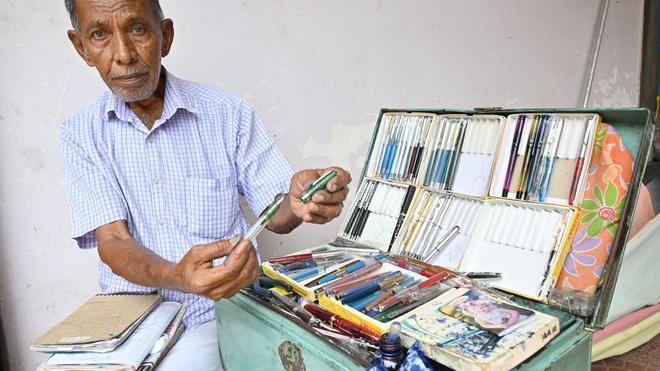
Pen Doctor Madurai
Related keywords: R Srinivasan pen repair, fountain pen repair Madurai, Pen Doctor fountain pens, Meenakshi Amman Temple shops, vintage fountain pens India, fountain pen restoration, traditional repair shops Madurai, pen repair expert, old fountain pens
Introduction: Where broken pens get a second life
In an age when a malfunctioning pen is often treated as disposable, there is something almost radical about taking it to a specialist and asking for it to be repaired.
Near the Meenakshi Amman Temple in Madurai, that philosophy survives in the form of a small shop run by R Srinivasan, known to customers as a “Pen Doctor”. For more than five decades, Srinivasan has worked on fountain pens, repairing, restoring and bringing back into use writing instruments that many people might otherwise have thrown away.
His story is not simply about fixing pens. It is about a disappearing form of craftsmanship, the emotional value attached to everyday objects and the remarkable amount of knowledge that can accumulate in the hands of a specialist over 50 years.
The shop’s location adds another layer to the story. Close to one of Madurai’s most recognisable landmarks, surrounded by the movement of one of Tamil Nadu’s historic urban centres, Srinivasan’s work represents a much quieter kind of heritage — one built not in stone, but through tools, parts, patience and memory.
Who is Madurai’s Pen Doctor?
R Srinivasan has been repairing fountain pens in Madurai for over 50 years. His small establishment near the Meenakshi Amman Temple has become a destination for people who want old or damaged pens repaired rather than replaced.
The title “Pen Doctor” is fitting because fountain-pen repair is rarely a matter of simply replacing a visible broken component. A pen can have problems involving its nib, filling mechanism, feed, ink flow, seals or other small parts. Diagnosis is therefore an important part of the craft.
For someone with decades of experience, that diagnosis becomes almost instinctive.
The pen itself may be tiny, but the knowledge required to understand why it is not working can be considerable.
Why fountain pens require a specialist
Fountain pens are fundamentally different from disposable ballpoint pens.
A fountain pen is a small mechanical system designed to control the movement of liquid ink. Its nib has to deliver ink smoothly to paper, while the feed and filling system have to work together to maintain a consistent flow.
When something goes wrong, the problem may not be immediately obvious.
A pen that skips while writing may have an ink-flow issue. A damaged nib may need careful adjustment. A filling mechanism may require attention. A pen that has been stored for years may need cleaning and restoration before it can function properly again.
That is why experienced repairers are valuable. They do not simply replace a part whenever possible. They first try to understand the instrument.
The hidden skill behind fountain-pen repair
Modern repair culture often focuses on speed. Replace the damaged component, test the device and move on.
Traditional fountain-pen repair can demand a different mindset.
The repairer needs to understand how the components interact and how much intervention is appropriate. A delicate nib, for example, cannot simply be treated like a generic metal component. Excessive force can turn a minor problem into permanent damage.
That is where decades of practical experience become important.
Srinivasan’s work demonstrates a form of knowledge that is difficult to learn entirely from manuals. It comes from handling thousands of pens, seeing recurring faults and developing an understanding of how different instruments behave.
Fifty years of changing technology
Srinivasan’s career has unfolded across a period in which writing technology changed dramatically.
When he began his trade, fountain pens were still an important part of everyday writing culture. Students, office workers and professionals commonly carried them.
Over the decades, ballpoint pens, gel pens, rollerballs and digital devices gradually reduced the everyday importance of fountain pens.
Yet the disappearance of fountain pens from mainstream daily life did not eliminate the desire to own them.
Instead, the relationship changed.
For many owners today, a fountain pen is no longer simply a writing instrument. It can be a keepsake, a collectible, a gift, a professional accessory or a family possession passed from one generation to another.
That shift may actually make specialists such as Srinivasan more important.
Why people repair old pens instead of buying new ones
The obvious question is: if modern pens are inexpensive and easily available, why spend time repairing an old fountain pen?
The answer is rarely economic alone.
Some fountain pens have sentimental value. They may have belonged to a parent or grandparent, been used during school years or been associated with an important period in someone’s life.
A replacement pen can reproduce the function. It cannot reproduce the history.
This is where repair becomes a form of preservation.
When Srinivasan restores an old pen, he is potentially helping preserve a small personal archive — handwriting, letters, notebooks and memories connected to that object.
Madurai provides the perfect setting for this story
Madurai is a city where history and everyday commerce coexist unusually closely.
The Meenakshi Amman Temple has long been at the heart of the city’s cultural and commercial geography. Streets around the temple are associated with specialised shops, traditional crafts, food businesses and services that have developed alongside the city’s historic centre.
A tiny pen-repair shop fits naturally into that environment.
It is easy to walk past such a business without noticing it. Yet the specialist inside may possess knowledge that is increasingly difficult to find elsewhere.
That contrast is part of what makes Srinivasan’s story compelling. The shop may be small, but its history extends across generations of writing technology.
The Pen Doctor and the culture of repair
Srinivasan’s profession also belongs to a much larger tradition: India’s culture of repair.
For generations, Indian cities and towns have supported specialists who repair everything from watches and footwear to radios, sewing machines, bicycles and household appliances.
These trades share a common principle: an object does not become useless simply because something has gone wrong with it.
The repairer searches for the problem, replaces or fixes what is necessary and returns the object to service.
That philosophy has obvious environmental implications today.
Every object repaired rather than discarded potentially avoids becoming waste. While a single fountain pen is tiny compared with large consumer products, the underlying principle is significant: extending the life of products can be an alternative to a disposable culture.
Fountain pens are particularly suited to restoration
Unlike many modern disposable writing instruments, fountain pens are designed as reusable objects.
They can be refilled, cleaned, maintained and, in many cases, repaired. Some are also made from materials and components intended to last for years.
This gives them a natural connection to restoration culture.
A well-maintained fountain pen can remain functional for decades, which means its useful life can extend far beyond that of a typical disposable pen.
That longevity also explains why vintage fountain pens continue to attract collectors and enthusiasts.
What makes a fountain pen sentimental?
There is an interesting psychological difference between a fountain pen and many modern devices.
A pen directly records a person’s physical movement.
The pressure, speed and rhythm of handwriting become part of the writing itself. A pen that has been used for years can therefore become associated with the owner’s handwriting style.
When that pen belongs to a family member who has passed it down, its emotional value can become even stronger.
Repairing it can consequently feel less like servicing an object and more like preserving a connection.
A unique angle: the Pen Doctor is preserving knowledge, not just pens
The most overlooked aspect of Srinivasan’s story may be the knowledge embodied in his hands.
A repaired pen is visible. The expertise required to repair it is not.
Traditional repair trades depend heavily on tacit knowledge — the kind learned through repeated physical practice. Knowing which component to inspect first, how much pressure to apply or when a repair should stop cannot always be reduced to a simple checklist.
When an experienced craftsman retires without passing that knowledge on, the loss is larger than one shop closing.
A small piece of practical cultural knowledge disappears.
That makes the continued work of a specialist like Srinivasan important not merely for pen collectors but for the broader preservation of traditional repair skills.
From everyday stationery to collectible heritage
The cultural status of fountain pens has changed considerably.
Once, owning a fountain pen was ordinary. Today, some people seek out vintage instruments because they represent craftsmanship, design history or personal nostalgia.
This transformation mirrors what happened to many other everyday objects.
Mechanical watches, film cameras, typewriters and vinyl records were once ordinary technologies. As newer technology replaced them, their mechanical and tactile qualities became part of their appeal.
Fountain pens occupy a similar space.
| Object | Earlier role | Why it remains valuable today |
|---|---|---|
| Fountain pen | Everyday writing tool | Craftsmanship, handwriting and sentimental value |
| Mechanical watch | Timekeeping | Engineering, heritage and collectability |
| Film camera | Photography | Hands-on process and visual character |
| Typewriter | Document production | Tactile experience and nostalgia |
The economics of a disappearing craft
There is also an economic question behind traditional repair businesses.
A specialist cannot compete with mass-produced stationery simply by offering a cheaper product. The value proposition is different.
The customer is paying for diagnosis, experience, precision and the ability to save an object that has meaning.
That model is increasingly relevant as consumers rediscover repair and restoration. However, it also faces challenges: fewer young people may enter specialised repair trades, replacement parts can become difficult to obtain, and the customer base for older products may remain relatively small.
The survival of such crafts therefore depends on more than nostalgia. It requires new generations of customers who recognise the value of maintenance and repair.
What Srinivasan’s story says about India’s disappearing specialist shops
India’s traditional commercial streets contain countless businesses whose importance is not captured by their size.
A tiny repair counter can represent decades of accumulated expertise. A family-run workshop may know how to service an object that modern retailers no longer handle. A craftsman may continue using techniques that have disappeared from mainstream manufacturing.
These businesses form an informal archive of practical knowledge.
The challenge is that such knowledge is often poorly documented.
When the owner retires, the story can disappear with the shop.
That makes oral histories and careful documentation increasingly valuable. Srinivasan’s five-decade career is not only a personal achievement; it is evidence of how much technical knowledge can survive within a small traditional business.
Why the Pen Doctor’s location adds another layer
There is something fitting about finding a fountain-pen specialist close to the Meenakshi Amman Temple.
The temple itself represents continuity: architecture, rituals, craftsmanship and traditions maintained across generations. Srinivasan’s work belongs to a much smaller scale of continuity, but the principle is similar.
His workshop preserves a practical skill through repeated use.
One is monumental heritage. The other is everyday heritage.
Both remind us that history does not survive only inside museums. Sometimes it survives because somebody keeps repairing an old object.
The future of fountain-pen repair
The future of the craft is unlikely to resemble its past.
Fountain pens may never return to their former position as India’s default writing instrument. Digital communication has permanently changed how people write and work.
But that does not mean repair culture has no future.
Collectors, stationery enthusiasts, writers and people interested in sustainable consumption can create a new market around restoration. Social media can also make specialist repairers easier to discover, allowing niche crafts to reach customers far beyond their immediate neighbourhood.
The next generation of pen repairers may therefore serve fewer everyday users but more enthusiasts who deliberately choose objects designed to last.
Conclusion: A small shop with a very long memory
R Srinivasan’s story is ultimately about more than fountain pens.
For over 50 years, the Pen Doctor in Madurai has continued a craft built around patience, precision and the belief that an old object can still have a useful life.
His small shop near the Meenakshi Amman Temple stands in contrast to today’s culture of instant replacement. Where one approach asks how quickly something can be replaced, Srinivasan’s profession asks a different question: Can this be saved?
That question has become surprisingly relevant.
As consumers reconsider waste, craftsmanship and the emotional value of possessions, traditional repairers may find that their skills have a renewed cultural importance. The fountain pen itself may be old-fashioned, but the principle behind repairing it is anything but outdated.
In a city famous for monuments that have survived centuries, a tiny pen-repair shop offers another kind of heritage story — one measured not in stone, but in working instruments, handwritten pages and five decades of expertise passed from one pen to another.
For breaking news and live news updates, like us on Facebook or follow us on Twitter and Instagram. Read more on Latest Lifestyle on thefoxdaily.com.

COMMENTS 0