Sometimes, the most memorable lessons come from the most unexpected questions. For Dr Kirsten Banks, an Astronomy guide who worked at Sydney Observatory while studying science, an encounter with an eight-year-old visitor completely changed the way she explained one of the universe’s most fascinating phenomena: black holes.
Banks thought she had found a family-friendly way to explain spaghettification, the process through which an object is stretched by the extreme gravitational forces near a black hole. But just as she finished her explanation, a young girl raised her hand and asked a question that left the entire group laughing: “So would the blood be the sauce?”
The unexpected response made Banks reconsider the examples she used while communicating complex scientific ideas. It also taught her two important lessons: scientific explanations need to be carefully adapted for their audience, and curiosity can emerge in the most surprising forms.
Her experience at Sydney Observatory offers a wider message about science Education. Making science accessible is not simply about simplifying complicated information. It is also about listening to questions, encouraging imagination and recognising that children can sometimes notice details adults overlook.
How a Student Job at Sydney Observatory Introduced Banks to Science Communication
During the first year of her science degree, Banks secured a job as an astronomy guide at Sydney Observatory. The role gave her an opportunity to introduce visitors to astronomy and help them explore the universe through different experiences.
She regularly led groups of approximately 20 people, guiding them through observations of stars and planets using telescopes. The experience depended partly on the weather. When the skies were clear, visitors could look at celestial objects through the observatory’s telescopes.
However, Sydney’s weather and urban light pollution did not always cooperate. When clouds covered the sky, Banks would take visitors to a 3D theatre or the planetarium, where they could continue exploring the universe beyond what was visible from the city.
These experiences taught her that astronomy communication required more than simply knowing scientific facts. A guide had to make enormous distances, unfamiliar objects and complicated cosmic processes understandable to people with different levels of scientific knowledge.
For Banks, one of the most rewarding parts of the job was watching visitors react when they encountered the scale of the universe for the first time.
The Hubble Ultra Deep Field: An Image That Changed How Visitors Saw the Universe
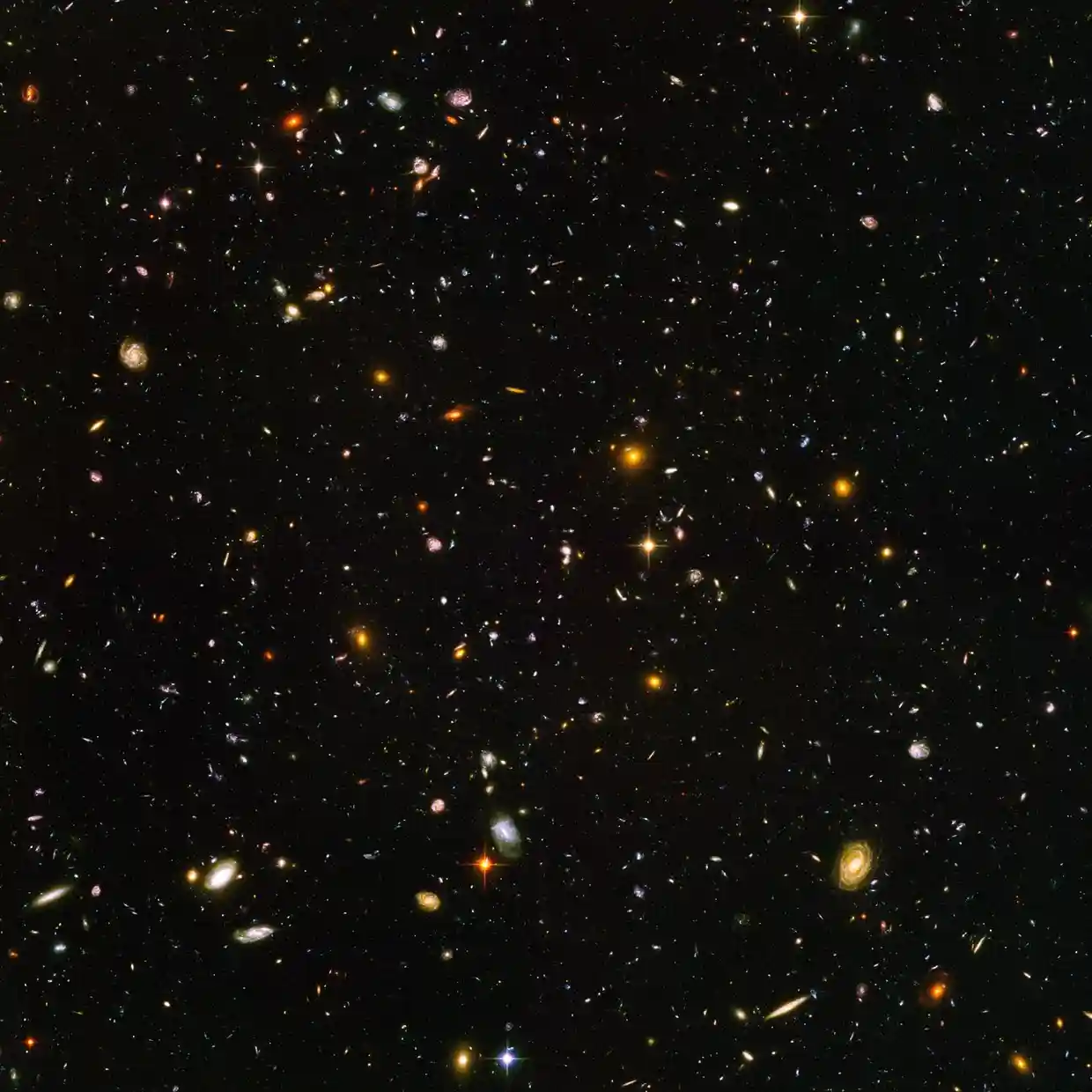
One of Banks’ favourite presentations involved the Hubble Ultra Deep Field image, a remarkable view of a seemingly ordinary patch of the night sky containing an extraordinary number of distant galaxies.
Before showing the image, she would explain how the Hubble Space Telescope had observed a tiny section of the sky for an extended period. The area was roughly the size of a grain of sand held at arm’s length. By collecting faint light over 11 days, the telescope was able to reveal objects far beyond what the human eye could normally see.
After building anticipation, Banks would reveal the image and invite visitors to look closely at its details. The result often produced an audible gasp from someone in the audience.
She would then ask visitors to identify the objects with distinctive spikes. These were four obvious stars belonging to the Milky Way, the galaxy that contains our Solar System.
But the most surprising part came next. Banks explained that almost everything else visible in the image, including the tiny blobs, smudges and specks, represented an entire galaxy.
For many visitors, this was an extraordinary realisation. What appeared to be a small, insignificant patch of darkness actually contained thousands of distant galaxies. Each galaxy, in turn, could contain enormous numbers of stars.
The demonstration showed how astronomy can transform our understanding of scale. A tiny area of the sky can reveal a universe filled with structures far beyond our everyday imagination.
When Bad Weather Turned a Telescope Tour Into a Lesson About Black Holes
On one particular tour, the weather prevented Banks and her visitors from enjoying the usual telescope observations. Instead of ending the experience there, she adapted the session and took the group to the 3D theatre.
The discussion gradually moved towards black holes, one of the most popular subjects in astronomy. Black holes attract attention because they challenge familiar ideas about gravity, space and time. They are also surrounded by fascinating scientific concepts that can make for memorable explanations.
Banks enjoyed discussing several aspects of black holes, including their discovery, the origin of their name and the phenomenon known as spaghettification.
She explained how black holes possess extremely strong gravitational fields. Their event horizon marks the boundary beyond which nothing, including light, can escape to the outside universe.
However, the gravitational pull of a black hole does not remain equally strong at every distance. It becomes weaker as the distance from the object increases. For a simple explanation, Banks told visitors that doubling the distance from a massive object reduces its gravitational pull to one-quarter, assuming the same point of reference and a sufficiently simplified gravitational model.
This difference in gravitational force between two parts of an object is central to understanding spaghettification.
What Is Spaghettification? Understanding the Science Behind It
Spaghettification is a term used to describe the stretching of an object by extreme differences in gravitational force across its length. It is associated with the powerful tidal forces near a black hole.
Imagine an object falling feet first towards a black hole. Its feet would be closer to the black hole than its head. Because gravitational attraction becomes stronger at shorter distances, the feet would experience a stronger pull than the head.
This difference in gravitational force would stretch the object along its length. At the same time, tidal forces would compress it sideways. The result is a dramatic distortion that scientists describe as spaghettification because the object can become elongated like a strand of spaghetti.
The effect becomes particularly extreme near sufficiently compact black holes. The exact location at which spaghettification occurs depends on the black hole’s mass and the object’s distance from it. It is not necessarily true that every object would be stretched apart before crossing the event horizon of every black hole.
For Banks, the challenge was explaining this complicated process in a way that a mixed-age audience could understand. She chose a human body as an example, imagining someone falling feet first towards a black hole.
She believed the explanation was suitable for a family audience. However, the response from one young visitor quickly showed her that an example intended to make science easier could also create an unexpected mental picture.
‘Would the Blood Be the Sauce?’ The Eight-Year-Old’s Unexpected Question
Almost immediately after Banks finished explaining spaghettification, an eight-year-old girl raised her hand. Banks was pleased to see the young visitor participating because answering questions was one of the most important parts of her role as a science communicator.
She expected a question about gravity, black holes or the stretching process. Instead, the girl asked: “So would the blood be the sauce?”
Banks froze for a moment. The rest of the group began giggling as everyone processed the question. The child had taken the spaghetti comparison one step further, imagining what would happen to the blood in the human-body example.
After thinking about it, Banks realised that the question made sense within the analogy she had created. If she was describing a human body being stretched like spaghetti, the child had naturally extended the comparison to the other details of the imagined situation.
The moment was funny, but it also revealed something important about how people understand information. Listeners do not always interpret an explanation in the way the speaker expects. They bring their own experiences, imagination and associations to the subject.
For a child, the comparison between a person and spaghetti could lead to a very different line of thinking from the one an adult might anticipate.
Two Important Lessons Banks Learned From the Encounter
The unexpected question stayed with Banks because it changed how she approached science communication. She identified two important lessons from the experience.
1. Choose Scientific Examples Carefully
The first lesson was to reconsider the example she used to explain spaghettification. Instead of describing a human being falling towards a black hole, she decided it would be better to use a star as the example.
Stars are also subject to tidal forces when they approach sufficiently close to a black hole. Their material can be stretched and disrupted by the difference in gravitational pull across the star. This provides a scientifically relevant example without creating the same uncomfortable imagery associated with describing a human body being pulled apart.
The lesson is particularly relevant for teachers, educators and science communicators. An analogy can make a complicated idea easier to understand, but it can also lead an audience towards interpretations that were never intended.
Good science communication therefore involves considering not only whether an explanation is scientifically accurate, but also how different audiences might interpret it.
2. Curiosity Can Take Unexpected Forms
The second lesson was about the importance of curiosity. Banks realised that the girl’s question was not simply a funny interruption. It was an attempt to understand the explanation by following the comparison to its logical conclusion.
Children often ask questions that adults might not think to raise. Some questions may sound unusual or even silly, but they can reveal how a person is processing new information.
For science communicators, these questions are valuable opportunities. They can expose gaps in an explanation, encourage deeper discussions and remind educators that learning is a two-way process.
Banks’ experience also carries a message for anyone who is hesitant to ask questions. A question does not need to sound sophisticated to be meaningful. Sometimes, the simplest questions lead to the most interesting conversations.
Why Asking Questions Is Important for Science Education
Science progresses through questions. From understanding how planets move to investigating the nature of black holes, scientific discoveries begin with curiosity about how the world works.
For students, asking questions helps turn passive listening into active learning. Rather than simply memorising definitions, they begin connecting ideas, testing explanations and identifying what they do not yet understand.
In classrooms, museums and observatories, encouraging questions can make scientific subjects more approachable. It also allows educators to understand whether their explanations are reaching the audience.
The Sydney Observatory incident demonstrates that there is no single way to respond to an interesting scientific explanation. One person may focus on the physics, another on the scale of the universe, and a child may notice an unexpected detail in an analogy.
Instead of discouraging unusual questions, educators can use them as starting points for further learning. A respectful response helps children feel comfortable expressing their thoughts and developing confidence in their curiosity.
Lost in Space: Curiously Cosmic Stories by Dr Kirsten Banks
The observatory experience is shared in an edited extract from Lost in Space: Curiously Cosmic Stories, a book by Dr Kirsten Banks. The book explores fascinating stories and ideas connected to astronomy and the wider universe.
The extract reflects Banks’ experience as a science communicator and highlights the importance of making complex scientific subjects engaging for general audiences. Her story combines an introduction to black holes with a humorous encounter that changed the way she explained an astronomical phenomenon.
The book is available through Pan Macmillan Australia, with the supplied edition priced at A$36.99.
Conclusion: Sometimes the Best Science Lessons Begin With a Simple Question
Dr Kirsten Banks’ experience at Sydney Observatory is a reminder that science communication is not just about delivering information. It is about understanding how people receive, interpret and respond to new ideas.
An eight-year-old’s question about whether blood would become the sauce during spaghettification may have caught Banks off guard, but it helped her recognise the importance of choosing examples carefully. It also reinforced the value of encouraging curiosity, even when questions appear unusual.
Whether someone is learning about black holes, distant galaxies or everyday scientific phenomena, asking questions is an essential part of understanding the world. The next time a question seems silly, it may be worth asking anyway. It could lead to a lesson that stays with someone for years.
Frequently Asked Questions (FAQs)
1. Who is Dr Kirsten Banks?
Dr Kirsten Banks is an astronomer and science communicator who has shared her experiences explaining astronomy to the public, including her work as an astronomy guide at Sydney Observatory.
2. What did the eight-year-old girl ask about black holes?
After hearing an explanation of spaghettification, the girl asked, “So would the blood be the sauce?” Her unexpected question made the group laugh and prompted Banks to rethink her example.
3. What is spaghettification?
Spaghettification is the stretching of an object caused by differences in gravitational force across its length, particularly near an extremely compact object such as a black hole.
4. Why does spaghettification happen near a black hole?
Gravity is stronger closer to a black hole. When an object approaches it, the part nearer to the black hole experiences a stronger gravitational pull than the part farther away, creating tidal forces that can stretch the object.
5. What is an event horizon?
An event horizon is the boundary around a black hole beyond which nothing can escape to the outside universe, including light.
6. What was Dr Kirsten Banks’ first lesson from the incident?
She realised that explaining spaghettification using a human body could create uncomfortable imagery. She decided that describing a star approaching a black hole would be a more appropriate example.
7. What is the Hubble Ultra Deep Field image?
The Hubble Ultra Deep Field is an image of a tiny region of the sky that reveals thousands of distant galaxies. It demonstrates how powerful telescopes can uncover objects that are too faint to be seen with the naked eye.
8. Which book features the story about the young girl’s question?
The anecdote appears in an edited extract from Lost in Space: Curiously Cosmic Stories by Dr Kirsten Banks, published through Pan Macmillan Australia.
For breaking news and live news updates, like us on Facebook or follow us on Twitter and Instagram. Read more on Latest Lifestyle on thefoxdaily.com.





COMMENTS 0