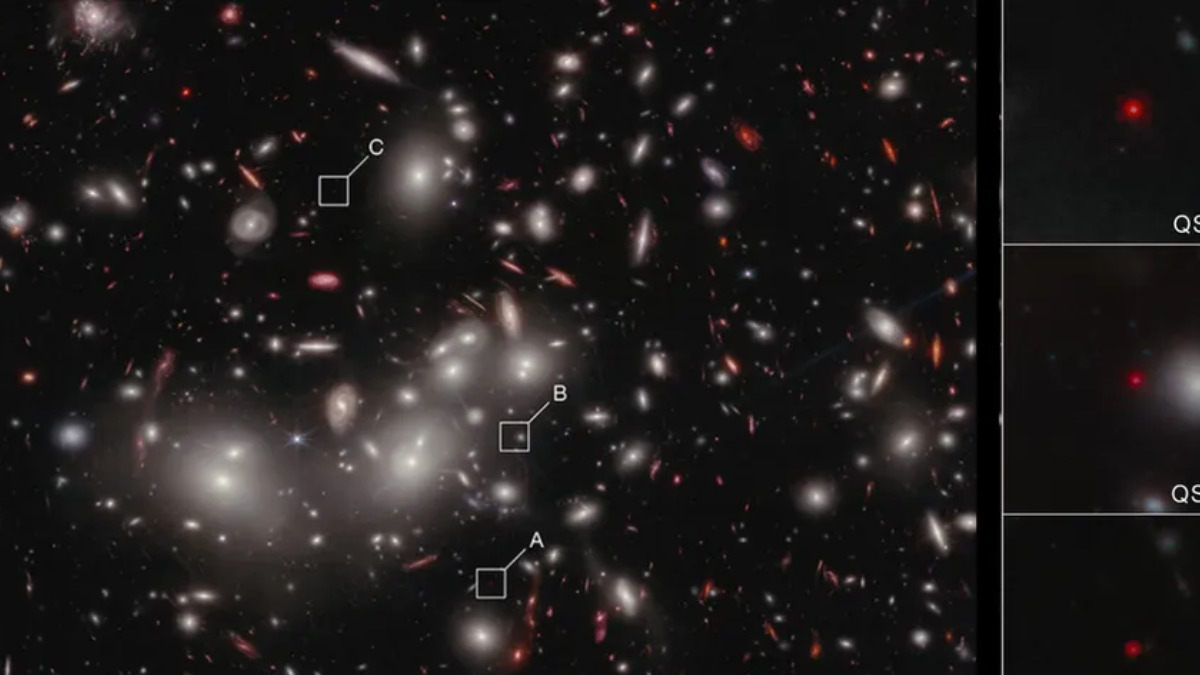
The James Webb Space Telescope (JWST) continues to deliver discoveries that are forcing astronomers to rethink the origins of the universe. Its latest finding involves an ancient supermassive black hole that existed just 700 million years after the Big Bang and appears so massive that it may have formed before the galaxy surrounding it.
The object, known as Abell2744-QSO1, belongs to a mysterious class of early-universe objects called Little Red Dots. By analyzing gas moving around the object, researchers discovered that the black hole contains roughly 50 million times the mass of the Sun and accounts for nearly two-thirds of the mass of its host galaxy.
That finding presents a serious challenge to conventional theories of cosmic evolution. For decades, scientists believed galaxies formed first and that black holes grew gradually inside them. This discovery suggests the opposite may have happened in at least some cases: giant black holes may have emerged first and helped build the earliest galaxies around them.
The implications extend far beyond a single object. If similar examples are found across the early universe, Astronomy textbooks may need significant revisions.
What Makes This Discovery So Important?
The standard model of Galaxy Formation describes a relatively orderly process. Following the Big Bang, matter began clumping together under gravity. Dark matter halos formed, gas accumulated, stars ignited, galaxies emerged, and black holes developed from the remnants of massive stars.
Over billions of years, these black holes grew by consuming gas, dust, and even other black holes.
The problem with Abell2744-QSO1 is that its black hole appears too large, too early.
At only 700 million years after the Big Bang a period when the universe was less than 5% of its current age the black hole already possessed a mass that should have taken far longer to accumulate under traditional growth models.
This raises an uncomfortable but exciting possibility: the black hole may have been born massive from the start.
Understanding the “Little Red Dots” Mystery
One of JWST’s most intriguing discoveries since becoming operational has been the detection of hundreds of compact, reddish objects scattered throughout the early universe.
These objects quickly became known as Little Red Dots because of their appearance in JWST imagery.
Initially, astronomers struggled to explain them. They appeared too bright, too compact, and too massive for conventional galaxy formation models.
As researchers began examining these objects in greater detail, evidence emerged that many contain rapidly growing black holes hidden behind thick clouds of gas and dust.
Abell2744-QSO1 has now become one of the most important members of this strange population because it offers one of the clearest examples of a black hole dominating its host galaxy.
The discovery suggests Little Red Dots may represent an entirely new phase of cosmic evolution that scientists had never directly observed before.
How JWST Measured the Ancient Black Hole
Measuring the mass of a black hole billions of light-years away is no easy task.
Researchers relied on JWST’s Near-Infrared Spectrograph (NIRSpec), one of the telescope’s most powerful scientific instruments.
By studying the motion of gas orbiting the black hole, astronomers can estimate the strength of its gravitational pull. Faster-moving gas indicates a more massive central object.
The observations revealed gas swirling at extraordinary speeds around the black hole, allowing scientists to calculate a mass of approximately 50 million solar masses.
This represents one of the most precise measurements ever made of a black hole from such an early period in cosmic History.
Why the Discovery Challenges Existing Theories
The biggest challenge posed by this finding is one of timing.
Current models suggest black holes originate from the collapse of massive stars. These stellar-mass black holes then grow gradually through mergers and accretion.
However, simulations indicate that growing from a typical stellar black hole to 50 million solar masses within just 700 million years is extremely difficult.
Even under ideal conditions, there simply may not have been enough time.
This discrepancy has led scientists to explore alternative explanations.
Possible Explanation 1: Direct Collapse Black Holes
One leading theory suggests that some black holes formed directly from enormous clouds of primordial hydrogen gas.
Instead of first creating stars, these gas clouds may have collapsed straight into massive black holes containing hundreds of thousands or even millions of solar masses.
This process would allow black holes to begin life already enormous, eliminating the need for rapid growth.
Many astronomers now view direct-collapse black holes as one of the most promising explanations for objects like Abell2744-QSO1.
Possible Explanation 2: Exotic Early-Universe Physics
Another possibility is that entirely new physical processes operated during the universe’s infancy.
Some researchers have proposed that density fluctuations shortly after the Big Bang may have produced primordial black holes.
These hypothetical objects could have formed before the first stars existed.
Although evidence remains limited, discoveries like this are reviving interest in such theories.
How This Compares to the Milky Way
The scale of this discovery becomes even more impressive when compared with our own galaxy.
| Feature | Abell2744-QSO1 | Milky Way |
|---|---|---|
| Age Observed | 700 million years after Big Bang | 13.8 billion years after Big Bang |
| Black Hole Mass | 50 million solar masses | 4.3 million solar masses |
| Share of Galaxy Mass | Approximately 66% | Less than 0.01% |
| Galaxy Development | Still assembling | Fully developed spiral galaxy |
The comparison highlights why astronomers are so intrigued. In modern galaxies, black holes are important but represent only a tiny fraction of total galactic mass. In Abell2744-QSO1, the black hole appears to dominate the entire system.
What This Means for Galaxy Formation
If future observations confirm that massive black holes commonly appeared before galaxies fully formed, scientists may need to rethink the relationship between the two.
Instead of galaxies creating black holes, black holes may have acted as cosmic architects, influencing how gas accumulated and stars formed around them.
Some researchers now suggest that supermassive black holes could have served as gravitational anchors that accelerated galaxy formation during the universe’s earliest epochs.
This reversal of the traditional narrative would represent one of the most significant shifts in modern astrophysics.
JWST Is Revealing a Very Different Early Universe
Since its launch, JWST has repeatedly discovered galaxies, stars, and black holes that appear larger, brighter, and more mature than expected.
Many astronomers anticipated seeing primitive cosmic structures during the telescope’s first years of operation.
Instead, JWST is finding surprisingly complex systems that existed much earlier than theoretical models predicted.
Some experts describe this period as one of the most exciting moments in astronomy since the discovery of cosmic expansion.
Each new observation is helping scientists refine their understanding of how the universe evolved from a nearly uniform sea of particles into the vast cosmic web visible today.
The Bigger Question: Are We Missing Part of the Story?
The discovery of Abell2744-QSO1 raises a broader possibility that current cosmological models may be incomplete.
That does not mean existing theories are wrong. Rather, it suggests that important pieces of the puzzle remain undiscovered.
Just as the Hubble Space Telescope transformed our understanding of galaxies and dark energy, JWST may ultimately reveal new mechanisms governing black hole growth, star formation, and galaxy evolution.
The next few years will be critical as researchers investigate more Little Red Dots and compare them with Abell2744-QSO1.
If similar objects continue appearing, astronomers may be witnessing evidence of an entirely new chapter in cosmic history.
Conclusion: A Discovery That Could Change Astronomy
The James Webb Space Telescope’s discovery of the ancient black hole in Abell2744-QSO1 is more than another astronomical milestone. It challenges a foundational assumption about the universe: that galaxies come first and black holes follow.
With a mass of 50 million Suns and a size that appears disproportionate to its host galaxy, the object represents one of the strongest pieces of evidence yet that some supermassive black holes may have formed extraordinarily early or perhaps even before their galaxies fully assembled.
As JWST continues exploring the universe’s first billion years, astronomers are likely to uncover more surprises. Whether this object proves to be a rare exception or part of a widespread population, one thing is becoming clear: the early universe was far more complex, dynamic, and mysterious than scientists once imagined.
The coming decade of observations could fundamentally reshape humanity’s understanding of how the first galaxies, stars, and black holes emerged from the aftermath of the Big Bang.
For breaking news and live news updates, like us on Facebook or follow us on Twitter and Instagram. Read more on Latest Technology on thefoxdaily.com.




COMMENTS 0