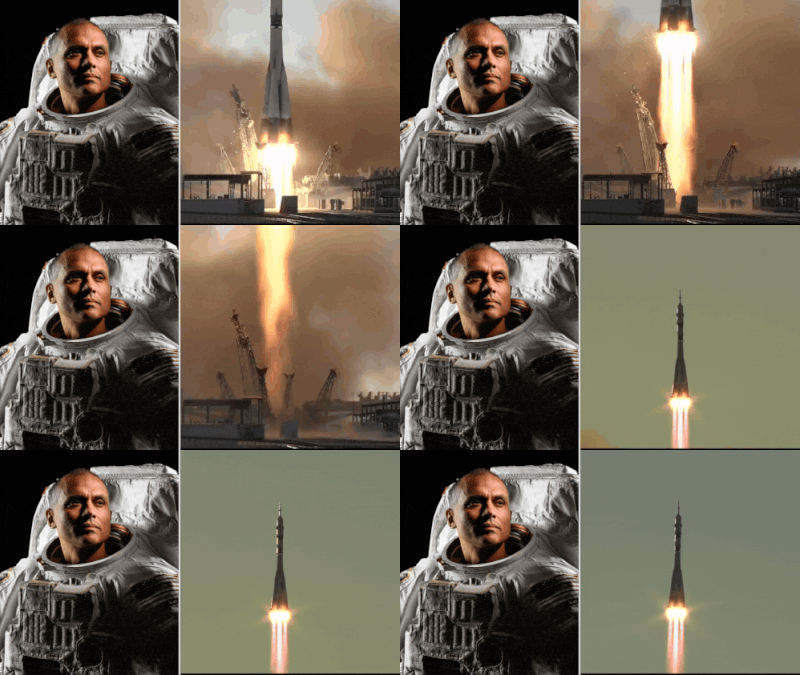
The International Space Station (ISS) welcomed another long-duration expedition as NASA astronaut Anil Menon launched aboard the Soyuz MS-29 spacecraft from the Baikonur Cosmodrome in Kazakhstan alongside Roscosmos cosmonauts Pyotr Dubrov and Anna Kikina. The launch marks a significant milestone in Menon’s career, representing his first journey into space after years of serving as a physician, flight surgeon, military officer, and aerospace medicine expert.
The mission is scheduled to last approximately eight months, during which the crew will conduct hundreds of scientific experiments designed to improve life on Earth while preparing humanity for future deep-Space Exploration. Their work will span medicine, biology, Artificial Intelligence, materials science, and advanced manufacturing, all of which are essential for NASA’s long-term plans to establish a sustained human presence beyond low Earth orbit.
For Menon, whose family roots trace back to Kerala in India and Ukraine, the mission is both a professional milestone and an inspiring story of international collaboration in modern space exploration.
Mission Overview: Soyuz MS-29 Launches to the International Space Station
The Soyuz MS-29 spacecraft lifted off from the historic Baikonur Cosmodrome aboard a Soyuz rocket, one of the world’s most reliable launch systems. Following launch, the spacecraft began a fast-track rendezvous profile designed to dock automatically with the ISS after approximately three hours in orbit.
Once docking is completed, the three-member crew joins the existing Expedition crew already living and working aboard the orbital laboratory.
| Mission Detail | Information |
|---|---|
| Mission | Soyuz MS-29 |
| Destination | International Space Station (ISS) |
| Launch Site | Baikonur Cosmodrome, Kazakhstan |
| Mission Duration | Approximately 8 months |
| Expected Return | April 2027 |
| Docking Module | Prichal Module |
Who Is Anil Menon?
Anil Menon is far more than a first-time astronaut. Before joining NASA’s astronaut corps, he built an extraordinary career spanning emergency medicine, military service, aerospace medicine, and commercial spaceflight.
Born in Minneapolis, Minnesota, Menon comes from a multicultural family. His father, K. P. Shankaran Menon, hails from Ottapalam in Kerala, India, while his mother, Elizabeth, immigrated to the United States from Ukraine.
His diverse background has shaped a career dedicated to science, medicine, and international collaboration.
An Extraordinary Career Before Becoming an Astronaut
Long before wearing a NASA spacesuit, Menon established himself as one of the world’s leading experts in aerospace medicine.
His professional journey includes:
- Emergency medicine physician.
- Colonel in the US Space Force.
- Former US Air Force flight surgeon.
- Service during Operation Enduring Freedom in Afghanistan.
- Medical volunteer with the Himalayan Rescue Association treating climbers on Mount Everest.
- NASA flight surgeon beginning in 2014.
- Leader of SpaceX’s astronaut medical program.
- Contributor to Crew Dragon human spaceflight missions.
- Support for Starship medical operations.
His combination of medical expertise and operational experience made him one of NASA’s most uniquely qualified astronaut candidates.
Selected by NASA After Years of Space Medicine Experience
NASA selected Menon as part of its 2021 astronaut class following an extensive evaluation process involving thousands of applicants.
Astronaut candidates undergo rigorous training that includes spacecraft systems, robotics, survival training, spacewalking preparation, scientific operations, emergency procedures, Russian language instruction, and International Space Station operations.
Following months of intensive preparation, Menon earned certification for future missions, with Soyuz MS-29 becoming his first assignment in space.
Scientific Research That Could Shape Future Missions to Mars
The International Space Station serves as the world’s largest microgravity research laboratory, allowing scientists to perform experiments impossible under Earth’s gravity.
During Expedition activities, Menon will participate in several high-priority research programs designed to improve astronaut Health during long-duration missions.
Key research areas include:
- Effects of microgravity on blood circulation.
- Changes in vein structure during extended spaceflight.
- Blood composition adaptations in orbit.
- Long-term physiological changes experienced by astronauts.
Understanding these changes is essential before humans undertake multi-year missions to Mars or establish permanent lunar bases.
Developing Medical Technologies for Deep-Space Exploration
One of the mission’s most innovative objectives involves producing intravenous (IV) fluids directly aboard the International Space Station using its potable water supply.
Future astronauts traveling far beyond Earth will not be able to rely on rapid medical resupply missions. Technologies that allow crews to manufacture essential medical supplies during flight could dramatically improve emergency Healthcare in deep space.
This research supports NASA’s broader efforts to increase spacecraft self-sufficiency during missions lasting months or even years.
Artificial Intelligence Will Play a Bigger Role in Space Medicine
Menon will also help evaluate advanced ultrasound systems enhanced by artificial intelligence and augmented reality.
These technologies aim to enable astronauts to perform complex medical examinations without requiring immediate guidance from specialists on Earth.
Future benefits may include:
- Autonomous medical diagnosis.
- Improved emergency healthcare during deep-space missions.
- Reduced communication delays.
- Enhanced crew independence.
- Broader use of AI-assisted healthcare on Earth.
Such innovations may eventually transform healthcare delivery in remote regions where specialist doctors are unavailable.
Advancing Semiconductor Manufacturing in Space
Another important objective of the mission involves studying semiconductor crystal growth under microgravity conditions.
Microgravity allows materials to form with fewer structural defects than on Earth, potentially leading to higher-quality semiconductor components.
These materials could contribute to future advances in:
- Artificial intelligence hardware.
- High-performance computing.
- Medical imaging devices.
- Satellite communications.
- Advanced electronics.
Although commercial space manufacturing remains an emerging field, experiments aboard the ISS continue to demonstrate its long-term potential.
The Importance of the International Space Station
Orbiting Earth approximately every 90 minutes, the International Space Station represents one of humanity’s most successful examples of international scientific cooperation.
The laboratory supports research across numerous scientific disciplines, including:
- Human biology.
- Climate science.
- Physics.
- Materials engineering.
- Plant biology.
- Space medicine.
- Technology demonstrations.
Research conducted aboard the ISS has already contributed to improvements in medical treatments, water purification technologies, robotics, and satellite engineering.
Who Is Joining Menon on Expedition?
After docking, Menon, Pyotr Dubrov, and Anna Kikina will join an international crew already living aboard the station.
| Astronaut/Cosmonaut | Space Agency |
|---|---|
| Anil Menon | NASA |
| Pyotr Dubrov | Roscosmos |
| Anna Kikina | Roscosmos |
| Jessica Meir | NASA |
| Jack Hathaway | NASA |
| Chris Williams | NASA |
| Sophie Adenot | European Space Agency |
| Sergey Kud-Sverchkov | Roscosmos |
| Sergei Mikaev | Roscosmos |
| Andrey Fedyaev | Roscosmos |
A Family Dedicated to Space Exploration
Space exploration is a shared passion in the Menon household. His wife, astronaut Anna Wilhelm, previously traveled to space aboard the SpaceX Polaris Dawn mission, making them one of the few astronaut couples with direct spaceflight experience.
Her presence at Baikonur for the launch added a personal dimension to a mission already rich in scientific significance.
An International Journey Rooted in Service
Menon’s career reflects a rare blend of military service, humanitarian work, commercial innovation, and scientific research.
Beyond serving in the US Air Force, he also spent time in India as a Rotary Ambassadorial Scholar supporting polio vaccination initiatives. His experience treating climbers near Mount Everest further demonstrates his commitment to practicing medicine in some of the world’s most challenging environments.
These experiences have prepared him well for the unique demands of long-duration human spaceflight.
Mission Timeline
| Mission Phase | Expected Activity |
|---|---|
| Launch | Soyuz MS-29 lifts off from Baikonur. |
| Orbit Insertion | Spacecraft begins fast-track rendezvous. |
| Docking | Automatic docking with the ISS Prichal module. |
| Mission Operations | Scientific research and technology demonstrations. |
| Return Mission | Scheduled landing in April 2027. |
Why This Mission Matters
The Soyuz MS-29 mission represents much more than another crew rotation aboard the International Space Station. It advances scientific understanding of how humans can safely live and work in space for extended periods while testing technologies that may one day support missions to the Moon, Mars, and beyond.
Research into autonomous medicine, AI-assisted healthcare, semiconductor manufacturing, and human physiology will help reduce risks associated with deep-space exploration while generating innovations that may benefit healthcare, manufacturing, and technology industries on Earth.
Looking Ahead
As NASA, Roscosmos, and international partners continue preparing for future lunar missions under the Artemis program and eventual human expeditions to Mars, astronauts like Anil Menon play an increasingly important role in bridging medicine, engineering, and space science.
The knowledge gained during this eight-month mission will contribute to the next generation of human space exploration while demonstrating the enduring value of international cooperation aboard the International Space Station.
Conclusion
Anil Menon’s first mission to the International Space Station marks the culmination of decades of dedication to medicine, military service, and aerospace innovation. From treating patients in emergency rooms and on Mount Everest to helping develop SpaceX’s human spaceflight medical program, his journey reflects the diverse expertise required for modern astronautics.
Over the coming months, his work aboard the ISS will focus on improving astronaut health, advancing artificial intelligence in medicine, enabling in-space manufacturing, and developing technologies that could support humanity’s future beyond Earth. As the mission unfolds, it will not only strengthen scientific understanding but also inspire future generations of scientists, engineers, physicians, and explorers around the world.
For breaking news and live news updates, like us on Facebook or follow us on Twitter and Instagram. Read more on Latest World on thefoxdaily.com.




COMMENTS 0