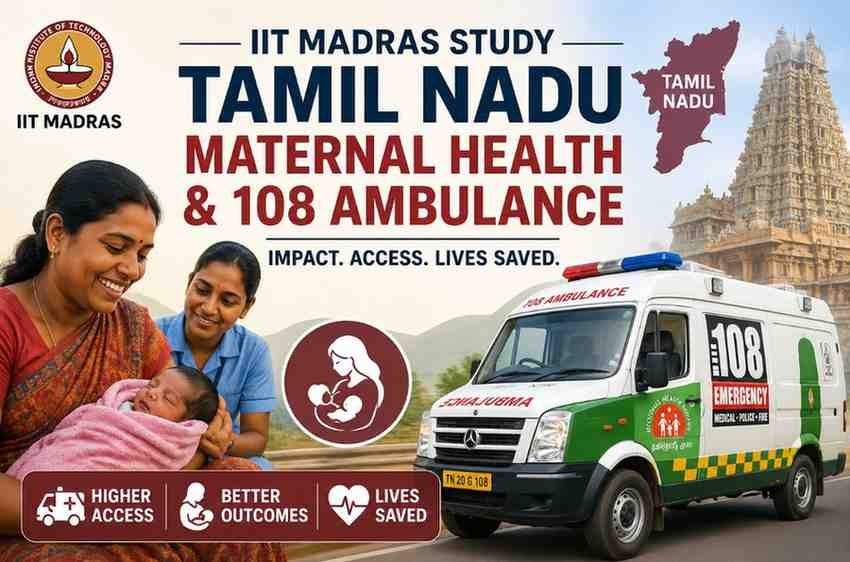
A landmark eight year study from IIT Madras reveals that sustained public investment in emergency medical services not only reversed pandemic-era maternal health setbacks in Tamil Nadu but pushed outcomes well beyond pre pandemic levels offering a replicable blueprint for India and the developing world.
During the devastating second wave of COVID-19, Tamil Nadu’s maternal Healthcare system appeared to be in freefall. Pregnant women could not reach hospitals. Home deliveries surged. And maternal mortality spiked by a staggering 98.5 per cent compared to pre pandemic levels. For a state long regarded as one of India’s public health leaders, it was a sobering moment. Yet within three years, those same indicators had not merely recovered they had improved beyond anything the state had previously recorded.
That is the striking finding at the heart of a new study by researchers at the Indian Institute of Technology Madras (IIT-M), published in the peer reviewed journal BMC Pregnancy and Childbirth in May 2026. Led by Prof. P. Kandaswamy, a retired IPS officer and Professor of Practice in the Departments of Management Studies and Data Science and AI at IIT-M, along with co author Ashwin Prakash of Moody’s Analytics, the Research offers one of the most comprehensive analyses of emergency maternal healthcare resilience ever conducted in India and perhaps anywhere in the developing world.
The Study: Scale, Scope and What Makes It Significant
At the core of this research is a dataset that few studies can match. The team analysed eight years of real world ambulance registry data from January 2017 to December 2024 drawn from Tamil Nadu’s 108 emergency response system, the state’s centralised ambulance and emergency dispatch network. The data covered 42 districts and a population of over 84 million people, making it one of the largest real world analyses of maternal healthcare and emergency response systems ever undertaken in India.
Most previous studies of this kind were limited to individual hospitals, single districts, or short time windows. This study tracked eight distinct pandemic phases between 2020 and 2022, and then followed outcomes through the recovery period of 2023 and 2024 what the researchers call the “resilient phase.” The breadth and duration of that lens is what makes the findings credible, replicable, and deeply instructive.
The metrics examined were both operational and clinical: call volume for pregnancy-related emergencies, ambulance response times, patient transfer times, hospital handoff times, travel distances and on the health outcomes side, maternal and neonatal mortality, home delivery rates, institutional childbirth rates, caesarean section deliveries, miscarriage rates, and complicated vaginal births.
What COVID-19 Did to Maternal Healthcare in Tamil Nadu
To understand why the post-pandemic recovery is so significant, it is necessary to understand how severe the disruption was at its worst. The pandemic did not merely slow Tamil Nadu’s maternal healthcare system it temporarily broke parts of it.
During the second wave in particular, the state’s hospitals were overwhelmed with COVID 19 patients, ambulances were repurposed, healthcare workers were redeployed, and the fear of infection kept many pregnant women away from institutional care. Home deliveries, a key indicator of healthcare access failure, surged sharply. Miscarriage rates climbed. And maternal mortality the most consequential indicator of all rose by nearly 100 per cent compared to pre-pandemic baselines.
“During the pandemic, particularly in Wave 2, Tamil Nadu witnessed severe disruptions in maternal healthcare access. Pregnant women faced challenges in reaching hospitals, home deliveries surged, and maternal mortality rose sharply by 98.5 per cent compared to pre pandemic levels. Against this backdrop, the research sought to understand whether these disruptions had long term adverse effects or if the system recovered. The findings present a strong and encouraging counter narrative.”
Prof. P. Kandaswamy, IIT Madras
That counter-narrative, as it turns out, is not just encouraging it is exceptional.
The Numbers That Tell the Real Story
By the resilient recovery phase of 2023–2024, Tamil Nadu’s maternal and newborn health indicators had not just returned to pre-pandemic baselines. They had surpassed them in several cases by substantial margins.
| Health Indicator | Change in Resilient Phase (vs. Pre Pandemic Baseline) |
|---|---|
| Maternal Mortality Rate | Declined 19% to 37 deaths per 100,000 live births |
| Home Deliveries | Reduced by over 36% |
| Miscarriage Rate | Dropped by 28% |
| Complicated Vaginal Births | Declined by over 19% |
| Neonatal Mortality | Reduced by 17% |
| Infant Mortality | Reduced by 19% |
| Tamil Nadu MMR vs. National Average | 37 vs. 97 deaths per 100,000 live births |
The maternal mortality rate figure deserves special attention. At 37 deaths per 100,000 live births, Tamil Nadu is now performing at a level that is far below India’s national average of 97 and approaching benchmarks associated with middle-income countries with significantly more resources. For context, the global Sustainable Development Goal target for maternal mortality is 70 deaths per 100,000 live births by 2030. Tamil Nadu has already comfortably achieved it.
The reduction in home deliveries by more than a third is equally consequential. Home deliveries in a resource-limited setting are one of the strongest predictors of maternal and neonatal complications. A 36 per cent drop means tens of thousands more births each year are now taking place in institutions equipped to handle obstetric emergencies.
The 108 Ambulance System: The Engine Behind the Recovery
The centrepiece of this success story is Tamil Nadu’s 108 emergency response system the state’s centralised ambulance network that functions as the operational backbone of emergency maternal care. Understanding how this system works, and how it was strengthened, is essential to understanding why the numbers moved the way they did.
The 108 system operates on a tiered referral model. Pregnant women are screened during the antenatal period, risk stratified, and pre designated to appropriate delivery facilities normal cases to Primary Health Centres, high risk or complicated cases to Comprehensive Emergency Obstetric and Neonatal Care (CEmONC) facilities at Medical College Hospitals. When unanticipated complications arise during or before delivery, the 108 network dispatches ambulances and manages inter-facility transfers across this hierarchy.
What the IIT M study found is that this system despite being under severe strain during the pandemic did not collapse. And in the recovery period, it was actively upgraded. Ambulance fleets were expanded. Healthcare manpower was increased. Referral protocols were strengthened. The result was that even as pregnancy related emergency call volumes rose sharply during the pandemic, key operational metrics response time, patient transfer time, and hospital handoff time improved significantly after the first wave and remained efficient through 2023–2024.
This is a critical finding that standard outcome data alone would not reveal. The system got busier and faster at the same time a combination that typically does not happen without deliberate, sustained investment.
Why This Recovery Did Not Happen by Accident
The IIT-M researchers are explicit on this point: Tamil Nadu’s post-pandemic maternal health gains were not the natural consequence of the pandemic ending. They were the result of conscious, sustained government investment in three specific areas during and after the crisis.
Expansion of the Ambulance Fleet
Recognising that vehicle availability was a critical bottleneck particularly in rural and semi-urban districts where distances to hospitals are greatest Tamil Nadu expanded its 108 ambulance fleet during the pandemic period. More ambulances meant reduced response times and the ability to handle higher call volumes without degrading service quality. The study’s data confirms this: response metrics improved even as the number of calls increased.
Healthcare Workforce Expansion
Paramedics, nurses, obstetric specialists, and support staff were added to the system at multiple levels of the care hierarchy. This mattered not just for capacity but for quality a wellnstaffed Primary Health Centre that can handle a normal delivery reduces the burden on district hospitals, which in turn can better serve high risk cases that genuinely need their resources.
Targeted Maternal Health Schemes
Tamil Nadu’s National Health Mission programmes particularly those focused on free institutional deliveries, antenatal monitoring, and transport support for pregnant women were maintained and in some cases expanded during the pandemic, rather than being de prioritised in favour of COVID-19 response. This is a governance decision that many states and countries did not make, and the outcomes data reflects that difference clearly.
A Counter Narrative to the Global Story
The global picture of maternal healthcare during COVID-19 is overwhelmingly grim. Across the world, research documented surges in maternal deaths, spikes in home deliveries, and dramatic reductions in institutional care access as health systems pivoted to pandemic response. The disruption was worst in low and middle income countries, where healthcare systems had the least surplus capacity to absorb a shock of that scale.
Tamil Nadu stands as a direct and documented exception to that pattern. The state experienced the same disruptions the same surge in emergency calls, the same spike in home deliveries, the same sharp rise in maternal mortality during the second wave. What it did differently was refuse to let those disruptions become permanent.
The study’s authors note that this makes Tamil Nadu’s experience not just a local success story, but a global proof of concept: that strategic public investment in emergency medical services, referral systems, and maternal health programmes can reverse pandemic damage and produce outcomes better than the pre-crisis baseline even in a densely populated, resource constrained environment.
What Other Indian States Can Learn: The Blueprint Hiding in Plain Sight
India’s national maternal mortality rate of 97 deaths per 100,000 live births is not a single number it is an average of enormous variation. States like Uttar Pradesh, Madhya Pradesh, and Assam continue to struggle with maternal mortality rates several times higher than Tamil Nadu’s. The gap is not explained by population size or income alone. It is explained, in large part, by the quality and accessibility of emergency obstetric care infrastructure.
The Tamil Nadu model is not exotic or prohibitively expensive. It rests on three pillars that any Indian state government can adopt in principle: a well maintained centralised ambulance network with genuine geographic coverage, a functioning tiered referral system that links primary facilities to specialist centres, and sustained investment in maternal health programmes that do not get abandoned when competing priorities arise.
The IIT-M study makes this policy implication explicit. The findings, the researchers note, extend far beyond Tamil Nadu, reinforcing that strategic public investment in ambulance fleets, referral systems, and targeted maternal health schemes can significantly improve outcomes even during large-scale crises. That is not a speculative conclusion. It is an evidence-based one, grounded in eight years of real world data from 42 districts.
The Research Itself: Why It Carries Weight
It is worth pausing on the quality of the evidence underpinning these findings. The study was published in BMC Pregnancy and Childbirth, a peer reviewed, open access international journal with a strong reputation in maternal and neonatal health research. The data came directly from the Tamil Nadu 108 Ambulance Control Room and was supported by the Emergency Medical Services and National Health Mission under the Tamil Nadu Department of Health and Family Welfare giving it both operational authenticity and institutional credibility.
The research team itself brings an unusual combination of expertise. Prof. P. Kandaswamy’s background as a retired IPS officer with public systems management experience, combined with Ashwin Prakash’s analytical training at Moody’s Analytics, produced a study that is as attentive to systemic governance factors as it is to statistical outcomes. That interdisciplinary lens is precisely what allows the study to explain why outcomes improved, not merely that they did.
The Outlook: What Comes Next for Tamil Nadu and for India
Tamil Nadu is not resting on this data. The challenge now is sustaining these gains as the state’s population ages, as urban migration continues to reshape district level healthcare demand, and as new health emergencies whether pandemic, climate, or otherwise inevitably place fresh stress on the system. The study’s data through 2024 is encouraging, but institutional healthcare quality is not a destination. It is an ongoing investment.
For the rest of India, the more urgent question is replication. With India’s SDG commitments on maternal mortality requiring national level progress, the Tamil Nadu model offers a route that is evidence backed, operationally feasible, and critically already working at scale. The 108 system is not an experiment. It is a mature, tested infrastructure that delivered measurable results across 84 million people over eight years, including through one of the worst public health crises in living memory.
The lesson from Chennai to Lucknow, from Bhopal to Guwahati, is straightforward: the difference between a maternal health system that collapses under pressure and one that emerges stronger is not luck. It is investment, maintained consistently, across the right infrastructure, at the right scale. Tamil Nadu did that. The numbers prove it. And now, so does the peer reviewed literature.
Conclusion: A Public Health Success Story Worth Studying Worldwide
The IIT Madras study on Tamil Nadu’s post COVID maternal health recovery is more than an academic paper. It is a documented rebuttal of the assumption that pandemic damage to healthcare systems is inevitable and lasting. It is a validation of public investment in emergency medical infrastructure as a genuine lifesaver measured not in policy intentions but in the number of mothers and newborns who are alive today because an ambulance arrived on time and a hospital bed was ready.
Tamil Nadu’s maternal mortality rate of 37 deaths per 100,000 live births against a national average of 97 and a global SDG target of 70 is not a statistic. It is a statement about what Indian public healthcare can achieve when it prioritises the right systems, sustains investment through disruption, and measures its own performance with the rigor that this study exemplifies.
Other states would do well to read it carefully.
For breaking news and live news updates, like us on Facebook or follow us on Twitter and Instagram. Read more on Latest Health on thefoxdaily.com.






COMMENTS 0