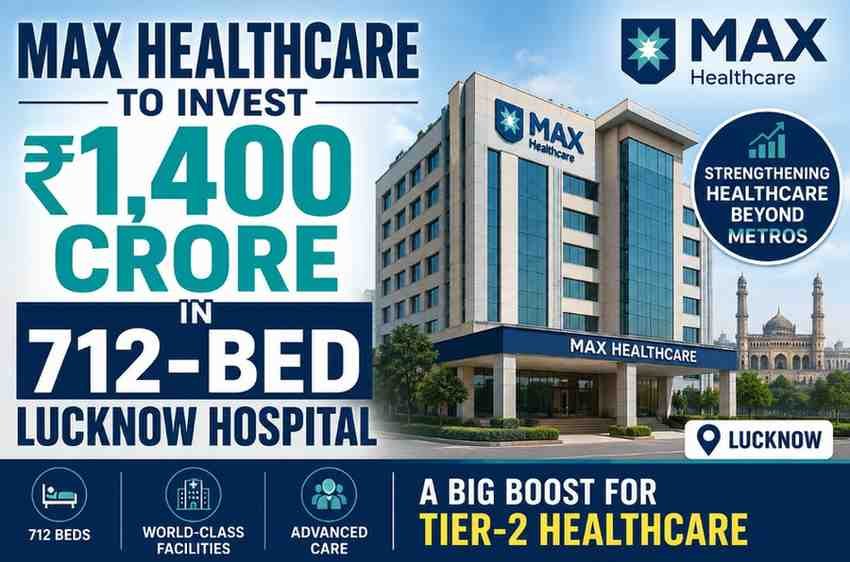
Who is involved? Max Healthcare, one of India’s leading private hospital networks. What is happening? A ₹1,400 crore investment to build a 712 bed multi specialty hospital. When will it happen? Development is planned over the coming years as part of long term expansion. Where? Lucknow, a rapidly growing healthcare hub in North India. Why does it matter? Because access to advanced medical care in tier 2 cities remains uneven. How will it help? By bringing high-end infrastructure, specialists, and technology closer to millions of patients.
Why Max Healthcare Is Betting Big on Lucknow
Lucknow is no longer just an administrative capital it’s quickly becoming a healthcare destination for Uttar Pradesh and neighboring states. With rising incomes, increasing awareness, and a growing burden of chronic diseases, the demand for quality healthcare is expanding faster than infrastructure can keep up.
This is where Max Healthcare’s new 712-bed facility comes in. The scale of investment ₹1,400 crore is not just about building another hospital. It reflects a broader shift in how private healthcare providers view tier 2 cities: not as secondary markets, but as high-growth opportunities.
For patients, this could mean fewer long-distance trips to metros like Delhi for advanced treatments. For the healthcare ecosystem, it signals confidence in Lucknow’s ability to support large scale, high quality medical services.
Understanding the Scale: What a 712-Bed Hospital Really Means
To put things in perspective, a 712-bed hospital is not just large it’s a comprehensive healthcare ecosystem. These facilities typically include multiple specialties, critical care units, advanced diagnostics, and surgical capabilities under one roof.
| Feature | Impact on Patients |
|---|---|
| High Bed Capacity | Reduced waiting times and improved access |
| Multi-specialty Departments | Comprehensive treatment in one location |
| Advanced ICUs | Better critical care outcomes |
| Modern Diagnostics | Faster and more accurate diagnosis |
| Specialist Availability | Access to experienced doctors locally |
In simple terms, this isn’t just about size it’s about capability. Hospitals of this scale can handle everything from routine care to highly complex procedures.
The Bigger Picture: India’s Healthcare Infrastructure Gap
India’s healthcare system faces a well known challenge: demand is rising faster than supply. While metro cities have seen rapid hospital growth, tier 2 and tier 3 cities still struggle with limited access to advanced care.
This imbalance creates a ripple effect. Patients often travel long distances, delaying treatment and increasing costs. Families face emotional and financial strain. And metro hospitals become overcrowded.
Projects like Max Healthcare’s Lucknow facility aim to address this gap by decentralizing quality care. Instead of patients going to healthcare, healthcare comes to them.
Key Drivers Behind This Expansion
1. Rising Lifestyle Diseases
Conditions like diabetes, heart disease, and cancer are increasing rapidly in India. These require long term, specialized care something smaller hospitals often cannot provide.
2. Growing Middle Class
As incomes rise, more people are willing to pay for better healthcare. Expectations are shifting from basic treatment to quality, comfort, and outcomes.
3. Insurance Penetration
With more people covered under health insurance, affordability barriers are gradually reducing, making private healthcare more accessible.
4. Medical Tourism Potential
Cities like Lucknow have the potential to attract patients from nearby regions and even neighboring countries, especially if infrastructure improves.
What This Means for Patients
For the average patient, the impact of this development could be significant and very real.
- Shorter Travel Time: Advanced care closer to home
- Faster Diagnosis: Access to modern diagnostic tools
- Better Outcomes: Early intervention and specialized treatment
- Reduced Costs: Less spending on travel and accommodation
In many ways, access is the first step toward better health outcomes. And that’s exactly what this project aims to improve.
Economic and Employment Impact
Large hospital projects don’t just impact healthcare they influence the local economy as well.
A 712 bed facility typically creates thousands of direct and indirect jobs, including doctors, nurses, technicians, administrative staff, and support services. It also boosts surrounding businesses, from pharmacies to housing and transportation.
Over time, such projects can turn cities into healthcare hubs, attracting talent and investment.
Comparison: Tier 1 vs Tier 2 Healthcare Expansion
| Factor | Tier 1 Cities | Tier 2 Cities (Like Lucknow) |
|---|---|---|
| Infrastructure | Well developed | Rapidly improving |
| Patient Load | Overcrowded | Growing demand |
| Cost of Care | Higher | Relatively lower |
| Growth Potential | Moderate | High |
This comparison highlights why healthcare companies are increasingly focusing on cities like Lucknow they offer both demand and room for expansion.
The Strategic Angle: Why This Move Matters for Max Healthcare
This isn’t just a hospital it’s a strategic investment. Expanding into tier-2 cities allows Max Healthcare to diversify its footprint and tap into underserved markets.
It also positions the company for long term growth as India’s healthcare demand continues to rise. In a competitive industry, early movers in emerging markets often gain a strong advantage.
Challenges to Watch
While the opportunity is huge, execution will be key. Large-scale healthcare projects come with challenges:
- Talent Acquisition: Attracting skilled doctors and staff
- Affordability Balance: Maintaining quality while keeping costs accessible
- Operational Efficiency: Managing a large facility effectively
- Regulatory Approvals: Navigating complex healthcare regulations
How these challenges are handled will determine the project’s long term success.
Unique Insight: The Shift Toward “Healthcare Closer to Home”
One of the most important trends this project highlights is the shift toward decentralized healthcare. Instead of building more hospitals in already crowded metros, companies are moving closer to where patients actually live.
This approach not only improves access but also creates a more balanced healthcare ecosystem across the country.
Think of it as the “last-mile delivery” model but for healthcare.
What the Future Could Look Like
If this project succeeds, it could set a blueprint for similar developments across India. More private players may follow, leading to:
- Better healthcare access in smaller cities
- Reduced pressure on metro hospitals
- Improved health outcomes nationwide
In the long run, this could fundamentally reshape how healthcare is delivered in India.
Conclusion: A Defining Moment for Healthcare in Lucknow
Max Healthcare’s ₹1,400 crore, 712-bed hospital project is more than just an expansion it’s a signal of where India’s healthcare future is headed.
By investing in Lucknow, the company is not only addressing a critical infrastructure gap but also aligning with a broader shift toward accessible, high quality care beyond metro cities.
The real impact, however, will be measured not in bed count or investment size but in how many lives are improved, how many journeys are shortened, and how many treatments happen on time.
And if executed well, this project could become a turning point not just for Lucknow, but for healthcare delivery across India.
For breaking news and live news updates, like us on Facebook or follow us on Twitter and Instagram. Read more on Latest Health on thefoxdaily.com.






COMMENTS 0