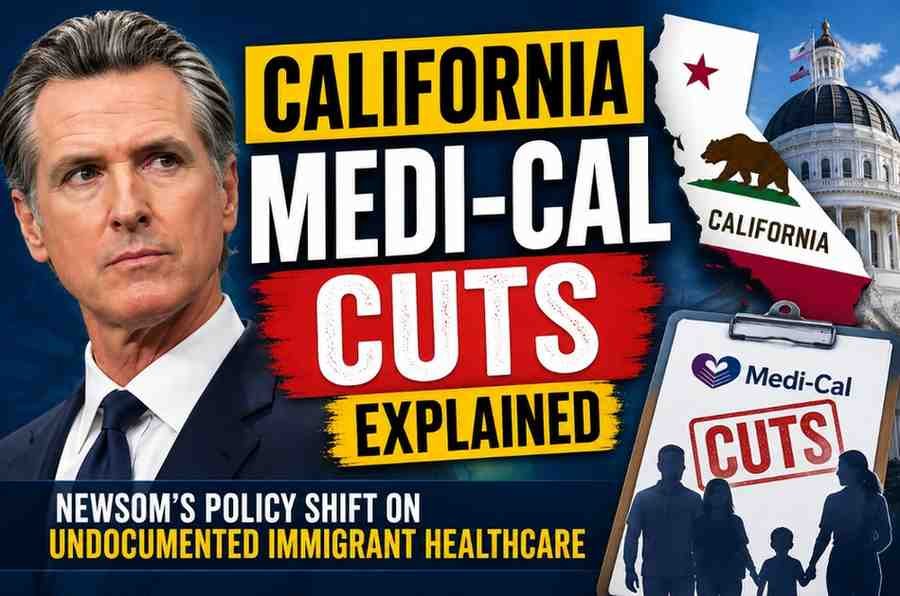
For years, California wore its immigrant-inclusive Healthcare policy as a badge of honor. Governor Gavin Newsom championed it. Advocates celebrated it. And 1.6 million undocumented adults enrolled in it. Now, facing a fiscal crisis of his own making compounded by federal pressure and a stubbornly swelling Medi-Cal budget Newsom has done something few expected: he has turned the financial heat onto the very population he promised to protect.
The policy shift is significant, layered, and still evolving. What began as a May 2025 proposal to freeze new Medi-Cal enrollments for undocumented adults has since hardened into enacted law complete with a monthly premium requirement, benefit reductions, and now, in the 2026-27 budget cycle, a further increase in those premiums. Understanding the full scope of these changes requires more than reading a headline. It requires following the money, the politics, and the human cost behind them.
The Promise That Built the Program and the Bill That Broke It
California’s Medi-Cal expansion for undocumented immigrants did not happen overnight. Newsom grew the program incrementally by age category, starting in 2020 with children, then expanding upward until 2024, when all income-eligible immigrants regardless of legal status became eligible for full-scope coverage. It was a groundbreaking achievement. California became only the second state in the country, after Oregon, to offer comprehensive government-funded health insurance to all low-income immigrants without legal status.
The program was genuinely transformative for millions of people who previously had no access to preventive care, prescription drugs, or routine doctor visits. It reduced emergency room overcrowding at least in theory. And it aligned with California’s stated values as a sanctuary state.
But the costs exceeded every projection. The state took out a $3.4 billion loan and approved an additional $2.8 billion appropriation just to cover the current fiscal year’s Medi-Cal shortfall. Without intervention, Newsom warned, program costs could balloon by another $10 billion through mid-2026 alone. The program had become a fiscal emergency dressed in progressive clothing.
What the Enacted Budget Actually Does: A Clear Breakdown
The Budget Act of 2025, signed into law in late June 2025, formalized several sweeping changes. Then, in the 2026-27 May Revision, Newsom went further. Here is the full picture of what is changing, and when:
| Policy Change | Effective Date | Who Is Affected |
|---|---|---|
| Freeze on new full-scope Medi-Cal enrollment for undocumented adults 19+ | January 1, 2026 | New undocumented adult applicants |
| Monthly premium of $30 for adults with “unsatisfactory immigration status” | July 1, 2027 | Currently enrolled UIS adults ages 19–59 |
| Premium increase proposed from $30 to $50 per month | July 2027 (proposed) | UIS adults ages 19–59 |
| Elimination of long-term care and full dental for undocumented adults | 2026 (phased) | Enrolled undocumented adults 19+ |
| Federal work requirements applied to state-funded Medi-Cal immigrants | July 2027 (proposed) | State-only Medi-Cal immigrant enrollees |
| Children under 18 remain fully eligible for Medi-Cal enrollment | Ongoing | All undocumented children |
| Emergency and pregnancy services remain available to all | Ongoing | All undocumented Californians |
At its core, the package does three things: it stops the program from growing, it makes existing enrollees pay to stay in, and it strips out some of the more expensive benefit categories. The projected savings are enormous the California Legislative Analyst’s Office estimates the eligibility policy changes related to adults with “unsatisfactory immigration status” will deliver $10.6 billion in ongoing savings as the state’s largest single budget solution.
The Premium Debate: $100 Became $30, and Now May Become $50
The premium story is a case study in California legislative negotiation. Newsom originally proposed $100 per month aligned, his office said, with average premiums on Covered California’s subsidized marketplace plans. The idea was that enrollees should have “skin in the game.” Critics immediately pushed back, arguing that most undocumented Medi-Cal enrollees are working poor individuals for whom $100 a month is not a minor inconvenience but a genuine financial barrier to care.
Democratic lawmakers, led by Senate Budget Committee Chair Scott Wiener and Senator María Elena Durazo, resisted hard. The legislature’s counter-proposal reduced the premium to $30 per month and delayed the enrollment freeze until summer 2027. The enacted budget split the difference on timing but settled on $30 as the premium floor for now.
But the 2026-27 May Revision has already proposed raising that floor to $50. Senator Durazo, who championed the original Medi-Cal expansion, has publicly called for the reversal of these increases, warning that even a $50 monthly premium could push tens of thousands of low-income enrollees to drop coverage entirely not because they no longer need care, but because they cannot afford to pay for it.
The irony is sharp: a premium designed to generate savings could, if it triggers mass disenrollment, shift costs back onto emergency rooms the most expensive form of care while leaving the state with worse health outcomes and higher long-term costs. It is a trade-off Newsom’s critics say he has not fully accounted for.
Who Bears the Burden? The Human Geography of These Cuts
The 1.6 million undocumented adults currently enrolled in Medi-Cal are not a monolithic group. They are farmworkers in the Central Valley, domestic workers in Los Angeles, restaurant kitchen staff in San Francisco, and construction workers across the Inland Empire. Most work jobs that do not offer employer-sponsored insurance. Many pay payroll taxes, sales taxes, and property taxes through their rent contributing to the very public revenue streams that fund Medi-Cal.
The enrollment freeze means that any undocumented adult who did not sign up for full-scope Medi-Cal before January 1, 2026, is now locked out of comprehensive coverage. They can still receive emergency care and pregnancy services through the limited-scope plan funded federally but prescription drugs, preventive screenings, mental health services, and specialist visits are no longer accessible to new applicants.
For refugees, asylees, humanitarian parolees, and survivors of domestic violence or trafficking, the picture is even more complicated. Changes to how the federal government classifies immigration statuses, effective October 2026, could reclassify some of these populations in ways that further reduce their Medi-Cal eligibility a compounding effect that advocates say California has not adequately addressed in its budget planning.
The Federal Dimension: Trump, DOGE, and the Medicaid Squeeze
Newsom has been careful to assign partial blame for these cuts to Washington. His office has pointed to federal uncertainty including potential changes under H.R. 1, the Republican budget bill as a driver of fiscal conservatism at the state level. H.R. 1’s proposed reductions in federal matching funds for emergency Medi-Cal services for undocumented individuals are projected to cost California an additional $658 million in General Fund costs in 2026-27 alone, rising to $872 million annually by 2029-30.
The Department of Homeland Security has also waded in, criticizing California’s Medicaid spending on undocumented individuals and citing a dramatic rise in taxpayer-funded ambulance costs from $339 per transport in 2022 to over $1,168 in 2024, with state requests pending to raise rates further. DHS has framed this as evidence of unsustainable spending, though the state’s own health department has not directly tied the ambulance cost increases solely to undocumented immigrant care.
The federal-state tension adds a layer of political complexity that makes Newsom’s position particularly uncomfortable. He wants to be seen as protecting immigrants from a hostile federal administration while simultaneously cutting their benefits to balance a state budget. That contradiction has not been lost on immigrant advocates or on Newsom’s own party.
The Political Fallout: A Governor Caught Between Two Legacies
For Newsom, these cuts carry a specific kind of political cost. He has long positioned himself as a presidential-tier progressive a leader who expanded healthcare where Washington would not. The Medi-Cal expansion for undocumented immigrants was among his most cited achievements. Rolling it back, even partially, undercuts the narrative he has spent years building.
Health Access California’s Amanda McAllister-Wallner called the changes “reckless and unconscionable” and described them as “a betrayal of the governor’s commitment to California immigrants.” Senator Durazo, a Democrat and longtime ally, was equally blunt, arguing that California should not single out immigrants to solve its budget deficit especially when their healthcare costs are partly driven by factors entirely outside their control, including federal payment structures that limit cost-sharing for their care.
Republicans, for their part, have called the spending unsustainable from the beginning. Senator Kelly Seyarto put the total cost of undocumented immigrant healthcare at $10 to $12 billion, a figure that, in the context of a $12 billion state deficit, is politically damaging regardless of its full context.
The political reality is that Newsom has satisfied almost no one. Progressives see betrayal. Fiscal conservatives see insufficient action. And the 1.6 million enrollees caught in the middle see uncertainty.
What Happens Next: The Road to 2027 and Beyond
The immediate landscape is somewhat settled: the enrollment freeze is in effect. The $30 monthly premium begins in July 2027. Dental and long-term care reductions are being phased in. But the proposed increase from $30 to $50 in the 2026-27 May Revision is still subject to legislative negotiation and California’s Democrats have already shown a willingness to push back.
The larger question is whether these changes mark the beginning of a longer retreat from California’s immigrant health coverage commitments, or a one-time correction forced by unusual fiscal pressures. Healthcare advocates argue that once premiums and coverage barriers are introduced into a program, they tend to expand rather than contract. History in other states supports that concern.
Work requirements, now proposed for state-funded Medi-Cal immigrants starting in July 2027, are particularly contentious. Analysts consistently find that work requirements do not increase employment they primarily increase administrative burden and cause eligible people to lose coverage due to paperwork failures. Applying them to immigrants who may lack work authorization adds another layer of complexity that could result in significant unintended disenrollments.
The Bigger Picture: California as a Healthcare Policy Bellwether
California’s experiment with universal immigrant health coverage was always going to be tested eventually. The state expanded access faster than its fiscal infrastructure could reliably sustain it particularly given that the federal government does not share in the cost of comprehensive coverage for undocumented immigrants, only for their emergency care. That structural funding gap has been visible for years; it simply became impossible to ignore during a budget crisis.
Other states watching California’s retreat will draw lessons not all of them the right ones. The lesson should not be that covering immigrants is inherently unaffordable. It is that coverage expansions need to be paced against sustainable federal matching structures, and that states cannot absorb open-ended enrollment without cost-sharing mechanisms built in from the start.
The lesson California’s rollback may unfortunately teach is simpler and crueler: that immigrant health coverage is the first thing cut when budgets get tight. That lesson, if it spreads, will have consequences far beyond Sacramento.
Conclusion: A Policy in Transition, and the Stakes Are High
Governor Newsom’s decision to freeze Medi-Cal enrollment for undocumented adults, impose monthly premiums, and reduce benefits reflects a genuine fiscal crisis not simply a political pivot. California borrowed billions to sustain a program that cost far more than projected, in a federal environment increasingly hostile to state-funded immigrant coverage.
But the human cost of these decisions is real and measurable. Hundreds of thousands of working Californians who did not enroll before January 2026 are now locked out of preventive care. Those who remain enrolled face a monthly premium that will rise, not fall, in coming budget cycles. And the broader architecture of immigrant health access in the state’s most expensive population centers is being quietly dismantled, piece by piece, through budget trailer bills that attract far less attention than they deserve.
The immediate future will be shaped by the 2026-27 budget negotiations still underway in Sacramento. Whether lawmakers hold the line at $30 premiums or allow the increase to $50 and whether work requirements survive legislative scrutiny will determine how many of those 1.6 million enrollees remain covered by the time the next election cycle arrives. For Newsom, the political math is uncomfortable. For the people losing coverage, it is simply their health on the line.
For breaking news and live news updates, like us on Facebook or follow us on Twitter and Instagram. Read more on Latest Health on thefoxdaily.com.





COMMENTS 0